
IIT's CroSTAta Teaches Robot Arms to Learn From Their Own Failures
CroSTAta teaches robot policies to learn from their own failures by rewiring how attention flows through execution history
 Pro
Takeaways
- CroSTAta introduces State Transition Attention (STA), a new attention mechanism that explicitly models failure-and-recovery patterns in a robot's execution history.
- STA achieves 2x improvement over standard cross-attention on precision tasks like peg insertion (18.3% vs 7.7% success rate).
- A temporal masking training strategy randomly removes visual frames, forcing the model to reason from historical context rather than current observations.
- Training data uses a DAgger-like pipeline with artificially induced failures followed by natural recovery, labeled to train only on clean actions.
- Gains are architecture-specific: the same temporal masking hurts standard transformers by ~3-4%, confirming STA is necessary for the benefit.
- Code and datasets are open-sourced; the model is simulation-only with no real-world deployment demonstrated yet.
Teaching a robot arm to insert a peg into a hole sounds simple. But when the arm misses, standard imitation-learning policies have no real mechanism to recognize what just went wrong and adapt. They treat every past observation the same way, with no special awareness that a failed grasp a few steps ago should inform the current recovery attempt. A new paper from the Istituto Italiano di Tecnologia introduces CroSTAta, a transformer architecture that explicitly learns to read failure-and-recovery patterns in its own execution history.
The wall every imitation-learner hits
Current policies still suffer from an inability to self-recover from online failures during inference, primarily because they are trained exclusively on successful expert trajectories without accounting for failures caused by model mispredictions and compounding errors. The standard fix is to collect more diverse demonstrations, including failure examples. But simply enriching demonstrations is not a scalable solution -- it would be extremely difficult to collect examples covering every possible failure scenario.
There is also a deeper structural problem. Behavioral Cloning (BC) is well-known to be vulnerable to covariate shift -- the mismatch between the state distributions induced by the learned policy and the expert policy. Once a robot drifts off the training distribution, errors compound. Standard attention mechanisms do not help much here because they process all past states in a sequence without explicitly modeling the temporal structure that demonstrations may include, such as failure and recovery patterns.
What STA actually does differently
The core innovation is the State Transition Attention (STA) mechanism. In a standard cross-attention transformer, the model learns to relate the current action query to all past state keys and values simultaneously. The softmax over the full history has to figure out, on its own, that a failed grasp five steps ago is more relevant than a successful reach three steps ago. STA restructures this computation.
Instead of scoring each past state independently against the current query, STA introduces a separate learned projection S that computes similarity between each historical state and the current state. This produces a set of transition scores -- essentially asking "how similar was the robot's situation back then to right now?" Those scores then modulate the per-timestep action-state alignment scores, so the final attention weights reflect both local action relevance and global trajectory similarity.

Formally, standard cross-attention computes:
Softmax( Q_t @ K_{t-k:t}.T / sqrt(d_K) ) @ V_{t-k:t}While STA computes:
Softmax( diag(Q_{t-k:t} @ K_{t-k:t}.T) * (S_{t-k:t} @ S_t.T) / sqrt(d_K * d_S * k) ) @ V_tThe key difference: the softmax in STA operates only over the current timestep's tokens rather than the full history, which keeps computational cost comparable while giving the model a fundamentally different representational handle on time.
Training the model to lean on its past
Architecture alone is not enough. The team pairs STA with a temporal masking strategy during training. All exteroceptive (visual) information is removed for k consecutive timesteps, where k is randomly sampled from [2, L/2] with L=16 being the total sequence length. This forces the model to reconstruct what it needs from historical context rather than relying on the current camera frame -- a form of self-supervised temporal reasoning.
The training data itself is also specially constructed. Using a DAgger-like pipeline, the team generates demonstrations where a privileged policy (trained with full state access via PPO) is deliberately fed corrupted state information for several steps, causing it to fail, then allowed to recover naturally. Crucially, the failure steps are excluded from the training loss -- only the clean recovery actions are supervised -- but the failure states remain in the input sequence as context.

Four tasks, one clear winner
ManiSkill is a comprehensive benchmark suite designed to evaluate generalizable robotic manipulation skills in simulation, emphasizing real-world task diversity, object variety, and generalization across instances. The paper evaluates on four tasks chosen for their distinct failure modes:
- StackCube -- single-arm grasping and precise placement
- PegInsertionSide -- sub-millimeter alignment of a peg into a slot (the hardest task)
- TwoRobotStackCube -- bimanual coordination where either arm can fail
- UnitreeG1TransportBox -- humanoid torso-and-arm coordination to transport a box
The STA Transformer outperforms all baselines across precision-requiring and coordination-demanding tasks, with particularly notable improvements on PegInsertionSide, reporting more than a 2x improvement over the standard Transformer (18.3% vs 7.7%). LSTM performed especially poorly on precision tasks. Interestingly, both standard Transformer variants acting with full history occasionally underperform the no-history baseline, together suggesting that naive integration of historical information does not always benefit policy performance.

The temporal masking ablation is particularly telling. On StackCube, the STA Transformer trained with masking achieves 71.3% success versus 64.7% without masking -- a gain from training alone, before any inference-time masking. The same masking actually hurts the standard cross-attention transformer by 3%, confirming that the benefit is architecture-specific, not a general regularization trick.
What the attention heads are actually doing
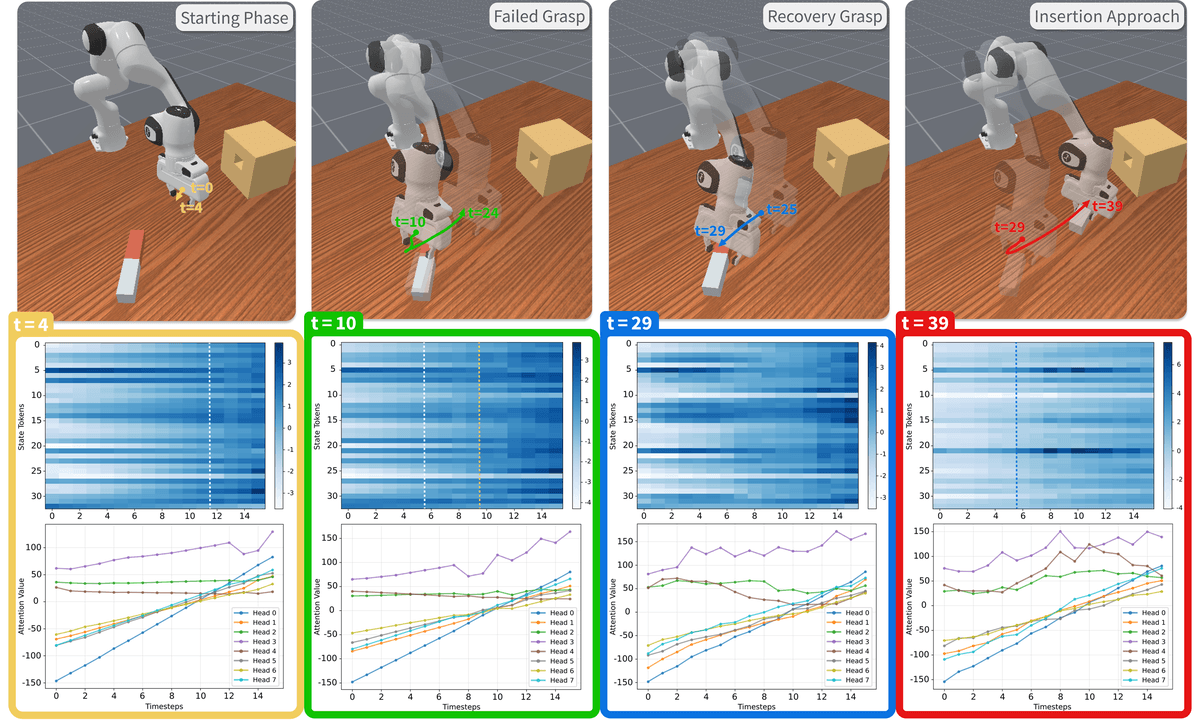
The paper includes an attention pattern analysis on a PegInsertionSide trajectory that is worth studying. During a failed grasp attempt, the model's transition scores stay concentrated on recent timesteps. During the subsequent successful recovery grasp, specific attention heads (heads 2 and 4 in the last transformer layer) activate strongly on states further back in history -- the model is literally looking back at the failure to inform its correction. Once the peg is aligned and insertion begins, attention snaps back to recent timesteps for the fine motor control phase.
Where it falls short
The authors are candid about limitations. The evaluated tasks are short-horizon (under 5 seconds), and on the UnitreeG1TransportBox task, STA offers no advantage over baselines -- the authors attribute this to the privileged policy recovering too cleanly during data collection, leaving little temporal structure for STA to exploit. More complex temporally-extended tasks with stronger partial observability would provide additional validation of historical reasoning capabilities, though extending to such scenarios is primarily limited by hardware requirements for training with extended sequences. The entire evaluation is also simulation-only, and the diversity of failure patterns is bounded by what the privileged PPO policy can generate.
The practical picture
CroSTAta is most useful when you have:
- Precision manipulation tasks where small errors cascade (peg insertion, assembly, surgical robotics)
- Scenarios with camera occlusion during manipulation (the arm blocks the view of what it's grasping)
- Multi-stage tasks where early failures need to inform later recovery
- Training data that includes failure-recovery trajectories, whether from human demos or automated generation
The code and datasets are open-sourced on GitHub. The architecture slots into a standard encoder-decoder transformer, with STA replacing the cross-attention module. The 23.3M parameter STA Transformer is only marginally larger than the 21.2M standard Transformer baseline, and both support KV-cache at inference. The real ask is on the data side: you need recovery-rich demonstrations for STA's temporal reasoning to have something to work with. On tasks where the training data is clean success-only trajectories, the gains will likely be modest.