
IIT's BinWalker Quadruped Picks Up Litter on Terrain Wheels Can't Reach
Italian Institute of Technology researchers built a legged robot that autonomously spots, grabs, and stores plastic bottles on rough terrain, releasing full training code.
 Pro
Takeaways
- BinWalker: an Aliengo quadruped with a Z1 arm and self-emptying bin for outdoor litter collection
- Decoupled architecture: RL locomotion policy plus Mink-based IK manipulation coordinated by a state machine
- Locomotion policy accepts base height and pitch commands, letting the IK reshape the body to extend arm reach
- Vision uses YOLOv8 segmentation plus PCA on the mask to estimate bottle 3D pose and axis
- Field tested at a picnic area with successful grasp, store, and unload cycles under joystick navigation
- Full IsaacLab extension released on GitHub with sim-to-sim and sim-to-real scripts
A team from the Dynamic Legged Systems lab at Istituto Italiano di Tecnologia has put a working prototype of an autonomous litter-picking quadruped through outdoor field tests, and released the full simulation-to-real code stack. The robot, called BinWalker, spots plastic bottles with a camera, grasps them with an arm, drops them into an onboard bin, and can even open its own hatch to unload the collected trash at a drop-off point.
The motivation is mundane but stubborn: litter still gets picked up mostly by hand, which makes large cleanup operations labor-intensive and expensive, and much of the worst pollution accumulates in places wheeled robots cannot easily reach, such as uneven terrain, coastal areas, parks, and roadside vegetation. Legged platforms handle that terrain, but bolting perception and manipulation onto a walking robot is where things usually break down.
Why a walking robot instead of wheels
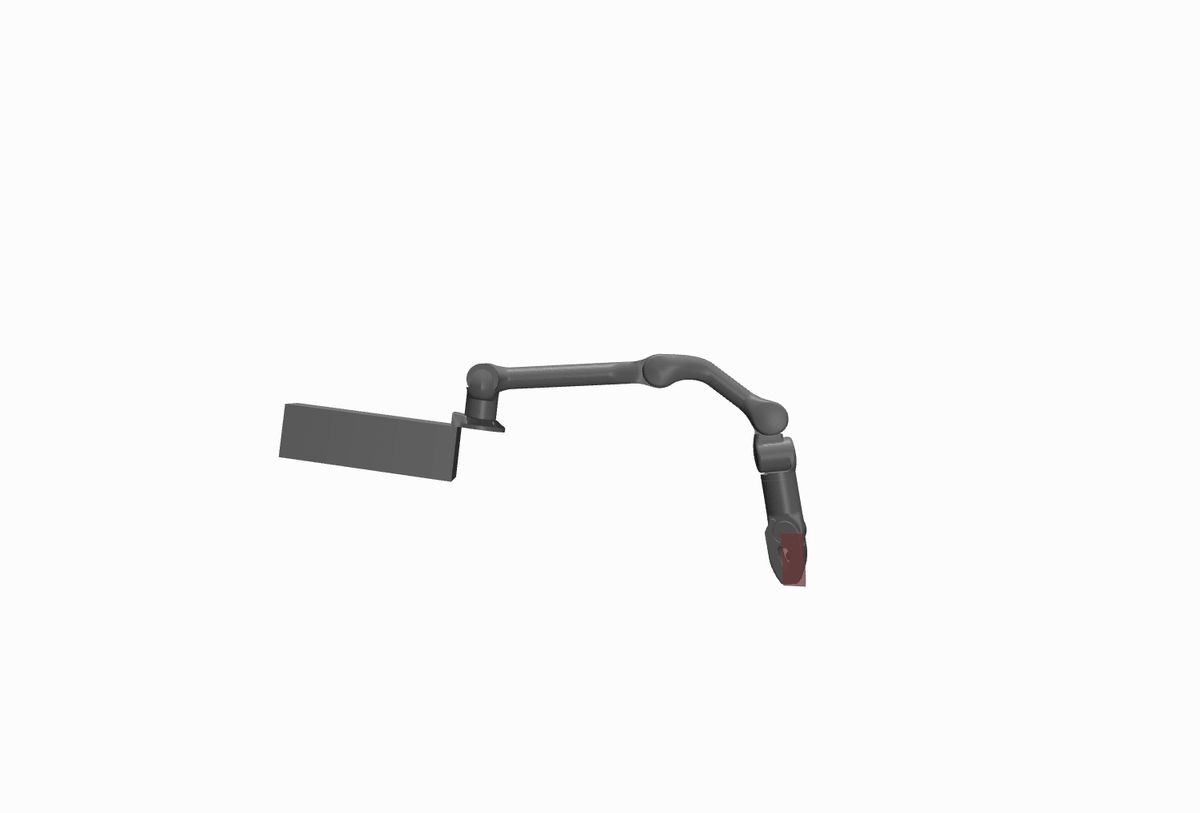
Most existing trash-picking robots are wheeled or tracked and only work on flat surfaces like sidewalks and pavements. BinWalker builds on the Unitree Aliengo quadruped and adds three pieces of hardware:
- A 6-DoF Unitree Z1 arm mounted on the trunk through an aluminum frame
- A RealSense D435 stereo camera positioned under the arm base for a wide frontal workspace
- A custom ABS bin cabinet (roughly 310 x 360 x 445 mm, 2.6 kg) sitting behind the arm
The bin is the clever mechanical detail. A hinged door at the base is mechanically linked to an internal rotating basket via two connecting links, so when the robotic arm lifts the detachable handle 114 mm upward, the basket rotates 26 degrees and the door swings open 48 degrees simultaneously to discharge the litter. Gravity then resets the mechanism. That means the robot empties itself using its existing arm, with no extra actuators.

Splitting the brain in two
The interesting software choice is that the authors refused to train one giant end-to-end policy. Full-body loco-manipulation with reinforcement learning is a hot research direction, but the team argues it suffers from precision problems and painful training. Instead they decouple locomotion and manipulation: an RL policy handles leg movements and can follow arbitrary base velocities and base poses, while a separate arm controller does the grasping.

The locomotion policy takes proprioceptive input (base linear and angular velocity, leg joint positions and velocities, and the current arm joint positions) plus reference commands. Two of those references are unusual: a desired base height and a desired base pitch. That is the bridge between the two controllers. When the arm needs to reach further, the manipulation side asks the legs to squat, tilt forward, or raise the body.
During training the arm joints are randomized and held fixed so the walking policy learns to stay stable regardless of arm posture. The policy stacks the last five observations to stay adaptive, and its output is desired leg joint positions tracked by a simple PD controller. Reward terms cover the usual suspects: velocity tracking, orientation, height, torque, joint acceleration, energy, action smoothness, and foot clearance driven by a periodic contact clock at 1.4 Hz with 0.6 duty factor.
The manipulation stack
Grasping is handled by two layers coordinated by a state machine. The first layer is a set of six predefined joint-space primitives: litter-loading, box-reaching, box-opening, rest-pose, open-gripper, and close-gripper. These are the repetitive canned motions.
The second layer is an inverse kinematics solver for reaching the actual bottle. The team uses Mink, an open-source differential IK library built on top of MuJoCo that solves weighted-task quadratic programs. Crucially, the IK variables are not just arm joints. They also include the desired base height and pitch, so the solver can ask the locomotion policy to reshape the body. A larger weight on the base-regularization task keeps the base still until the arm truly cannot reach on its own.
Finding the bottle
Perception uses Ultralytics YOLOv8 for instance segmentation of plastic bottles. The pipeline then:
- Picks the largest connected component of the mask and cleans it with morphological filtering
- Runs Principal Component Analysis on the mask pixels to find the bottle's dominant 2D axis
- Samples depth values along that axis and back-projects two points into 3D using the camera intrinsics
- Uses those two points to estimate the bottle's principal axis and midpoint in the camera frame
- Applies exponential smoothing and a sign-consistency check across frames to reduce jitter
The resulting 3D pose is mapped into the robot base frame and handed to the IK module so the gripper aligns with the bottle's long axis before closing. The authors note this generalizes to other elongated litter like cans, and for lumpier trash a simpler centroid grasp works.
What actually worked, and what did not
Field trials happened in a picnic area with benches and flat ground. The robot was teleoperated with a joystick for navigation while the perception, IK, and grasping ran autonomously. The full loop, approach, grasp, deposit into bin, and later unload at a designated location, ran successfully across multiple trials.
The honest discussion is where the paper gets useful. The team lays out what breaks:
- Smashed bottles confuse the vision system because there is no clean principal axis to grab
- Partially buried items (think a bottle in beach sand) require contact-rich manipulation, which IK cannot reason about
- Objects wedged in tight spots risk arm collisions the current planner does not model
- Gripper slippage during the box-reaching motion can drop the object before it lands in the bin
Their proposed fixes point toward the research frontier: sampling-based contact-rich controllers, grasp-point detection networks trained on deformed objects, and vision-language-action models like Physical Intelligence's pi-zero for compliant interaction. Autonomous navigation was intentionally out of scope.
Grab the code
The full stack lives on GitHub as an IsaacLab v2.3 extension, with rsl-rl v3.3 for training and MuJoCo v3.7 for sim-to-sim. It ships with two policies (locomotion and a work-in-progress manipulation policy), the Mink-based whole-body IK on a reduced model, and sim-to-real deployment scripts for Unitree robots via the lab's ROS2 low-level HAL. The Aliengo and Z1 robot configs are already registered as Gym environments, so anyone with the hardware or a simulator can run the pipeline as a baseline for their own loco-manipulation research.