
IIT's AugMPC Teaches Robots to Walk Without Domain Randomization
A hierarchical controller pairs reinforcement learning with model predictive control to make quadrupeds discover acyclic gaits and transfer to real hardware without domain randomization.
 Pro
Takeaways
- AugMPC couples a high-level RL policy with a low-level MPC that handles full rigid-body dynamics and constraints.
- The method learns acyclic contact schedules through trial and error, with no predefined gaits or demonstrations.
- Validated on quadrupeds from 50 to 120 kg, including the wheeled-legged Centauro humanoid.
- Zero-shot sim-to-real transfer works without any domain randomization on Centauro.
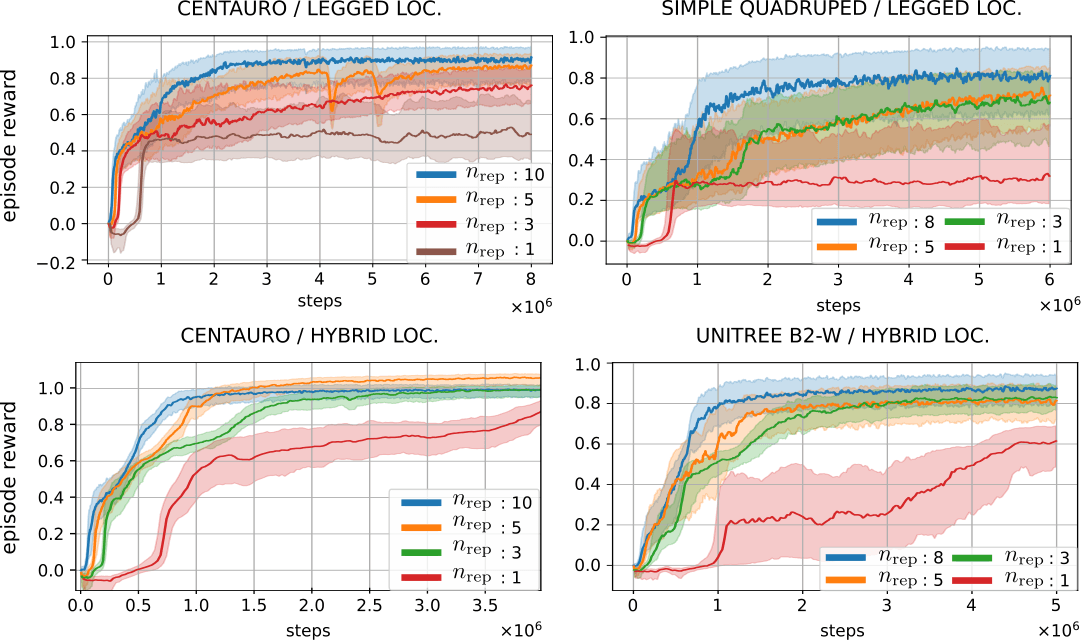
- Training converges in 4 to 10 million steps, roughly 6 hours on a single workstation.
- Framework, code, and pretrained models released on GitHub and Hugging Face.
Making a legged robot walk is hard for two very different reasons. Model predictive control (MPC) is precise but chokes on the combinatorial problem of deciding when each foot should touch the ground. End-to-end reinforcement learning sidesteps that math, but usually needs enormous amounts of simulated data and heavy domain randomization to survive contact with reality. A new architecture called AugMPC tries to get the best of both by letting a small RL policy sit on top of a full-body MPC and simply tell it when to lift a foot.
The paper, from the Humanoids and Human-Centred Mechatronics lab at IIT, shows the approach working on quadrupeds ranging from 50 kg to a 120 kg wheeled-legged humanoid, with zero-shot transfer from simulation to a real robot and no domain randomization at all.
Splitting the job in two
The core idea is a strict hierarchy. A low-level MPC locomotion controller handles motion execution, while a high-level policy is responsible for both contact scheduling and navigation. The RL agent, trained with Soft Actor-Critic, only decides two things at each step: a base twist reference (where to go, how fast) and, per foot, whether to inject a new flight phase into the MPC's optimization horizon.
That second output is the interesting one. A scalar injection action controls whether a new flight phase should be injected, and in practice an injection is triggered when the action goes negative. The MPC keeps assuming a predefined contact schedule over its current horizon, so it can use fast DDP-based solvers, but the policy is free to edit that schedule on the fly. The result is fully acyclic gaits without any clock signal in the observation.

Why the MPC hurts and how RL takes the pain
Classical locomotion MPC formulations either assume a fixed contact sequence, jointly optimize contacts as a mixed-integer program that is often too slow for real time, or use contact-implicit formulations that usually need offline solving and good initial guesses. Pushing contact scheduling out to a learned policy avoids all three traps. Meanwhile the MPC absorbs the ugly parts RL normally struggles with: friction cones, joint limits, unilaterality of contact forces, and full rigid-body dynamics, so the reward function stays trivially short.
The reward has only three components: a tracking term for the commanded twist, a small penalty on action rate of change, and a cost-of-transport term for energy efficiency. No gait prior, no imitation, no reference trajectories.
Training at scale on CPU plus GPU
Running thousands of nonlinear MPCs alongside a GPU simulator is not trivial. The team built a shared-memory framework where each MPC instance runs in its own CPU subprocess and synchronizes with an Isaac Sim or MuJoCo environment on GPU. The system sustains real-time factors of up to 50, even on complex platforms such as Centauro, and 12 simulated days of training correspond to approximately 5.8 hours of wall time on a Threadripper 7970 with an RTX 4090.
Sample efficiency is the payoff. Policies are obtained within 4 to 10 million environment steps, corresponding to about 9 to 29 simulated days, whereas blind end-to-end RL policies typically consume an order of magnitude more samples.
What actually emerges
On flat ground with cyclic waypoint chasing, the Centauro policy discovers behavior that looks a lot like biology. Symmetric trotting appears during steady forward motion, but when the commanded direction changes, single and double flight phases interleave asymmetrically. As the robot nears its target and the commanded velocity drops, contact durations lengthen smoothly, effectively lowering the gait frequency without any explicit frequency control.
Hybrid wheeled-legged mode shows a different behavior: the policy prefers wheels for velocity tracking and only steps when it needs to reorient. On Centauro that translates to a measured cost of transport near 0.12 for hybrid locomotion versus 0.35 for pure legged, a nearly 3x efficiency gap under identical task conditions.
Sim-to-real without the usual tricks
The most eye-catching result is deployment on the real 120 kg Centauro without domain randomization. For the real-world deployment, policies are trained with an MPC running in open-loop mode, and due to the lack of reliable onboard odometry, the robot's position is estimated directly from the MPC state. All inference runs onboard on an Intel Core i7-11800H, with policy evaluation taking 0.334 ms per step.
The architecture also extends beyond flat ground. In a stepped-pyramid experiment, the policy is given raw heightmap data and additional control over flight parameters like foot clearance, landing height difference, and swing duration. It learns to take larger steps during ascent and smaller ones on the flat, ascending both forward and backward.

Where this fits and where it does not
The trade-offs are worth naming clearly:
- Wall-clock training is slower than pure end-to-end RL because the MPC runs on CPU inside the loop.
- Each policy is currently tied to a specific MPC formulation and robot; cross-controller generalization is left for future work.
- Robustness to strong, persistent external disturbances was not systematically tested.
- The MPC still needs a reasonable rigid-body model, so this is not a solution for unknown or highly deformable platforms.
For teams already invested in trajectory optimization pipelines, this is a practical way to add adaptive gait discovery without throwing out the MPC stack. Code, the modular training framework, and pretrained models are released under GPL-2.0, with public demo checkpoints available on Hugging Face and training runs on Weights and Biases. The repo depends on the sibling MPCHive and EigenIPC shared-memory components, which are also open.