
IIT Delhi's ARMADA Teaches Language Models From Frozen Image Generators
Researchers from IIT Delhi show that generative multimodal models can teach text-only LLMs, boosting LLaMA and BERT without retraining the teacher.
 Pro
Takeaways
- ARMADA distills knowledge from frozen multimodal generators (Stable Diffusion, Midjourney, ModelScope, SpeechT5) into text-only LLMs.
- Gains reach 3.4% on GLUE/SuperGLUE and 2.6% on reasoning tasks with LLaMA-7B, using only 0.8M added parameters.
- Method centers on a small TS Aligner that matches teacher and student on a shared manifold with three alignment losses.
- Beats sequence-level distillation from LLaMA-8B on several instruction-tuning tasks despite using sub-2B multimodal teachers.
- Shuffled-input ablations confirm gains come from semantic alignment, not extra capacity or regularization noise. See the paper.
- Code will be released upon acceptance; framework works with black-box teachers, no teacher pretraining required.
A team from IIT Delhi and IIIT Delhi has released ARMADA, a knowledge distillation framework that pulls knowledge out of large multimodal generative models like Stable Diffusion and pushes it into language-only students such as BERT, OPT, DeBERTa, and LLaMA. The surprise is that the teachers never see a labeled text task and their weights are never touched, yet the distilled students still gain up to 3.4% on language understanding and 2.6% on generative reasoning.
The paper argues that generative vision, video, and audio models carry latent linguistic structure that a plain LLM can absorb through the right alignment mechanism. That reframes what a "teacher" can be in distillation: not a bigger version of the same architecture, but any pretrained model whose representations encode something useful about the world.
Why cross-modal distillation is hard
Classical knowledge distillation, going back to Hinton, assumes teacher and student live in the same modality. The authors point out that unlike multimodal pretrained models such as CLIP or Qwen-VL, in cross-modal distillation the trainable model can access only one modality, making knowledge fusion immensely challenging, and ARMADA is the first architecture-agnostic cross-modal knowledge distillation technique from black-box teachers to language-only student models.
Prior attempts at cross-modal transfer, such as Vokenization and VidLanKD, required expensive modality-specific pretraining of the teacher. VidLanKD, for example, pretrained its teacher on 136M video clips before any distillation could happen. That cost has kept the approach out of reach for most teams.
The setup: a frozen teacher, a shallow aligner, a text-only student
ARMADA sits three components side by side:
- A frozen multimodal teacher. For each text input, the researchers pass it through a generative model (Stable Diffusion v1-4, Midjourney, ModelScope text-to-video, or SpeechT5 text-to-audio) and extract latent representations rather than the final image, video, or waveform.
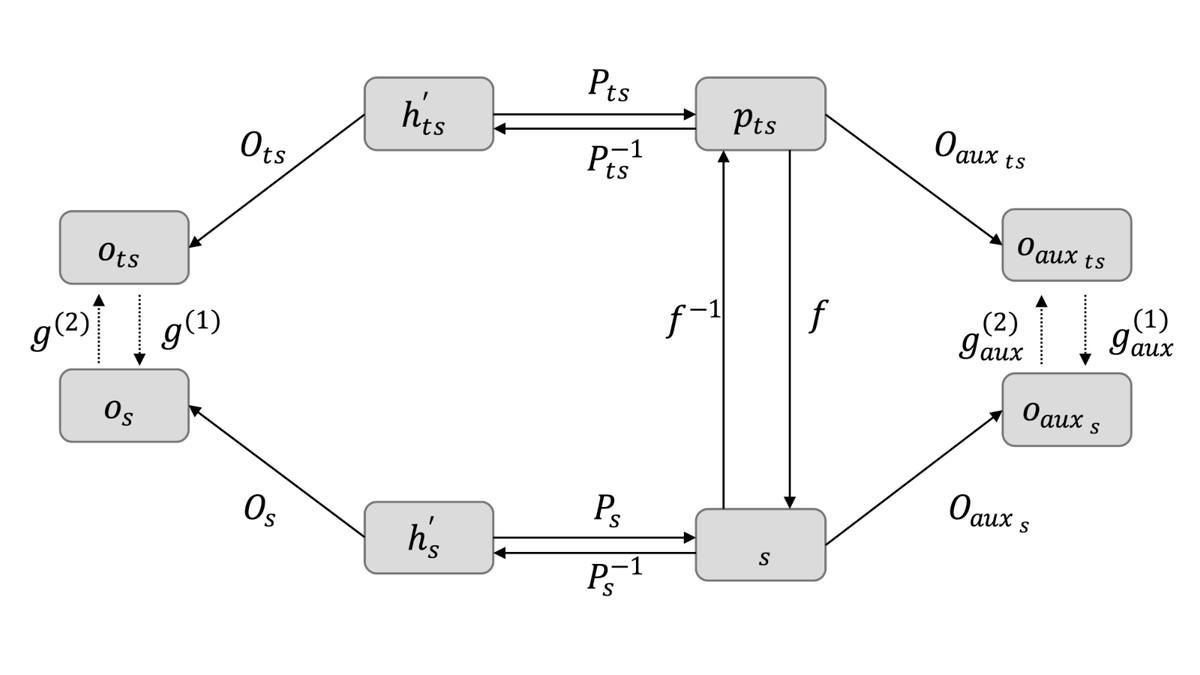
- The TS Aligner. A small module (roughly 0.8M learnable parameters) that maps the teacher's latents into a task-relevant space through a non-linear projection, an output head, a manifold projection, and an auxiliary output head.
- A language-only student. BERT-6L, BERT-base, DeBERTa-v2-xxlarge (1.4B), OPT-1.3B, or LLaMA-3B/7B/8B, trained on text as usual.

The teacher's weights never change. For a text-to-image teacher, the researchers generate latent representations that are 32x32 dimensions (flattened to a 1024-dimensional vector) for each text input, using 20 diffusion inference steps and a guidance scale of 7.5. These latents feed the TS Aligner, which is trained jointly with the student on task-specific objectives.
How the alignment actually works
ARMADA layers three losses on top of standard supervised training:
- Output alignment. The student matches the aligner's task logits with a temperature-scaled logit matching term, following the classical Hinton recipe.
- Manifold alignment. Aligner and student hidden states are projected through orthogonal maps into a shared 768-dim subspace, then pulled together. The paper tests three distance functions: cosine, Euclidean over batch centroids, and elementwise Euclidean. In practice, Euclidean produces the most robust gains.
- Auxiliary output alignment. A second output head on top of the manifold projection enforces that the projected representations still solve the task, preventing the manifold match from collapsing to something trivial.
The authors back this up with a topological argument: if the projected manifolds of teacher and student are homeomorphic (structurally equivalent as continuous spaces), their output spaces are also homeomorphic. That is what justifies squeezing the manifolds together as a proxy for aligning behavior.
What the numbers say
Across 12 GLUE and SuperGLUE tasks, eight reasoning tasks, and five instruction-tuning benchmarks, ARMADA shows consistent, if modest, gains. Highlights from the Stable Diffusion teacher experiments:
| Student | Baseline avg | ARMADA avg | Gain |
|---|---|---|---|
| BERT-6L | - | - | +3.4% |
| BERT-base | - | - | +2.8% |
| DeBERTa-v2-xxlarge (1.4B) | - | - | +1.4% |
| OPT-1.3B | - | - | +1.5% |
| LLaMA-7B (zero-shot reasoning) | 69.0 | 69.5 | +0.5% (max +2.6%) |
On the Hateful Memes benchmark, an intentionally hard multimodal dataset, a text-only BERT-12L jumps from 55.4% to roughly 60.4% accuracy after ARMADA distillation, even though the student never sees an image at inference. The authors argue this shows that cross-modal distillation is particularly beneficial for tasks requiring joint reasoning over visual and textual semantics.
On instruction tuning with LLaMA-3.2-3B, ARMADA even beats sequence-level distillation from a language-only LLaMA-8B teacher on tasks like Dolly, SelfInst, and UNI, despite using much smaller multimodal teachers.
The most useful ablation
A natural skeptical read is that ARMADA gains come from the extra parameters in the aligner rather than any real cross-modal signal. The authors test this two ways.
First, they build a capacity-matched aligner that removes the projection and auxiliary heads but adds equivalent depth. Performance drops 2.8% on average, meaning raw capacity is not the source of the gains.
Second, they shuffle teacher inputs so that each text sample is paired with an unrelated image latent. Under shuffled inputs, TS Aligner performance drops by 3.8%, whereas the BERT-12L student degrades by 1.8%, and on tasks such as BoolQ, performance decreases by up to 5%, dropping below the undistilled model. Semantic alignment between text and teacher latent matters. Random noise in the latents does far less damage than misaligned latents, which suggests ARMADA is transferring structured semantic priors rather than acting as a generic regularizer.
Where it wins, where it does not
Error analysis on CoLA shows over 70% of the ARMADA-only correct predictions involve syntactically complex constructions like filler-gap dependencies. On COPA, roughly 42% of the newly correct examples fall in the "social and institutional" commonsense category. In other words, the gains concentrate in structurally hard syntax and socially grounded reasoning, not uniformly across every task.
Limits worth flagging:
- Absolute gains on already-strong models are small. LLaMA-7B improves 0.5% on average across reasoning tasks, and Dolly evaluation with LLaMA-8B is essentially flat.
- The TS Aligner itself is a poor standalone model (single-digit Matthews correlation on CoLA), so the framework only pays off when jointly trained with the student.
- Teacher representation quality matters. As noise on teacher latents grows, distilled LLaMA-3B collapses back toward the undistilled baseline.
What is new here
The practical contribution is that ARMADA works with any white-box or black-box multimodal teacher without touching it. You do not need to pretrain a video-text encoder for a hundred million clips, and you do not need gradients from a proprietary generation API. You just need latent vectors keyed to your training text.
The conceptual contribution is arguably bigger: the findings challenge conventional knowledge distillation paradigms by demonstrating that even vision-language models, despite lacking direct textual understanding, can significantly enhance language models when distilled appropriately. Generative image, video, and audio models appear to encode transferable structure about the world that a plain LLM can use, even at billion-parameter scale.
The authors state that the source code of ARMADA will be released upon acceptance of the paper, so a public repo is not yet available. For anyone working on compact LLMs, domain adaptation, or squeezing more from small budgets, the recipe is worth watching: pair your text with cheap latents from a frozen generative model, train a tiny aligner alongside your student, and let manifold matching do the rest.