
IISc's VIP-Loco Teaches Robots to Plan Through Gaps, Crawls, and Climbs
A new framework fuses depth vision, reinforcement learning, and model predictive control so legged robots can see, plan, and cross gaps, stairs, and crawl spaces.
 Pro
Takeaways
- VIP-Loco combines depth vision, RL, and infinite-horizon MPC in one legged locomotion framework
- Internal model learns compact kinodynamic states used for both imagination during training and MPC dynamics at deployment
- Variational loss beats consistency loss on crawl and tilt tasks with tight lateral constraints
- Validated on Unitree Go1, Cassie, and TronA1-W across six terrain types in Isaac Gym
- Runs at 40 to 50 Hz on a desktop GPU with roughly 20 to 25 ms per control step
- Simulation only for now; hardware transfer is the stated next step via Stoch Lab
Getting a legged robot to sprint over stairs is one thing. Getting it to duck under a low slab, tilt through a narrow gap, and then leap over a hole while staying stable is a much harder ask. A new paper out of the Indian Institute of Science, VIP-Loco, proposes a way to unify the two dominant paradigms in legged control, model predictive control and reinforcement learning, then adds depth vision on top so the robot can anticipate what is coming rather than just react.
The reactive robot problem
Legged locomotion research has largely split into two camps. Model Predictive Control (MPC) optimizes actions over a short horizon under explicit constraints, which makes it interpretable and safe, but it chokes on high-dimensional inputs like depth images. Reinforcement learning goes the other way: model-free policies generalize beautifully across messy visual scenes but do not actually plan, so they can miss footholds on gap jumps or wall clearances in crawl tunnels.
Most prior systems using proprioception alone behave reactively, the authors point out. That works on flat ground, but gap crossing, confined navigation, and climbing require foresight. Recent perception-based methods such as WMP added world models with depth inputs, and PIP-Loco added infinite-horizon MPC to a proprioceptive policy, but no one had put vision, planning, and on-policy RL training into one loop.
How the framework is wired
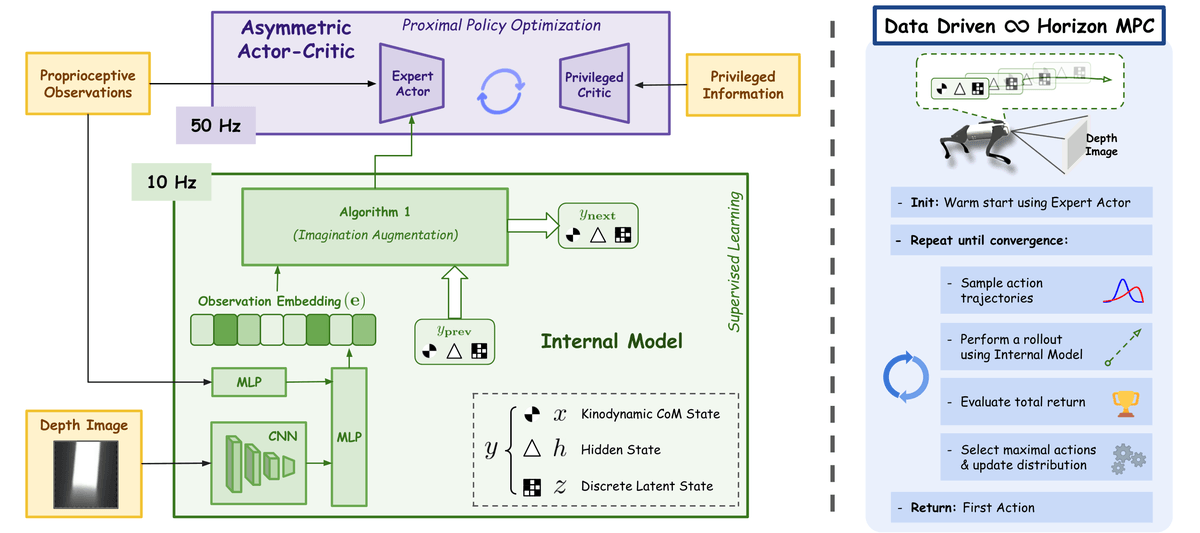
VIP-Loco has two phases. During training, an internal model learns to map proprioception plus depth images into a compact kinodynamic state, essentially a low-dimensional description of body pose, velocity, and joint configuration. At deployment, that same learned model becomes the dynamics oracle for an infinite-horizon MPC planner that samples trajectories, scores them with a learned value function, and picks the best one.

The internal model itself borrows the RSSM backbone from Dreamer. It runs at 10 Hz (depth encoding is expensive) and contains a GRU for temporal memory, a stochastic latent state z for uncertainty, and an explicit kinodynamic center-of-mass state x for interpretability. The expert actor runs faster at 50 Hz, consuming an imagined rollout from the internal model plus the hidden state. Training uses an asymmetric actor-critic with PPO, while the internal model is trained via supervised learning with a joint loss covering:
- KL divergence between encoder posterior and dynamics prior for consistent imagination
- An L2 loss on the kinodynamic CoM state against simulator ground truth
- Negative log-likelihood for reward and value prediction
- Behavior cloning of the expert policy
- Reconstruction of proprioceptive observations and the depth image
At deployment, the planner uses a constrained Model Predictive Path Integral (MPPI) solver, warm-started by the RL policy, that enforces joint limits and base velocity bounds. On a desktop GPU the whole loop lands at 40 to 50 Hz, with roughly 20 to 25 ms per control step split across depth encoding, imagination rollout, MPPI sampling, and elite selection.
Why variational beats consistency
One of the more interesting findings concerns representation learning. TD-MPC style methods use a consistency loss that ties the latent representation to the critic's privileged inputs. The critic here gets scan dots, height samples around the robot. Those work fine on open terrain, but scan dots do not capture lateral wall clearances, which is exactly what defines crawl and tilt tasks. So the authors use a variational objective that reconstructs the depth image directly.
The ablation shows the payoff clearly: the variational variant sustains success above 60 percent on crawl and tilt at high difficulty, while the consistency variant collapses. Proprioception-only baselines (HIM-Loco, PIP-Loco) fail entirely beyond difficulty level 4 on climb and gaps, confirming that vision is required for these tasks.

Three robots, six terrains
The framework was validated in Isaac Gym on three very different robots: the Unitree Go1 quadruped, the Cassie biped, and a TronA1-W wheeled biped. Terrains covered slopes, stairs, gaps, climbing, crawling, and tilting. Adding the MPC planner on top of the trained policy produced return gains on all three robots, with the largest lift on TronA1-W, likely because its non-holonomic wheeled-biped constraints benefit most from explicit trajectory planning. On stairs, VIP-Loco variants held above 90 percent success at maximum difficulty, while proprioception-only methods degraded sharply.
On raw success rate, VIP-Loco (Variational) and the vision-only WMP baseline are often similar. The authors argue the real advantage of VIP-Loco lies in interpretability and constraint satisfaction from the explicit MPC layer, since predicted CoM trajectories can be compared against actual execution and the two align tightly across climb and crawl rollouts.
Where it falls short
Results are simulation only. The team notes that their predecessor PIP-Loco has been validated on real hardware, which gives some confidence that the on-policy training plus MPC deployment recipe should transfer, but real depth sensor noise and onboard compute limits are the obvious next hurdles. Marginal regressions also appear on some easier terrains where planning does not add much over the already-saturated policy. No code release is mentioned in the paper itself, only a project website from the Stoch Lab.
For anyone building perceptive legged controllers, the takeaway is concrete: neither vision nor planning alone gets you through the hardest terrains. Combining them, with a carefully chosen variational representation that avoids the critic's blind spots, is what pushes performance at the highest difficulty levels.