
IISc's STRIDE Cuts Robot Motion Prediction Error by 30% on Rough Terrain
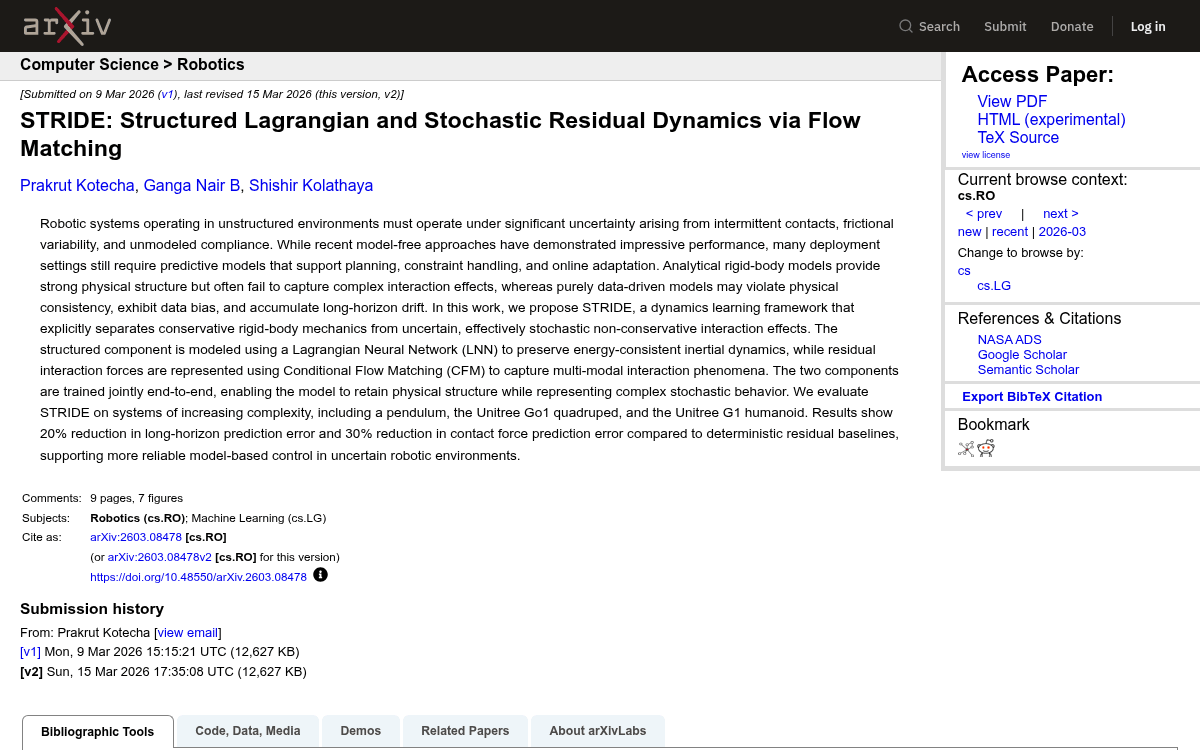
IISc researchers propose STRIDE, combining physics-informed Lagrangian networks with generative flow matching to cut long-horizon robot prediction error by 20% over deterministic baselines.
 Pro
Takeaways
- IISc researchers propose STRIDE, a robot dynamics framework splitting physics-consistent mechanics from stochastic contact forces.
- A Lagrangian Neural Network handles conservative rigid-body dynamics; Conditional Flow Matching models unpredictable contact residuals as a probability distribution.
- Achieves 20% lower long-horizon prediction error and 30% lower contact force error vs. deterministic baselines on Unitree Go1 and G1.
- Runs at 3ms per step inside an MPPI control loop, enabling real-time 50Hz deployment on physical Unitree Go1 hardware.
- Zero-shot adapts to four unseen terrains (slopes, mud, grass, friction changes) without retraining.
- No code released yet; project page at prakrutk.github.io/STRIDE.
Teaching a robot to predict its own future motion is harder than it sounds. The moment a foot hits the ground, or a joint slips on a wet surface, the neat equations of classical mechanics start to break down. Researchers from the Indian Institute of Science (IISc) have published a paper introducing STRIDE (Structured Lagrangian and Stochastic Residual Dynamics via Flow Matching), a dynamics learning framework that splits this problem in two: let physics handle what physics is good at, and let a generative model handle the rest.
The gap between clean theory and messy reality
Model-based control methods like Model Predictive Control (MPC) -- which plans ahead by simulating many possible futures and picking the best one -- need an accurate dynamics model to work well. The challenge is that no single modeling approach nails this for legged robots.
- Classical rigid-body models are grounded in physics but break down when friction changes, contacts are intermittent, or joints have unmodeled compliance.
- Pure data-driven models (black-box neural nets) are expressive but violate physical laws, accumulate errors over long rollout horizons, and need large datasets to generalize.
- Physics-informed neural networks (like Lagrangian or Hamiltonian neural networks) improve consistency, but they still model contact forces deterministically -- and contact is anything but deterministic.
The core problem is that robotic systems operating in unstructured environments must contend with significant uncertainty arising from intermittent contacts, frictional variability, and unmodeled compliance. When a foot might slip or grip depending on subtle terrain variations, a model that predicts a single average outcome is wrong in both cases.
The averaging bias problem
This is the key insight driving STRIDE. When contact forces are multi-modal -- meaning the robot's foot might either slip or stick, producing very different force profiles -- a deterministic regression model trained with mean-squared error will predict the average of those two outcomes. That average corresponds to a force that never actually occurs in the real world.
In robotic systems, such averaging can smooth over discontinuous interaction phenomena -- for example, when a foot either slips or establishes stiction depending on subtle state variations -- and deterministic residual models may produce force predictions that do not correspond to any physically realizable interaction outcome. The fix is to model those residual forces as a probability distribution, not a single point estimate.

How STRIDE works
STRIDE decomposes robot dynamics into two streams trained jointly end-to-end:
- Lagrangian Neural Network (LNN) -- the structured part. A Lagrangian Neural Network (LNN) learns the conservative, physics-consistent part of the dynamics: inertia, gravity, and Coriolis effects. It does this by parameterizing the robot's kinetic and potential energy functions directly, then deriving accelerations from the Euler-Lagrange equations. The mass matrix is constructed via Cholesky factorization to guarantee it stays physically valid (symmetric and positive-definite) throughout training and deployment.
- Conditional Flow Matching (CFM) -- the stochastic part. Conditional Flow Matching (CFM) is a generative modeling technique that learns to transport samples from a simple Gaussian noise distribution to the target distribution of residual forces, conditioned on the robot's current state and control inputs. Unlike diffusion models, which require many iterative denoising steps, CFM learns a continuous vector field and can generate samples in a single integration pass -- making it fast enough for real-time control loops.
The two components are trained jointly end-to-end, enabling the model to retain physical structure while representing complex stochastic behavior. The joint training objective encourages an implicit division of labor: the LNN absorbs the smooth, low-variance structured dynamics, while the CFM residual focuses on the noisy, contact-driven variability.
The paper validates this separation empirically on a bouncing pendulum. During free swing, the generative residual contributes only 6.5% of the predicted acceleration. During contact impacts, it scales up to 78.8%, absorbing the high-frequency discontinuities without corrupting the global mass matrix.
What the numbers say
STRIDE was evaluated on three systems of increasing complexity: a simple pendulum, the Unitree Go1 quadruped (a four-legged dog-like robot), and the Unitree G1 humanoid. Baselines included a plain MLP, DeLaN (a physics-informed Lagrangian baseline), a pure diffusion model, and an LNN paired with diffusion instead of flow matching.
Results show a 20% reduction in long-horizon prediction error and 30% reduction in contact force prediction error compared to deterministic residual baselines. The comparison against the strongest structured baseline (LNN + Diffusion) is also meaningful: STRIDE achieves a further 19% reduction on the Go1 and 21% on the G1 humanoid.
The table below summarizes performance at a 30-step rollout horizon:
| Robot | Model | State RMSE (lower is better) | Force Error (N) |
|---|---|---|---|
| Go1 | Plain MLP | 5.489 | N/A |
| Go1 | DeLaN | 1.326 | 9.4 |
| Go1 | LNN + Diffusion | 1.154 | 8.8 |
| Go1 | STRIDE | 0.932 | 6.7 |
| G1 | Plain MLP | 1.204 | N/A |
| G1 | DeLaN | 1.023 | 17.1 |
| G1 | LNN + Diffusion | 0.918 | 15.4 |
| G1 | STRIDE | 0.289 | 12.1 |
Fast enough for real hardware
A dynamics model that runs in 500ms is useless for a robot that needs to replan at 50Hz. The CFM-based residual was specifically chosen over diffusion because it reaches comparable accuracy with far fewer neural network evaluations. STRIDE runs in 3ms within the MPPI loop, maintaining an on-board control frequency of 50Hz, thereby demonstrating real-time feasibility alongside improved robustness.
The team embedded STRIDE inside a sampling-based MPC framework (MPPI -- Model Predictive Path Integral control) and deployed it on real Unitree Go1 hardware. The controller successfully adapts gaits and joint positions across four previously unseen terrains -- including transitions from high-friction to low-friction surfaces, 20-degree slopes, muddy, and grassy terrain -- maintaining stable locomotion without additional training or parameter tuning.
Where it fits and where it falls short
STRIDE is most useful when you need a model-based controller (MPC, trajectory optimization) for a legged or contact-rich robot, and you want better long-horizon prediction without sacrificing physical consistency. It is a natural upgrade over DeLaN-style physics-informed baselines.
It is less suited to scenarios where:
- Pure model-free RL is sufficient and you do not need explicit planning or constraint handling.
- Inference compute is extremely constrained -- the CFM integration step, while faster than diffusion, still adds overhead compared to a plain MLP.
- The environment is so high-dimensional that direct observation-space modeling (like pure diffusion) can absorb sensor noise more easily. The paper notes that pure diffusion actually outperforms structured models on the G1 humanoid in state RMSE, likely because the high-dimensional sensing noise is easier to absorb without physical constraints.
No code or pretrained model has been released alongside the paper at this time, though the project page is listed at prakrutk.github.io/STRIDE. The work comes from the Robert Bosch Center for Cyber-Physical Systems at IISc, Bengaluru, and is available on arXiv.