
IISc's Stoch-3 Brings Dog-Sized Research Robot Under $8000
A team from IISc Bengaluru open-sourced Stoch-3, a 25 kg chain-driven quadruped built for under $8000 using laser cutting and 3D printing.
 Pro
Takeaways
- IISc Bengaluru open-sourced Stoch-3, a 25 kg quadruped built for under $8000.
- Sandwich leg design uses laser-cut aluminum with 3D-printed cores, yielding 1.5 kg per leg.
- Dual-motor architecture places both hip and knee actuators near the hip, reducing swing inertia.
- Chain-driven knee with 8.18:1 gear reduction avoids belt slippage and four-bar range limits.
- Custom knee heat sinks tripled outdoor runtime from 10 minutes to 30 minutes.
- Full mechanical CAD released; paper and demo video available.
Quadruped robotics has an accessibility problem. Boston Dynamics' Spot and Ghost Robotics' Vision-60 stay locked behind five-figure price tags and closed designs, while the popular open-source alternatives either need CNC-machined custom motors or top out at toy-scale payloads. A team from the Indian Institute of Science has just dropped mechanical CAD files for a middle path: a 25 kg dog-sized research platform built for under $8000 using laser-cut sheet metal and 3D-printed parts.
The robot, called Stoch-3, is described in a new paper on arXiv, and the full CAD is available on GitHub. Each leg has three actuated degrees of freedom, driven by a modular Quasi-Direct-Drive (QDD) actuator with a single-stage planetary gearbox. The interesting engineering choices are downstream of that: how they got the leg light, how they got the price down, and how they made it not fall apart during outdoor tests.

Why leg inertia is the whole game
In a running quadruped, the legs swing back and forth many times per second. Any mass out at the knee or foot has to be accelerated and decelerated every stride, which burns torque and slows down control loops. Reducing that inertia is one of the main unsolved practical problems in mid-size legged robotics.
Stoch-3 attacks it two ways. First, a dual-motor architecture borrowed from horse anatomy: both hip and knee actuators sit near the hip joint, eliminating the need for a knee-mounted actuator and significantly reducing leg inertia. The knee is driven remotely through a chain and sprocket running along the thigh. With an 11-tooth driving sprocket and a 15-tooth driven sprocket, the combined planetary and chain system achieves an effective gear reduction of 8.18:1.
Second, a sandwich leg design: two laser-cut aluminum sheets bracketing a 3D-printed plastic core, glued and bolted together, with steel reinforcement plates at the high-stress knee region. Each leg weighs 1.5 kg, enabling faster control responses and effective movement across diverse terrains.
Why chain drive, and not belts or linkages
Transmission choice is where a lot of open-source quadrupeds struggle. Belts slip under load (a known issue with Solo and reportedly Mini-Cheetah in some regimes), direct drive puts mass at the wrong place, four-bar linkages restrict range of motion, and screw mechanisms add complexity. The authors argue chain wins on the trade-off curve:
- Belt drives require friction-based tensioners, increasing friction and efficiency losses, while chain drives use tension-based tensioners.
- Four-bar linkages limit knee range to less than 90 degrees, while screw mechanisms add design complexity and restrict motion.
- Chain drives also allow easy gear ratio tuning by swapping sprocket sizes.

The parts list
The QDD actuator uses off-the-shelf components rather than the custom frameless motors that make robots like MIT Cheetah 3 and KAIST Hound expensive to reproduce. The robot utilizes an off-the-shelf T-motor U10 plus BLDC motor with a 6:1 single-stage planetary gear reduction and a moteus r4.10 motor driver from MJBOTS. The actuator weighs approximately 920 g, with an onboard Hall effect sensor allowing it to be mounted directly on the actuator module for a compact design and reduced wiring.
Compute is a Raspberry Pi 4B paired with an mjbots pi3hat board over four CAN buses, one per leg. An Xsens MTi-610 IMU handles orientation. Power comes from a 22.2V, 10 Ah Li-Po battery in a swappable sliding tray.
Reliability, the boring part that matters
What separates a nice-looking CAD from a robot you can actually run experiments on is whether it survives the second afternoon. The paper documents three fixes that came out of testing:
- Cable strain reliefs at every joint, using a daisy-chain wiring scheme so motor wires don't yank loose during erratic motion.
- Custom knee heat sinks that thermally couple the motor driver to the hip-to-knee coupling. Thermal coupling of the knee actuator to the hip-to-knee link increased runtime from 10 to 30 minutes.
- Mechanical joint limits made from laser-cut, bent steel that physically stop the leg from moving beyond safe ranges, which matters when you are testing an unstable new controller three feet from your face.
Where it fits and where it doesn't
Stoch-3 lands in a specific niche: labs that need something bigger and more capable than Stanford Doggo but cannot justify a $75K commercial platform. The build breakdown is approximately $4500 for motors and $3500 for electronics and manufactured parts. The authors are also candid about what still needs work:
- The torso bends under high forces at the actuator mounting points and needs thicker plate.
- The knee motor driver still overheats under sustained load; future revisions will integrate the heat sink with the coupling and add fins.
- The silicone-molded foot wears quickly on abrasive terrain; vulcanized rubber is next.
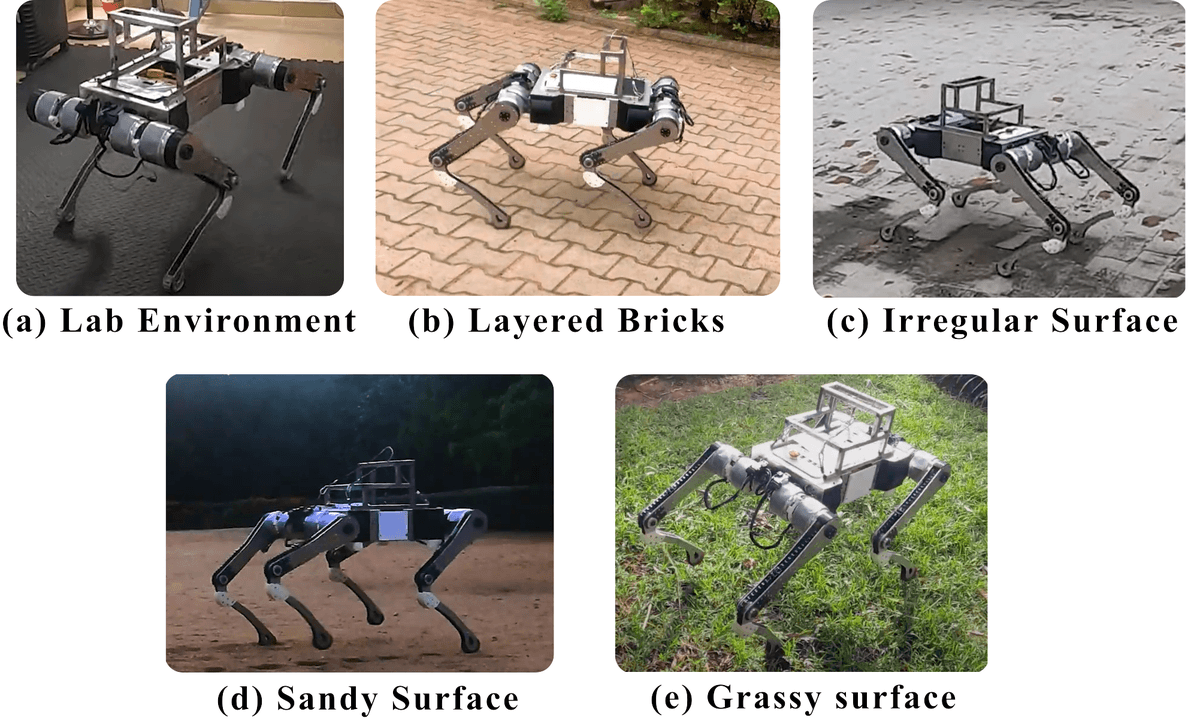
Experiments so far demonstrate trot and crawl gaits on flat ground, slopes, sand, and grass, plus disturbance rejection. There is no jumping or backflipping in the demo video, which is honest given the design goals. If you are building learning-based locomotion controllers and need a mid-size hardware target where you can actually swap parts without a machine shop, the CAD is worth a look.