
Idiap Cuts Speech Recognition Errors 22% Without Collecting Audio
Researchers reframe domain adaptation as a denoising problem, letting speech LLMs learn new vocabularies from text alone without breaking speech-text alignment.
 Pro
Takeaways
- New text-only adaptation method for speech LLMs reframes fine-tuning as a denoising task on corrupted target transcripts.
- Trains the LLM to recover clean transcripts from noisy inputs while preserving projector-LLM alignment via mixed batches.
- Achieves up to 22.1% relative WER improvement, beating recent soft-prompt and perplexity-monitoring baselines.
- Requires no architectural changes, no extra parameters, only a batch composition trick and character-level noise.
- Works well for in-domain and out-of-domain lexical shifts, but cannot fix target-domain acoustic mismatch.
- Full paper available at arXiv:2601.20900, built on the SLAM-ASR framework with WavLM and Llama 3.2.
Adapting a speech recognition system to a new domain usually means collecting hundreds of hours of transcribed audio, which is expensive and slow. A team from Idiap Research Institute, EPFL, Uniphore, the University of Zurich and BUT Brno has published a paper proposing a lighter path: teach the language model half of a speech LLM to denoise corrupted transcripts, and let that stand in for the missing audio during fine-tuning.
The trick delivers up to 22.1% relative word error rate improvement over a non-adapted baseline, and beats two recently proposed text-only adaptation methods, without adding a single parameter to the architecture.
Why text-only adaptation keeps breaking
LLM-based ASR systems have three parts: a pretrained speech encoder like Whisper, HuBERT or WavLM, a learnable projector that maps speech features into the LLM's input embedding space, and a pretrained LLM that acts as the decoder. The projector is the glue. It turns audio frames into something the frozen LLM can read as if they were tokens.
The obvious way to teach this system a new domain from text alone, just fine-tune the LLM on target-domain transcripts, has a nasty side effect. Direct fine-tuning on target text causes catastrophic forgetting: the alignment between the speech encoder and the LLM degrades, the projector's mapping becomes ineffective, and overall performance drops. The LLM gets better at the new vocabulary but forgets how to interpret its own projector's outputs.
Speech recognition as a denoising problem
The key insight is about what the projector actually produces. Even a simple projector with two linear layers and a nonlinearity, combined with a frozen LLM, is enough for strong transcription, which suggests the projector learns to convert speech into soft tokens that approximate entries in the LLM vocabulary. Prior work reported that the projector may map an utterance like "yes that would be" into embeddings that resemble a garbled sequence such as "mmy Z YesssS S SGS that Will B be S S". The projector's output looks less like speech features and more like a noisy transcript.
If that is what the LLM sees at inference time, then transcription is essentially denoising. So the authors formalize adaptation as training on (noise(t), t) pairs, where noise(t) is a corrupted version of a target-domain transcript and the model has to reconstruct the clean one.
The four-way batch recipe
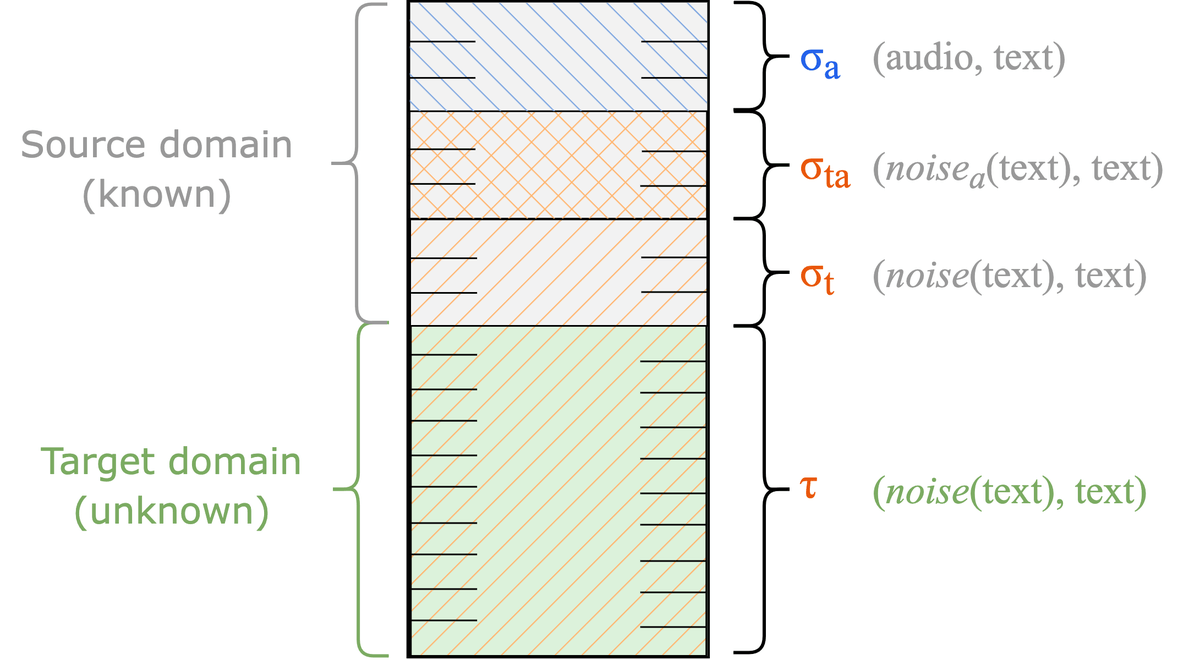
Naively applying that idea still breaks alignment. The fix is a batch composition that mixes four types of examples during fine-tuning:
- Source audio pairs (
σ_a): real audio-transcript pairs from the source domain, to keep the projector-LLM alignment intact. - Projector-induced noise (
σ_ta): source transcripts paired with a text-like corruption generated by passing the actual audio through the projector and snapping each embedding to its nearest LLM vocabulary token. This is the closest thing to "real" noise the projector produces. - Synthetic noise on source text (
σ_t): source transcripts corrupted by random character substitutions and duplications, no audio required. - Synthetic noise on target text (
τ_t): the actual adaptation signal, target-domain transcripts corrupted the same way.
The synthetic noise itself is intentionally simple. The team uses nlpaug to select 15% of words and replace 30% of characters within them with random symbols, then gives each character a 10% chance of being duplicated one to three times. The duplication step mimics the repetition patterns seen in real projector outputs.
In practice, a small but nonzero σ_a is critical to avoid forgetting the speech-to-text alignment, while τ controls the strength of adaptation. The authors set τ proportional to how big the target set is relative to the source, and split the remaining budget equally across the three source components.
Numbers on two conversational datasets
Experiments use the SLAM-ASR framework as the backbone, with WavLM-Large as the encoder and Llama 3.2 3B Instruct as the decoder LLM, connected by a single-hidden-layer projector. Evaluations run on two conversational corpora: DefinedAI (customer-agent phone calls in Banking, Insurance, Healthcare) and the open-source SlideSpeech corpus of YouTube conference videos.
Three scenarios were tested:
- In-domain (target familiar to base model): text-only adaptation gets close to the audio-adapted upper bound. On DefinedAI Banking, WER drops from 12.98% (base) to 10.11%, versus 9.92% when full audio is available.
- Out-of-domain (new vocabulary, same acoustics): consistent gains on two of three SlideSpeech target domains, with the method beating both Fang et al. and Ma et al. baselines.
- Cross-domain (new vocabulary and new acoustics): the hardest case. Gains are real but modest, and audio adaptation still dominates because it can address the acoustic mismatch that text cannot touch.
Ablations confirm the batch recipe matters. Dropping the audio component (σ_a = 0) blows WER up to 66-73%, a textbook catastrophic forgetting failure. Replacing the noise function with unperturbed text ("echo" the transcript in the prompt) works, but denoising consistently wins.
Where this fits, and where it does not
The practical appeal is that no new parameters, no soft prompts, and no architectural changes are involved. If you already have a SLAM-style speech LLM in production and you need to adapt it to a new call-center vertical, a medical specialty, or a product catalog, you can do it with transcripts you probably already have. It also beats the two most recent prior approaches in this specific niche, one of which relied on soft prompts as pseudo-audio embeddings.
The limits are honest and clear from the tables. When the acoustic conditions of the target domain differ from what the base model saw, text-only adaptation cannot close the gap. WER on cross-domain SlideSpeech stays in the mid-20s, while audio adaptation cuts it to around 12%. The method also assumes the text-only data looks like transcripts of spoken conversation, not arbitrary web text. And τ, the mixing coefficient, is picked with a heuristic rather than tuned per domain, so there is room for gains with proper validation sweeps.
Code was not linked in the paper. The setup is straightforward enough that reproducing it on top of the public SLAM-ASR repository should be tractable, and the noise function is just a thin wrapper around nlpaug's character-level augmenters.