
IBM's Granite Speech 4.0 Beats ASR Records While Running 4.4x Faster
IBM researchers turn a speech model's own CTC encoder into a draft speller, cutting inference time 4.4x while pushing Open ASR to a record 5.58% WER.
 Pro
Takeaways
- IBM proposes self-speculative decoding that reuses a speech LLM's CTC encoder as its own draft model, no extra training required.
- Three-step pipeline: entropy-gated CTC accept, parallel LLM verification, autoregressive fallback from the verified prefix.
- Achieves a record 5.58% WER on Open ASR with a 1B LLM and 440M CTC encoder.
- High-throughput mode delivers a 4.4x speedup in inverse real time factor for a 12% relative WER hit.
- Verification actually improves accuracy by catching LLM hallucinations against acoustically-grounded CTC drafts.
- Weights and code available under Apache 2.0 as part of Granite Speech.
Speech-aware LLMs currently dominate the accuracy leaderboards for automatic speech recognition, but they have an uncomfortable secret: they generate one token at a time, dragging inference through hundreds of sequential forward passes for every utterance. A new paper from IBM Research proposes a fix that costs nothing extra at training time and simultaneously makes the model both faster and more accurate on English ASR.
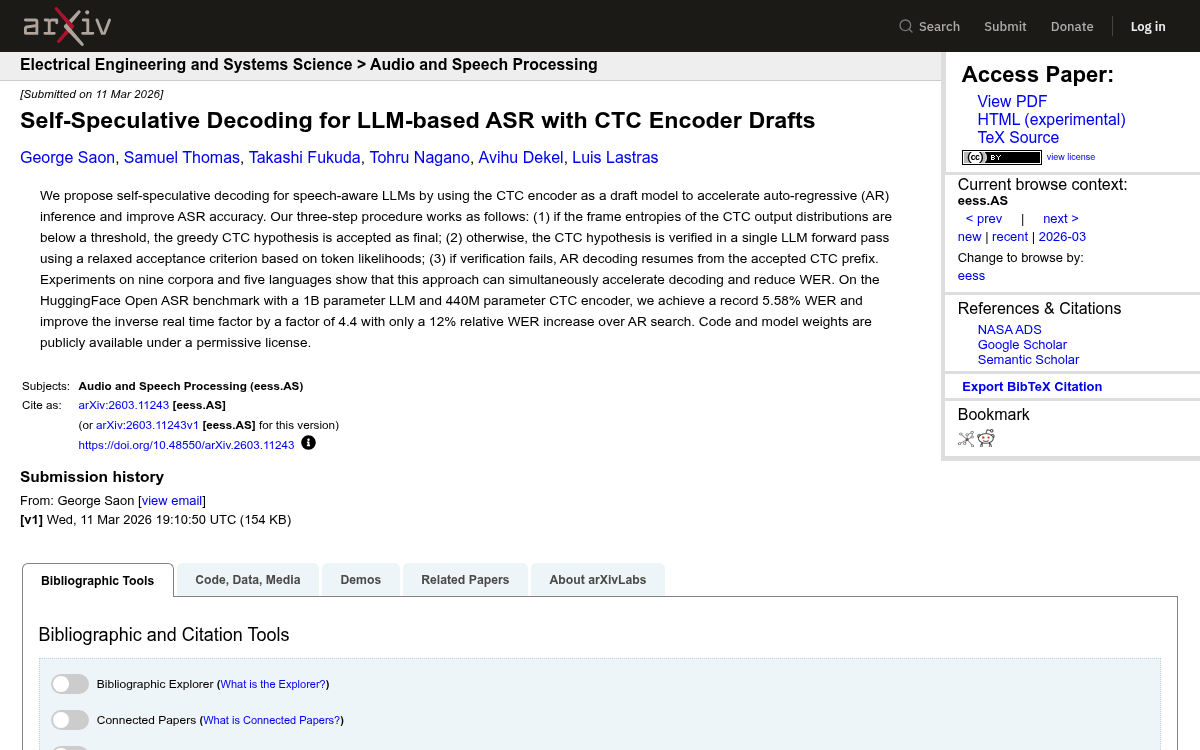
The trick is self-speculative decoding using the CTC encoder as its own draft model. On the HuggingFace Open ASR benchmark with a 1B parameter LLM and 440M parameter CTC encoder, the authors achieve a record 5.58% WER and improve the inverse real time factor by a factor of 4.4 with only a 12% relative WER increase over autoregressive search. Code and weights ship under a permissive license.
Why autoregressive ASR hurts
The top five open models on the HuggingFace Open ASR leaderboard are speech-aware LLMs with similar architectures, using conformer acoustic encoders trained with either RNN-T, CTC, or next-token cross-entropy loss, plus modality adapters that project acoustic embeddings into a space the LLM can read. The adapter downsamples frames in time and the LLM is essentially trained to repeat back what it hears.
That repetition framing is elegant but expensive. Inference is done auto-regressively, one token at a time, which requires one forward pass through the text LLM per generated token, limiting parallelism compared to non-autoregressive approaches like CTC with greedy decoding. It also introduces a second, subtler problem: language model bias. When the LLM prior overrides the acoustic evidence, the transcript reads fluently but stops matching what was actually said, the same hallucination pattern that plagues Whisper.
The core idea: use the encoder you already have
Classic speculative decoding pairs a small draft model with a large target model. The draft proposes K tokens, the target verifies them in one parallel pass, and mismatches trigger a fallback. IBM's insight is that a CTC-trained encoder already sitting inside the speech LLM is a perfectly good non-autoregressive drafter, since CTC sums over all alignments consistent with an output sequence and produces a full hypothesis in a single pass over the acoustic frames. No extra parameters, no extra training run, no separate draft transducer.
How the three passes work
The pipeline is a cascade with two early-exit points before it ever touches the autoregressive path:
- CTC draft with entropy gating. The greedy CTC hypothesis is computed. The draft hypothesis is accepted as final if all the frame-level entropies of the CTC output distribution are less than a threshold. Confident utterances skip the LLM entirely.
- Single-pass LLM verification. For less confident utterances, the CTC transcript is scored by the LLM in one forward pass. The draft CTC hypothesis is accepted during the SLM verification pass if all the token likelihoods under the SLM output distribution are greater than a threshold, and because of the causal attention mask this can be computed in parallel for all tokens with a single forward pass.
- Autoregressive fallback from the verified prefix. If verification fails at position j, the model keeps the accepted prefix and resumes normal AR decoding from there.
The choice of entropy for step 1 and likelihood for step 2 matters: entropy scores how confident the encoder is in general, while likelihood scores a specific proposed hypothesis. The authors also use a relaxed acceptance criterion that requires the CTC hypothesis to be plausible under the SLM distribution instead of an exact match of the SLM verification hypothesis, which mitigates the fact that failed verifications force the entire utterance to be AR-decoded from the failure point.
Where the accuracy gain actually comes from
The counter-intuitive result is that even at high accuracy settings the CTC-plus-verification path beats pure AR decoding. The LLM verification stage reduces WER across all corpora compared to full auto-regressive decoding, which the authors attribute to a system combination effect between CTC and the SLM which make complementary recognition errors: AR outputs tend to be more fluent but not always faithful to the acoustics, a well-known problem called language model bias. The CTC head is acoustically grounded, so verifying against it catches the LLM when it starts confabulating.
Benchmarks: fast, accurate, or both
The model tested is a new 1B granite-speech-4.0 built on top of granite-4.0-nano, with a 440M-parameter conformer CTC encoder and a q-former projector. The CTC encoder was trained on 90,000 hours of publicly available multilingual data across English, French, German, Spanish, Portuguese and Japanese, plus synthetic CommonVoice translations for the speech translation task.
Two operating points are reported on the ESB/Open ASR English suite and on multilingual CommonVoice and MLS. The high-accuracy regime uses tight thresholds (tau_CTC=0.7, tau_SLM=0.2), the high-throughput regime opens them up (tau_CTC=3.0, tau_SLM=0.1).
| Regime | Open ASR WER | RTFx | MLS avg WER |
|---|---|---|---|
| Full AR | 5.75 | 564 | 5.47 |
| High accuracy SSD | 5.58 | 548 | 5.33 |
| High RTFx SSD | 6.56 | 2491 | 5.73 |
At the high-RTFx point, close to 100% of utterances short-circuit at the CTC entropy gate. At the high-accuracy point, only 14% of Open ASR utterances are accepted at the CTC stage but 47% of what falls through gets rubber-stamped by the LLM verification pass, meaning the LLM only has to run AR decoding on roughly half of the data.

An ablation confirms both gates pull their weight. Deactivating the CTC acceptance pass matches accuracy in the high-accuracy regime but has substantially lower RTFx at the high throughput end; deactivating the LLM verification pass cannot reach the lowest WER (5.75% vs. 5.58%) but matches the baseline curve at high RTFx.
Where it does not help
The authors are upfront about the boundaries of the approach:
- It requires an SLM whose acoustic encoder is CTC-trained and frozen during projector training and LoRA finetuning of the LLM. If your model uses an RNN-T or attention-only encoder, you cannot bolt this on.
- The technique is limited to ASR and is not applicable to other speech tasks like translation or spoken question answering, because CTC can only produce alignments for what was said, not translated or paraphrased outputs.
- Verification is utterance-level, so corpora with high rejection rates (heavy accents, noisy meetings) recover less of the potential speedup.
Availability
The Granite Speech family, including the newer granite-speech-4.1-2b and the compact granite-4.0-1b-speech checkpoints, is on Hugging Face. Like all Granite models, Granite 4.0 1B Speech is released under an Apache 2.0 license with native support in transformers and vLLM, so plugging the self-speculative decoder into an existing inference stack is mostly a matter of adding the entropy and likelihood gates around the existing encoder and LLM calls.
The broader message is that speculative decoding for speech does not need a bespoke drafter. If your ASR stack already contains a CTC head, it is already carrying a draft model, and using it as one buys back most of the throughput lost to autoregressive generation while sanding down the LLM's tendency to make things up.