
IBM's AssetOpsBench Reveals AI Agents Fail Industrial Plants at 70%
IBM Research releases a benchmark of 141 industrial scenarios where top LLM agents still cap out below 70 percent task completion on real chiller and HVAC operations.
 Pro
Takeaways
- IBM Research released AssetOpsBench, 141 scenarios benchmarking LLM agents on real chiller and HVAC operations, accepted at KDD 2026.
- No tested model exceeds 70 percent task completion; GPT-4.1 leads Agent-As-Tool at 65 percent, drops to 38 percent under Plan-Execute.
- Four specialized agents (IoT, TSFM, FMSR, Work Order) orchestrate over 2.3M sensor points and 4,200 real work orders spanning 11 years.
- Automated failure discovery on 881 trajectories found overstatement of completion in 23.8 percent of cases, driving concrete architectural fixes.
- Adding a clarification channel between sub-agents lifted llama-4-maverick task completion from 59 to 66 percent, beating GPT-4.1.
- Apache 2.0 code, Hugging Face dataset, MCP servers and Codabench competition already drew 500+ agent submissions.
Industrial plants are drowning in multimodal data. Chillers, air handlers, turbines and pumps stream telemetry through SCADA systems, generate work orders in enterprise systems like IBM Maximo, and accumulate failure histories in reliability libraries. Turning that mess into a decision, such as whether a chiller efficiency drop justifies a service call, has been stubbornly human work. A new benchmark from IBM Research called AssetOpsBench tries to measure how close LLM agents actually are to doing that job, and the answer is: not very.
The gap the benchmark exposes
Agent benchmarks so far have focused on web navigation, software engineering and IT operations. Physical asset workflows have been mostly ignored. The AssetOpsBench team audited 135 public industrial datasets and found only one included any work-order context, only 39 percent mentioned failure modes at all, and zero supported end-to-end agentic workflows that stitch sensor history to a downstream action. That absence is why LLM agents that ace tau-bench or SWE-bench have nothing meaningful to run on when the query becomes something like predicting next week's chiller energy use when the unit was off for the reference period.
What is in the box
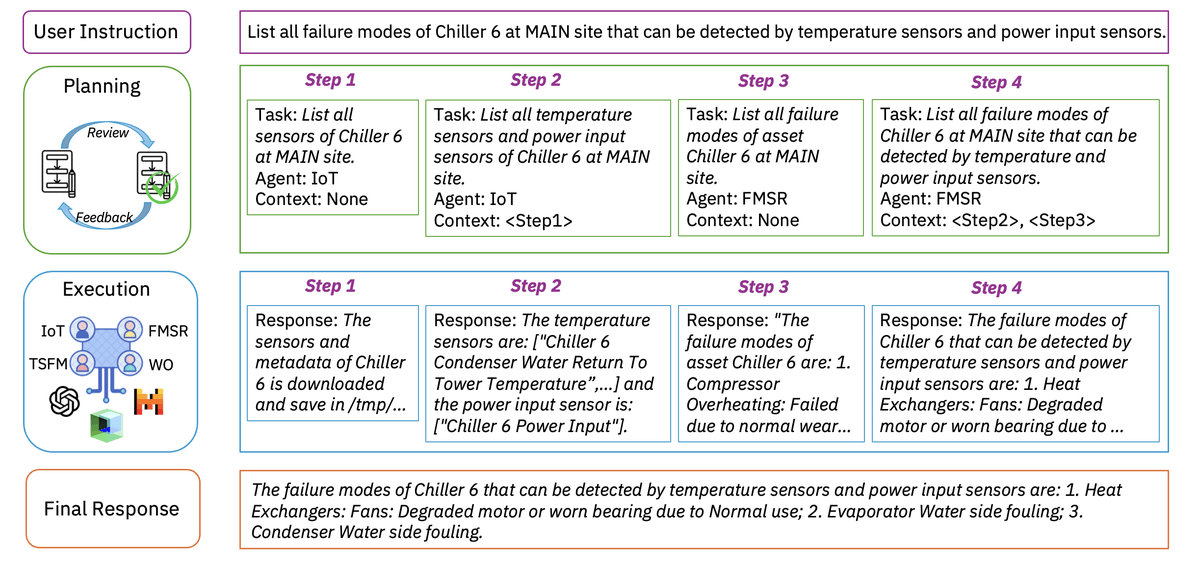
AssetOpsBench packages an industrial sandbox as a Dockerized environment backed by CouchDB, with four specialized domain agents that a global coordinator can call:
- IoT agent: fetches sites, assets, sensors and time-series history from a Building Management System replica.
- TSFM agent: wraps a pretrained time-series foundation model from Hugging Face for forecasting and anomaly detection.
- FMSR agent: maps physical failure modes (bearing wear, impeller erosion, compressor overheating) to relevant sensors using an LLM-driven mapping function.
- WO agent: uses CodeReAct to analyze 4,200 real work orders spanning 11 years, tagged with ISO failure codes.
The data foundation is real. Over 2.3 million sensor points come from six actual data-center assets (four chillers and two air handling units) instrumented with Building Management Systems and SkySpark. Failure models are drawn from 53 FMEA entries in IBM's Reliability Strategy Library.

Scenarios grounded in ISO standards, not toy tasks
The 141 scenarios were built over an 18-month collaboration with reliability engineers and organized around a four-phase taxonomy pulled from ISO 55000 and ISO 14224: asset configuration, model selection, monitoring and execution, and maintenance response. Each scenario is a 5-tuple with an ID, type, natural language text, category and a characteristic form that specifies expected outputs and procedural steps. Ninety-nine of them target a single domain agent, and 42 require multi-agent coordination. A representative task from the Hugging Face dataset reads: forecast Chiller 9's power input for the week of 2020-04-27, using data from the MAIN site. The correct behavior is to notice that the chiller was not operating that week and refuse to forecast, rather than emit a spurious number.
Two orchestration paradigms, one clear loser
The team compared two ways to wire the agents together:
- Agent-As-Tool: a supervisor agent uses ReAct to iteratively select and query domain agents as if they were tools, in a think-act-observe loop.
- Plan-Execute: a planner decomposes the query into a directed acyclic graph, a reviewer validates it, and an orchestrator dispatches subtasks with shared memory between agents. This adapts the ReWoo framework with an extra verification layer.
Seven LLMs were evaluated with three rubric scores judged by llama-4-maverick: task completion, data retrieval accuracy and result verification. The judge itself was human-validated on 40 tasks with four domain experts, hitting Cohen's kappa of 0.79 on data retrieval accuracy.

Where the numbers land
No model cleared 70 percent task completion. Under Agent-As-Tool, GPT-4.1 leads at 65 percent completion and 77 percent retrieval accuracy, with llama-4-maverick the strongest open-weight option. Switching to Plan-Execute collapsed peak completion to 46 percent, and GPT-4.1 dropped the most, from 65 to 38 percent. The interpretation: rigid up-front planning cascades errors when the query needs mid-flight recovery, while iterative tool use lets the model course-correct. Plan-Execute uses fewer steps (roughly 2.6 to 4.4 per task versus 4 to 6 for Agent-As-Tool) but often over-plans simple objectives and racks up wall-clock time from planner-executor overhead.
Automated failure mode discovery
Across 881 collected trajectories, the team applied a taxonomy of 14 known multi-agent failure modes and let the judge discover up to two novel ones per trace. System design errors dominated. Overstatement of task completion showed up in 122 cases (23.8 percent) and ineffective error recovery in 160 cases. A concrete fix followed: after noticing that agents failed to ask clarifying questions about 10 percent of the time, the team added a clarification channel between sub-agents and the parent. Rerunning the benchmark pushed llama-4-maverick task completion from 59 to 66 percent, overtaking GPT-4.1.
Small models have a niche
Small language models tanked on overall scores but showed clear specialization. Granite-3-8B hit 15 out of 20 on IoT tasks, 18 out of 22 on FMSR and 19 out of 23 on TSFM, then cratered to 2 out of 36 on Work Order tasks that require procedural multi-step coordination. The paper argues this points toward hybrid LLM-SLM architectures where small specialists handle sensing and diagnostics while larger generalists handle end-to-end orchestration.
What is available now
The repository is Apache 2.0, with MCP servers for each domain agent, a plan-execute runner, and Colab and Hugging Face Spaces playgrounds. A Codabench competition attracted 500+ agent submissions from 250+ participants. The paper was accepted at KDD 2026, and generalization tests on MetroPT-3 compressor faults, UCI Hydraulic Systems and 88 additional failure-mode scenarios suggest the framework travels beyond chillers. If you are building industrial agents or evaluating time-series foundation models in an operational loop, this is the first benchmark that treats operator-centric language, physical state logic and messy real-world telemetry as the actual test.