
IBM's A.DOT Planner Beats Standard RAG by 14.8 Points on Multi-Source Queries
IBM Research introduces a DAG-based query planner that beats RAG by 14.8 points on multi-hop questions spanning SQL tables and vector stores.
 Pro
Takeaways
- IBM Research introduces A.DOT, a DAG-based planner for multi-hop QA over hybrid SQL and vector data lakes.
- Achieves 71.0% correctness on HybridQA, beating standard RAG by 14.8 absolute points.
- Compiles natural language queries into parallelizable sub-queries with structural and semantic validation.
- Dual-stage DataOps system diagnoses and repairs invalid plans without full regeneration.
- Paraphrase-aware caching reuses execution plans across semantically equivalent queries.
- Under evaluation for deployment as retrieval module in IBM Watsonx.data Premium.
Retrieval-augmented generation has become the default way to answer natural language questions over enterprise data, but it starts falling apart the moment a query needs to hop between a SQL table and a document store. A new framework from IBM Research called A.DOT (Agentic DAG-Orchestrated Transformer) Planner takes a different route: instead of blindly retrieving from every source and hoping the LLM can stitch the results together, it compiles the question into a dependency graph and executes each step against the right backend.
The paper reports a 14.8 point absolute gain in answer correctness and a 10.7 point gain in completeness over the strongest baseline on the HybridQA benchmark. The system is currently under evaluation for deployment as the retrieval module in IBM Watsonx.data Premium.
Why brute-force retrieval leaks and lies
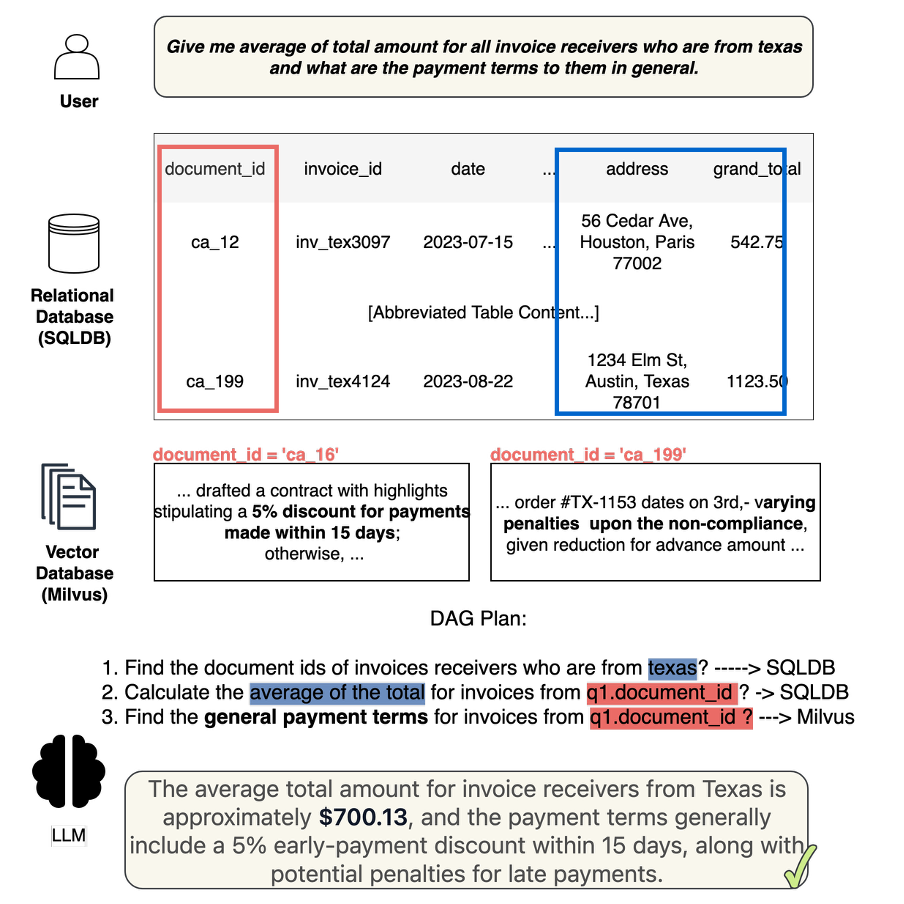
Consider a query like Give me the average total amount for invoice receivers from Texas and their general payment terms. Answering this requires identifying invoices with Texas addresses in structured tables, computing the average grand total for those invoices, and retrieving payment terms from associated unstructured invoice documents stored in a vector database.
Deployed RAG systems typically send the whole natural language question to both a SQL retriever and a vector retriever, then concatenate whatever comes back. This design leans heavily on NL2SQL or NL2Vector models to generate precise queries, which increases the risk of hallucinations, especially when key information is not present in the underlying source at all. To avoid missing relevant results, these systems often over-retrieve, pulling back large volumes of data, which increases computational overhead and can cause unnecessary data leakage.
Compiling questions into a DAG
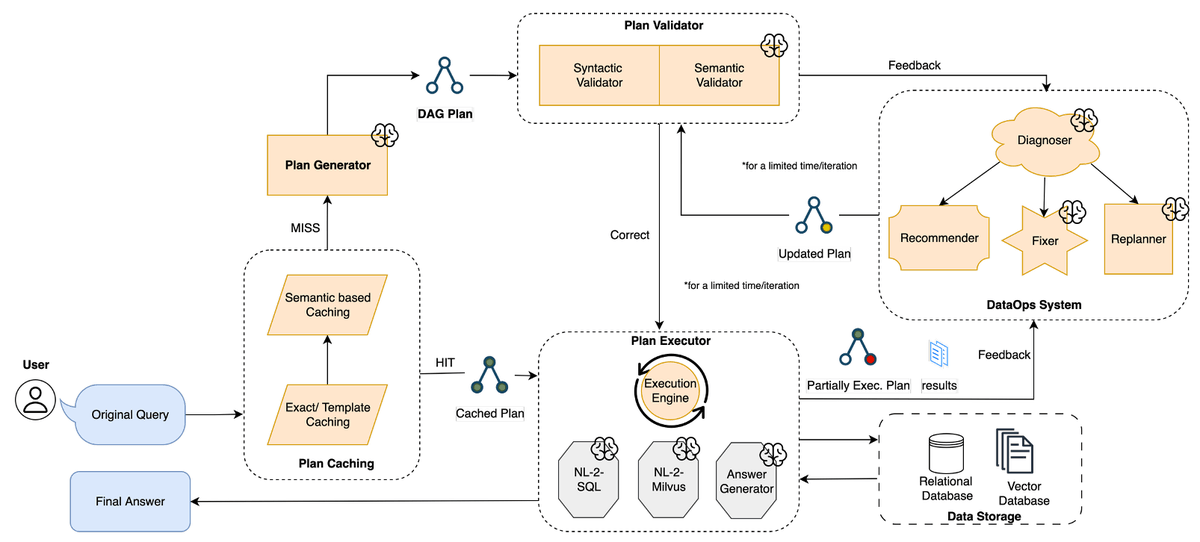
A.DOT treats query planning like a compiler pass. The Plan Generator transforms an NL query into a DAG plan in a single LLM pass, where each node is an atomic sub-query answerable from exactly one data source. Each node carries four fields:
question: the natural language sub-tasktool: eithersqlfor the relational store orvectorfor the document storelabel: a symbolic variable like$var_1that holds the node's outputshould_expose_answer: a flag for surfacing intermediate results to the user early
Edges encode dependencies. Independent nodes run in parallel, and a variable store passes only the minimal fields (typically IDs) between steps rather than dumping full result sets downstream. This slimming strategy prevents intermediate payloads from overwhelming memory or exceeding context limits in generation models.
The validation and repair loop
Generated plans go through two validation layers before execution. Structural checks verify schema compliance, that variable references point to real columns, and that the dependency graph is acyclic. Semantic checks use an LLM to audit whether the plan actually preserves the user's intent, catching things like join keys with mismatched types.
When validation or execution fails, a DataOps System kicks in with four specialized roles: a Diagnoser that identifies root causes, a Recommender for issues like server downtime that need user escalation, a Fixer that applies conservative local edits, and a Replanner that rewrites the DAG when structural issues are detected. The idea is progressive refinement so minor bugs don't trigger a full regeneration.
Paraphrase-aware caching also matters here. Semantic caching indexes normalized queries with embeddings and reuses a candidate plan only if structural validation succeeds on the retrieved match.

Numbers on HybridQA
The team evaluated on the HybridQA development split, which consists of 3,466 question-answer pairs requiring 1-2 hops between structured tables and linked textual passages. They restructured the dataset into a realistic dual-store setup: JSON tables converted into a SQL backend, passages chunked and embedded into Milvus, with document_id keys linking the two. The full pipeline runs on LLaMA-3 70B and is orchestrated with LangGraph, with Mistral Large 2 acting as LLM-as-judge.
| Framework | Answer Correctness | Answer Completeness |
|---|---|---|
| LLM Compiler | 27.8 | 30.8 |
| ReAct | 40.2 | 44.3 |
| Standard RAG | 56.2 | 62.3 |
| A.DOT | 71.0 | 73.0 |
The ablation is where things get interesting. Removing only the DataOps System causes the sharpest drop to 60.0% correctness, because the validator still flags issues but nothing can repair them, leading to premature termination. Validation and replanning are tightly coupled and only work when deployed together.
What it does not solve
The error analysis is honest about the framework's limits. Three failure modes recur:
- Intermediate subquery failures: the NL2SQL or NL2Milvus module simply fails to retrieve the required data, killing downstream nodes
- Wrong data source assignment: the planner routes a subtask to SQL when it should have gone to the vector store, or vice versa
- Missing commonsense knowledge: the system cannot bridge world knowledge gaps, for example knowing which cities are gateways to a national park when that fact isn't in either store
The paper also notes that plan caching, one of A.DOT's headline features, was excluded from the ablation because HybridQA's queries are too diverse to trigger cache hits. Caching wins show up in enterprise workloads with recurring templated queries, not academic benchmarks. There is no open-source code release announced with the paper, which puts A.DOT in the reference-architecture category rather than something you can pip install today, though the deployment path through Watsonx.data Premium suggests it will show up as a managed service first.