
IBM Research's ALTK Stops AI Agents From Corrupting Production Systems
IBM Research releases ALTK, a framework-agnostic Python library of ten drop-in middleware components that catch agent failures at every stage of the lifecycle.
 Pro
Takeaways
- IBM Research released ALTK, an open-source Python library of 10 middleware components for AI agents.
- Components hook into pre-LLM, post-LLM, pre-tool, post-tool, and pre-response stages of any agent framework.
- SPARC pre-validates tool calls syntactically and semantically, lifting τ-bench airline pass@4 from 0.260 to 0.300.
- JSON Processor makes the LLM write parsing code instead of reading raw payloads, averaging 16% accuracy gains.
- Silent Error Review catches soft failures behind 200 OK responses, nearly doubling ReAct win rate on LiveAPIBench.
- Framework-agnostic with integrations for LangChain, Langflow, and the ContextForge MCP Gateway.
Building an AI agent that survives a live demo is easy. Building one that will not corrupt a production database when it misreads a JSON field is much harder. A team at IBM Research is trying to close that gap with the Agent Lifecycle Toolkit (ALTK), an open-source Python library of drop-in middleware that plugs into any agent pipeline to catch the specific failure modes that make LLM-driven systems brittle in production.
The premise is straightforward. Early agents often rely on a simple loop of repeated LLM tool calls, useful for prototypes but insufficient for enterprise reliability. Once you put those loops in front of real APIs, hallucinated arguments, malformed JSON, silent tool failures, and policy violations start piling up. Agent orchestration frameworks such as LangChain, LangGraph, and CrewAI offer building blocks such as tools, memory, and popular agent architectures, but they leave the semantic safety net to whoever is on call at 3 a.m.
Ten hooks along the agent lifecycle
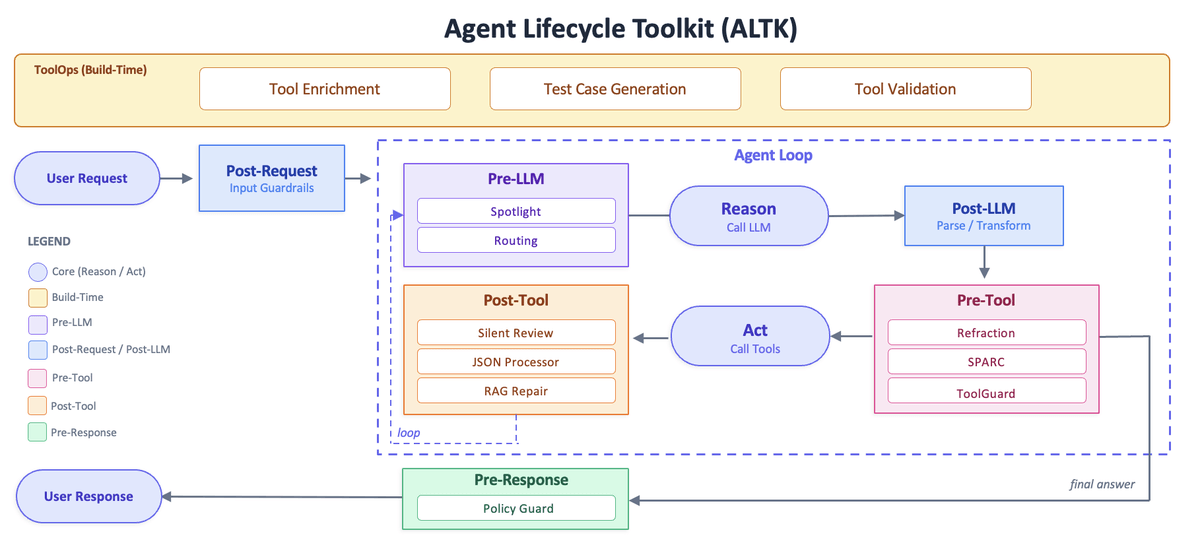
ALTK breaks an agent run into named stages: build-time, post-request, pre-LLM prompt conditioning, post-LLM output processing, pre-tool validation, post-tool result checking, and pre-response assembly. Each stage gets its own components. ALTK currently includes 10 components, each addressing a distinct failure mode in the agent lifecycle, and they are designed to be enabled independently so you can adopt one without re-architecting your stack.

The library ships as altk-boost on PyPI with source on GitHub. Integrating an ALTK component into an agent during runtime has three phases which can be done in three lines of code: 1) defining the input to the component, 2) instantiating and configuring the component, and 3) processing the given input and reviewing the result. The paper focuses on three of the ten components as representative case studies.
SPARC: stopping bad tool calls before they run
SPARC is the pre-tool validator. When the LLM emits a tool call, SPARC intercepts it and runs three layers of checks before execution. Syntactic validation is rule-based and catches non-existent tools, unknown arguments, missing required parameters, type mismatches, and JSON-schema violations. Semantic validation uses one or more LLM judges to assess function-selection appropriateness, parameter grounding, hallucinated values, value-format alignment, and unmet prerequisites. Transformation validation handles format or unit mismatches (for example, date, currency formats) and performs automatic conversions as demanded by the tool specifications.
If a call is rejected, SPARC does not just fail; it hands the agent a structured critique with the issue type, evidence, and a suggested fix, and the loop retries. On the airline slice of τ-bench with GPT-4o, pass@1 moves from 0.470 to 0.485, while pass@4 improves from 0.260 to 0.300. The gains grow with k because SPARC is best at rescuing near-miss trajectories that would otherwise burn a retry on a fixable mistake.
JSON Processor: treat the LLM as a programmer, not a reader
The second component targets a very practical problem: modern APIs return gigantic nested JSON blobs, and dumping them straight into context wrecks accuracy. Passing voluminous, deeply nested JSON directly into the agent's context competes for attention with the task prompt and has been shown to degrade accuracy as responses grow longer. Instead, this component delegates the parsing to a code generation step: the LLM is prompted to write a short Python function that navigates the JSON structure, applies any necessary filtering or aggregation logic, and returns only the extracted answer.
The generated script is executed deterministically and only the extracted value flows downstream. Evaluated on roughly 1,300 JSON responses across 15 models, the JSON processor shows a 16% improvement on average across models versus letting the model read the raw payload.

Silent Error Review: catching the 200 OK that isn't
The third component addresses the most insidious category of tool failure. An API may return responses that seem correct by returning a HTTP status code of 200 OK but the body of the response may contain text like Service under maintenance or No results found. Traditional agents happily accept these as final answers. Silent Error Review takes the user query, the tool response, and optionally the tool spec, and classifies the outcome as ACCOMPLISHED, PARTIALLY ACCOMPLISHED, or NOT ACCOMPLISHED. On the LiveAPIBench SQL subset, adding Silent Error Review to the ReAct loop nearly doubles the micro win rate, indicating more queries are fully or partially accomplished, while the average loop count drops.
Where it fits, and where it does not
ALTK is deliberately not another orchestration framework. It targets three integration profiles:
- Pro-code: import the Python components and wire them into your existing LangChain or LangGraph agent as lifecycle hooks.
- Low-code: use the ToolGuard, JSON Processor, and SPARC nodes inside Langflow's visual authoring canvas.
- No-code: deploy behind the ContextForge MCP Gateway so administrators can intercept outbound tool calls and inbound responses without touching agent source code.
The honest limitation is that ALTK is a collection of inference-time gates, not a training-time fix. Compared to data and model-centric approaches like APIGen, ToolACE, and Granite function-calling models, which improve average tool-calling quality through better training, ALTK provides an inference-time gate to determine whether a specific call should run. If your base model is fundamentally weak at tool use, ALTK will catch more mistakes but it will not fix the underlying reasoning. And every semantic check that involves an LLM judge, like SPARC's second stage, adds latency and token cost per tool call, which is a real tax on high-throughput pipelines.
The interesting broader idea in the paper is that these lifecycle hooks are also useful outside the runtime loop. ALTK can support analytics and evaluation workflows by applying its lifecycle checks to agent trajectories, enabling fine-grained analysis of failure modes and model behavior, and the same signals can feed reward model training. Treating agent middleware as reusable, composable safeguards, rather than one-off try/except blocks, is a shift that most production teams will recognize as overdue.