
IBM and NVIDIA Researchers Show Two Bit Flips Destroy Qwen3-30B Completely
Researchers from Technion, IBM Research, and NVIDIA show that flipping just two bits can reduce ResNet-50 accuracy by 99.8% and collapse a 30B MoE reasoning model.
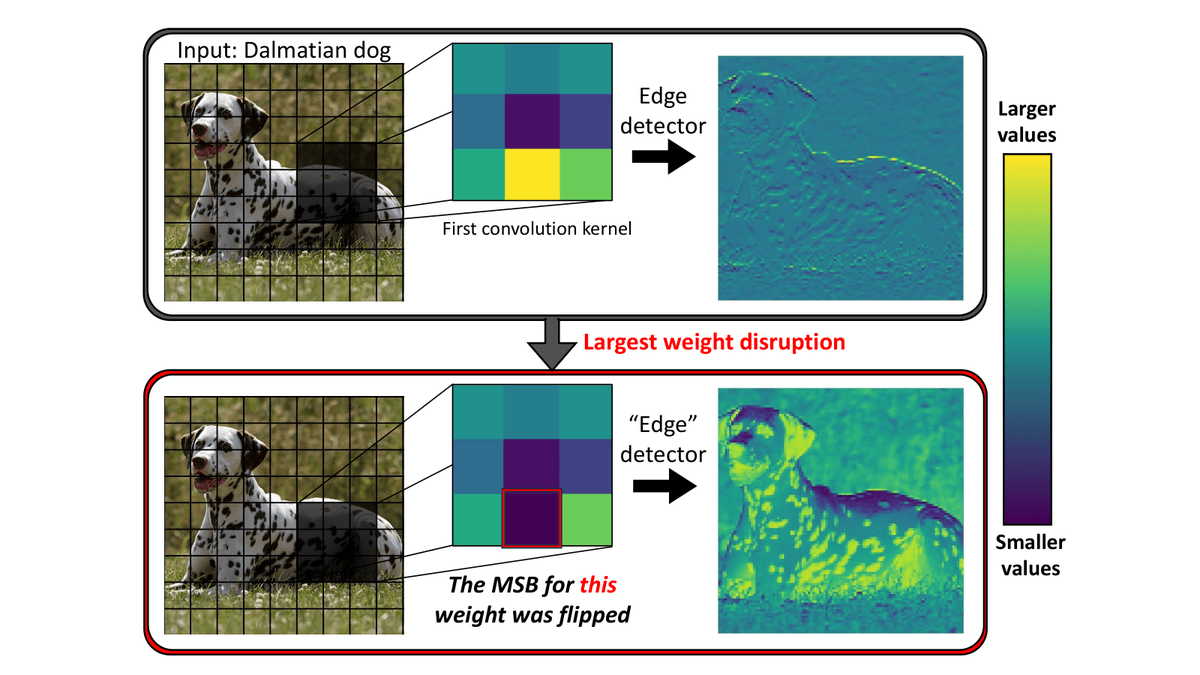
Takeaways
- DNL attack collapses ResNet-50 accuracy by 99.4% with a single sign-bit flip, no data or optimization needed.
- Two sign flips in different experts drop Qwen3-30B-A3B reasoning accuracy from 78% to 0% on MATH-500.
- One or two backbone flips collapse Mask R-CNN and YOLOv8-seg on COCO detection and segmentation.
- Attack is optimization-free and data-agnostic, unlike prior BFA, DeepHammer, and ZeBRA methods.
- Realistic threat vectors include Rowhammer, DMA peripherals, firmware exploits, and rootkits with write access.
- Selectively protecting just 1% of critical parameters nullifies iterative bit-flip attacks in evaluation.
A trio of researchers from Technion, IBM Research, and NVIDIA has published a paper showing that modern neural networks harbor a fragile core: flipping a handful of sign bits in stored weights, chosen without any access to training data or gradients, is enough to reduce state-of-the-art models to gibberish. The attack, called Deep Neural Lesion (DNL), works across image classifiers, detectors, segmentation models, and reasoning LLMs including Mixture-of-Experts architectures.
The headline numbers are hard to ignore. Flipping just two sign bits in ResNet-50 on ImageNet reduces accuracy by 99.8%. One or two sign flips in the backbone collapse COCO detection and mask AP for Mask R-CNN and YOLOv8-seg. Two sign flips into different experts reduce Qwen3-30B-A3B-Thinking from 78% to 0% accuracy on MATH-500. The authors, Ido Galil, Moshe Kimhi, and Ran El-Yaniv, argue that this exposes a systemic vulnerability in how deep networks store learned knowledge.
Why a sign bit is a weapon
Modern frameworks store parameters as IEEE 754 32-bit floats: one sign bit, eight exponent bits, and 23 mantissa bits. Flipping the most significant sign bit instantly switches a parameter from positive to negative, and localizing that bit in memory is straightforward since it is always the MSB. That matters because real hardware attacks like Rowhammer are much better at reliably flipping bits at a fixed offset than at arbitrary positions.
The threat model is deliberately brutal for defenders. The attacker has write access to stored parameters but no samples from the training distribution and cannot evaluate the model on any input. For the 1-Pass variant, they allow a single forward and backward pass on random noise. No training data, no calibration set, no queries. Just the ability to write into weight memory through mechanisms like rootkits, firmware compromises, DMA from untrustworthy peripherals, Rowhammer DRAM disturbance, GPU cache tampering, or voltage glitching.