
HyperExpress Breaks Images Into Reusable Pieces With 54% Accuracy Gain
HyperExpress uses hyperbolic geometry to pull composable object and attribute concepts from a single image, letting them recombine cleanly.
 Pro
Takeaways
- New task CI-ICE targets composable object and attribute concept extraction from a single image using diffusion models.
- HyperExpress learns concepts in hyperbolic space to preserve hierarchy while enabling additive recomposition.
- Three modules: Hyperbolic Contrastive Learning, Hyperbolic Entailment Learning, and Horosphere Projection for composability.
- Top-1 accuracy on UCEBench jumps from 0.325 (ICE) to 0.504, top-3 from 0.518 to 0.736.
- Trades a small drop in per-concept similarity for interpretable, human-readable compositional paths.
- No public code release yet; method builds on ICE's object localization pipeline.
Pulling apart a single image into reusable building blocks, like the object, its color, and its material, is one of those tasks that looks simple on the surface but breaks most existing text-to-image concept extractors. A new paper called Intrinsic Concept Extraction Based on Compositional Interpretability proposes a fresh task formulation and a method, HyperExpress, that borrows tools from hyperbolic geometry to fix the core weakness of prior work: the fact that extracted concepts don't cleanly recombine.
The gap between disentangling and recomposing
Concept extraction from diffusion models has moved fast. Break-A-Scene, ConceptExpress, and AutoConcept can extract concepts from a single image, but they only capture object-level concepts. A more recent method, ICE, went further and pulled out attribute-level concepts like color and material too. But there is a subtler problem underneath all of these approaches.
None of them consider the composability of concepts, which leads to poor interpretability and uncertainty when using these concepts to explain the original image content. In other words, you can extract a token for robot and a token for gold, but adding them back together doesn't reliably reconstruct a golden robot. Stein and colleagues showed that two composable concepts exhibit an approximately orthogonal relationship in the embedding space, and existing UCE methods impose no constraints on that space, so the concepts they learn lack composability.
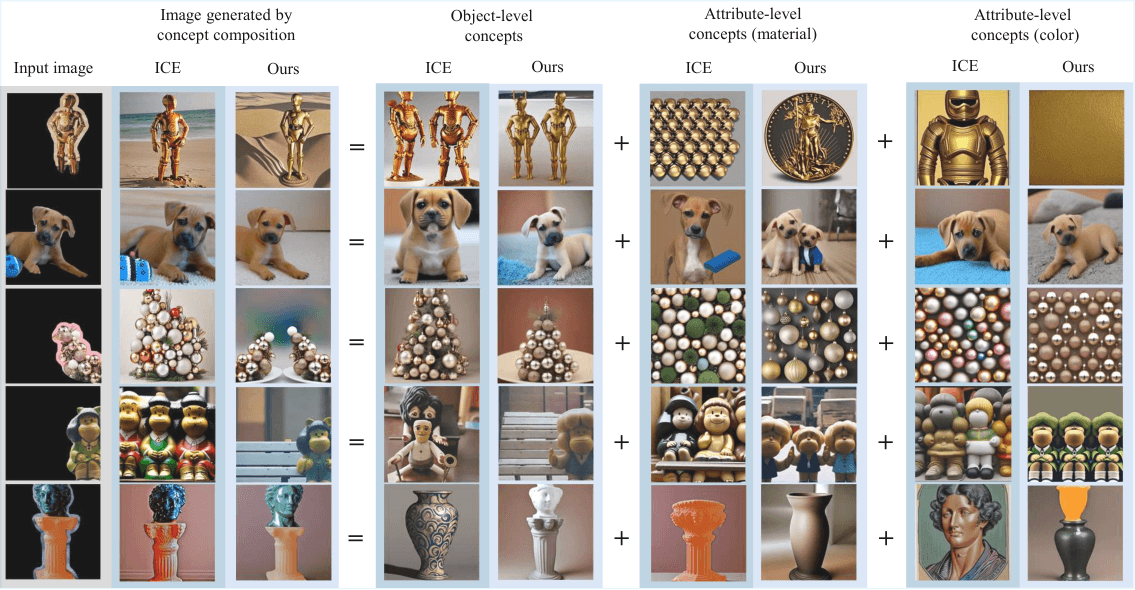
The authors formalize this gap as a new task called Compositional and Interpretable Intrinsic Concept Extraction (CI-ICE): extract both object-level and attribute-level concepts from one image such that combining them reconstructs the original.

Why hyperbolic space, and what it buys you
The core bet of HyperExpress is that concepts live on a hierarchy (an object contains attributes) and hyperbolic space is the natural home for hierarchies. Hyperbolic space is a Riemannian manifold with constant negative curvature, which ensures that embedding positions of concepts with greater differences are farther apart, while concepts with smaller differences are closer. Concretely, the method uses the Poincaré ball for measuring similarity between concepts and the Lorentz model for the calculations where it is simpler.
If that sounds abstract, here is the intuition. Euclidean vector spaces treat all directions symmetrically, so there is no natural way to say attribute is a child of object. Hyperbolic space bends outward exponentially, giving you room to place a parent concept near the center and its children farther out along specific directions, without distortion.
How HyperExpress works
The method has two stages, concept learning and concept-wise optimization, held together by three modules:
- Hyperbolic Contrastive Learning (HCL). Uses a hyperbolic triplet loss to push object-level concepts and attribute-level concepts into different regions of the Poincaré ball. Text embeddings from CLIP are mapped into the ball through an exponential map with a learned weight matrix.
- Hyperbolic Entailment Learning (HEL). Enforces the parent-child relationship using entailment cones in the Lorentz model. If the object-level concept and attribute-level concepts satisfy the entailment condition, the entailment loss is zero; otherwise the corresponding entailment loss is calculated. Visually, each object gets a cone, and its attributes must live inside that cone.
- Horosphere Projection (HP). This is the part that makes concepts composable. It projects concept embeddings onto a submanifold with zero intrinsic curvature. The learned submanifold inherits Euclidean properties from the zero-curvature horosphere, allowing native operations like vector addition. The projection is proven to be an isometry, meaning it preserves distances and therefore does not destroy the hierarchical structure learned earlier.

The full training objective combines the standard diffusion reconstruction loss with the triplet loss, an entailment loss, and a Wasserstein attention loss that aligns the T2I model's attention with object masks.
Results: a real accuracy jump, a small similarity trade-off
On the UCEBench from ConceptExpress, HyperExpress substantially improves how well concepts are actually disentangled while giving up a bit on raw similarity to the source image:
| Method | SIM-I | SIM-C | ACC-1 | ACC-3 |
|---|---|---|---|---|
| Break-A-Scene | 0.627 | 0.773 | 0.174 | 0.282 |
| ConceptExpress | 0.689 | 0.784 | 0.263 | 0.385 |
| AutoConcept | 0.690 | 0.770 | 0.350 | 0.520 |
| ICE | 0.738 | 0.822 | 0.325 | 0.518 |
| HyperExpress | 0.699 | 0.786 | 0.504 | 0.736 |
Top-1 concept accuracy jumps from 0.325 to 0.504 versus ICE, and top-3 from 0.518 to 0.736. On the ICBench, HyperExpress also beats ICE across object, material, and color similarity metrics.
The authors are honest about the trade-off. Although HyperExpress loses some performance, it gains easily interpretable concept composition paths and a composable concept space. Qualitatively, the paper shows that HyperExpress can pull robot, metal, and gold out of one image and recombine them into a golden robot made of metal, whereas ICE's compositional paths are harder to interpret.
What this is actually good for
If your work touches personalization, controllable generation, or model interpretability, this is worth paying attention to. Useful directions include:
- Personalization pipelines where you want to reuse a single reference object with new attributes, like recoloring a specific product or swapping its material.
- Interpretability research that needs to explain what a diffusion model has learned in terms of composable, human-readable tokens rather than opaque embeddings.
- Data augmentation or synthetic asset generation where combining extracted primitives beats retraining a bespoke model for every variant.
The main limitations are also clear from the numbers. Per-concept reconstruction fidelity (SIM-I, SIM-C) is a hair behind ICE, so if you only need a faithful single-concept recall and don't care about recombination, older methods may still be a better fit. Training also relies on ICE's first stage for object localization, which anchors the method to the quality of that pipeline. And as of publication the authors do not appear to have released code or weights on GitHub, so reproducing HyperExpress means implementing the hyperbolic contrastive, entailment, and horosphere projection modules from the paper.
The underlying idea worth stealing
The bigger takeaway is not the specific benchmark win. It is that disentanglement and composability are separate problems, and geometry can enforce both at once. By moving concept learning into hyperbolic space and adding an isometric projection onto a Euclidean-like submanifold, the authors get hierarchy from the curvature and additivity from the projection, without one destroying the other. That recipe should transfer well beyond image concept extraction, to any setting where you want a learned representation that both respects a tree of relationships and supports clean recombination.