
Hunan University's STEPH Merges Cancer AI Models to Boost Survival Predictions by 5%
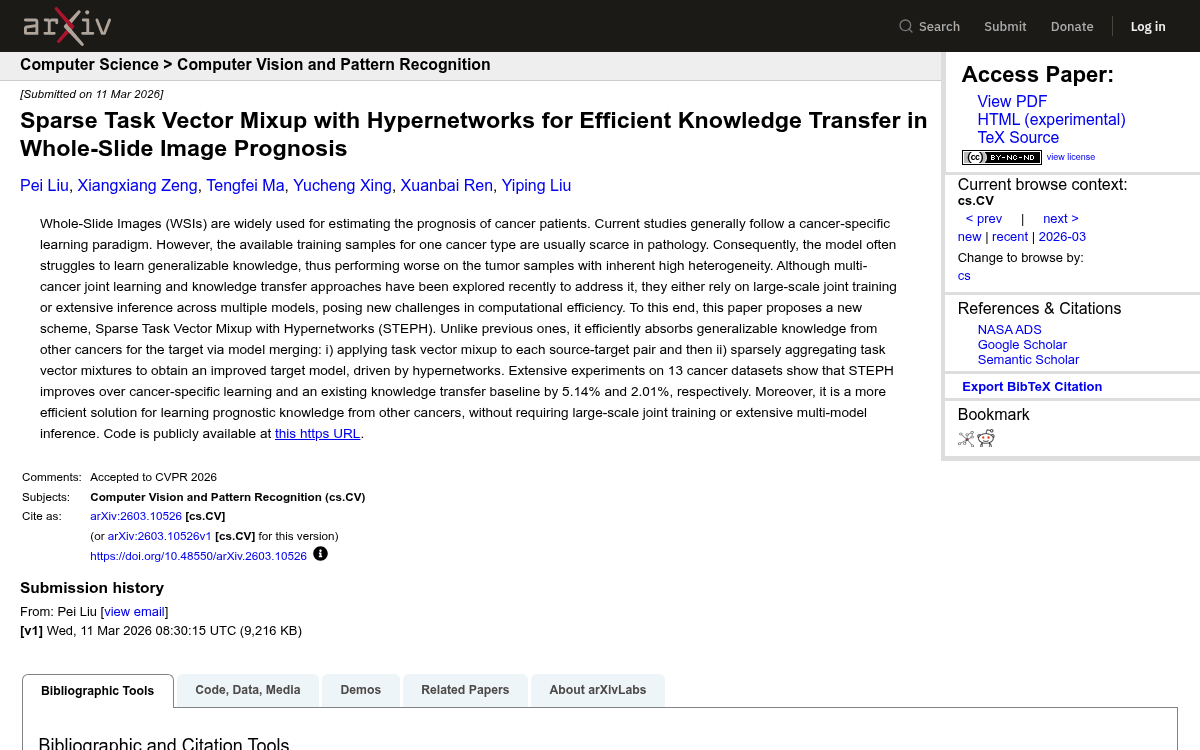
A model merging scheme uses hypernetworks and task vector mixup to transfer prognostic knowledge across cancers, beating cancer-specific training by 5.14% on 13 datasets.
 Pro
Takeaways
- STEPH merges cancer-specific prognosis models via task vector mixup driven by hypernetworks, avoiding joint retraining or multi-model inference.
- Beats cancer-specific training by 5.14% average C-Index across 13 TCGA cancer datasets, winning on 12 of 13.
- Outperforms representation-based transfer baseline ROUPKT by 2.01% with significantly lower inference cost.
- Two MIL-based hypernetworks output per-slide mixing coefficients and sparse aggregation weights over source-target task vector pairs.
- Improvement traces mainly to the attention layer of the MIL encoder, not the instance embedding layer.
- Code, checkpoints, and logs released at github.com/liupei101/STEPH.
Predicting how long a cancer patient will survive from a gigapixel pathology slide is one of the harder problems in medical AI. Each hospital has maybe a thousand slides per cancer type, tumors are wildly heterogeneous, and models trained on such small pools tend to memorize rather than generalize. A new paper from Hunan University and NUS proposes STEPH (Sparse Task Vector Mixup with Hypernetworks), which borrows generalizable knowledge from models trained on other cancers by merging their weights, rather than by retraining on a giant multi-cancer dataset or running an ensemble at inference time.
Why cancer-specific models keep hitting a ceiling
Whole-Slide Images (WSIs) are widely used for estimating the prognosis of cancer patients, but the available training samples for one cancer type are usually scarce in pathology. A single WSI can reach 20,000 by 20,000 pixels, so datasets tend to be small in patient count even when they are enormous in bytes. WSI samples are often scarce for one cancer type (around 1,000) in the real world, which forces the model to learn heterogeneous tumor patterns from a very thin data slice.
Two workarounds already exist, and both have real costs:
- Multi-cancer joint learning: pool slides from many cancer types and train one big model. This approach is rooted in large-scale multi-cancer data, and due to the gigapixel size of WSIs, it incurs extremely expensive computational costs and raises potential concerns about data privacy.
- Representation-based transfer (ROUPKT): keep several off-the-shelf cancer-specific models and route each slide through all of them at test time. It has to explicitly pass each sample through multiple transferred models at test-time, causing the computational overhead to increase linearly with the number of transferred models.

Merging models instead of ensembling them
STEPH takes a different route inspired by task arithmetic. For each cancer, the team defines a task vector as the fine-tuned weights minus the initial weights: τ_t = M_t - M_0. That vector encodes what the model learned about that specific cancer. From an optimization view, task vectors represent cumulative gradients for a task and delineate an overall direction for a model to perform well on it. The core idea is to blend the target cancer's task vector with each source cancer's task vector, then merge the useful blends into a single improved target model.
The pipeline has three steps:
- Task vector computation. Compute
τ_tandτ_{s_i}for the target cancer and every source cancer. - Task vector mixup (TVM). For each source-target pair, interpolate the two vectors:
τ_mix = λτ_t + (1-λ)τ_s. The mixing coefficientλis not a fixed hyperparameter. A small MIL-based hypernetwork reads the slide's patch features and outputs a per-inputλfor each pair. It is called a hypernetwork because it is a network that learns how to adjust the weights of another network by steering task vectors. - Sparse aggregation. A second hypernetwork produces weights
w_ifor each mixed vector, and only the top-K mixtures are summed into a final task vectorτ_t*. The merged model is thenM_t* = M_0 + τ_t*. Sparsity is critical because the mixture is not always beneficial for the target, and it could contain redundant knowledge, especially when the prognosis of two cancer diseases is highly correlated.

Training uses a survival negative log-likelihood loss plus two regularizers: one penalizes large λ values (to encourage actually pulling in cross-cancer knowledge rather than defaulting to the target-only vector), and one suppresses runaway aggregation weights, a trick borrowed from Mixture of Experts training.
The numbers on 13 TCGA cancers
The authors evaluated STEPH on 13 cancer datasets from TCGA covering 8,818 diagnostic WSIs from 7,268 patients, with patches processed through the UNI foundation model. Datasets range from about 250 patients (SARC) to over 1,000 (BRCA), and the metric is the concordance index (C-Index) under 5-fold cross-validation.
Headline results across the 13 datasets:
- STEPH outperforms cancer-specific learning by 5.14% on average and obtains better performance on 12 out of 13 datasets.
- STEPH surpasses the representation-based knowledge transfer baseline on 9 out of 13 datasets, with an overall improvement of 2.01%, and has significantly lower inference costs.
- Generic model-merging methods designed for multi-task learning (AdaMerging, TIES, Surgery, Iso-C) underperform, because existing approaches generally consider developing multi-task capabilities by resolving task interference, while STEPH aims to boost the model performance on a single task by utilizing the most beneficial, generalizable knowledge from others.
An interesting side finding: the improvement seems to live mostly in the attention layer of the MIL encoder. The TVM of the attention layer often keeps a close alignment with the target task vector, while that of the instance embedding layer does not, suggesting that the improvements in generalization ability may be attributed more to the attention layer in MIL.
What is useful and what still hurts
The practical appeal is efficiency. STEPH runs at test time as a single merged model, not an ensemble, so inference cost stays close to a vanilla ABMIL network. Training only optimizes two lightweight hypernetworks on top of already-trained cancer-specific models, so you do not need to pool raw slides across institutions, which sidesteps some privacy concerns around WSI sharing.
A few honest limitations remain:
- The datasets rely on TCGA, and the number of patients is still very limited for certain types such as cervical and liver cancer with fewer than 400 cases, which makes evaluation on small cohorts noisy.
- Experiments use a general attention-based MIL backbone. More recent architectures like Patch-GCN or TransMIL are not yet plugged in, though the authors show STEPH already beats them on their default setup.
- STEPH still requires access to training data to obtain suitable merging weights, and training-free strategies would be exciting future work.
Code, checkpoints, and training logs are on the STEPH GitHub repo, along with the data splits derived from the earlier ROUPKT work. For teams building prognostic models on rare cancers, this is a cheap thing to try before reaching for a full pan-cancer retraining run.