
Hunan University's O3N Lets Robots See Every Direction Without Retraining
O3N is the first framework to predict 3D occupancy and unseen semantic categories from a single 360-degree RGB image.
 Pro
Takeaways
- O3N predicts 3D occupancy for unseen categories from a single 360-degree RGB image, a first in the field.
- Polar-spiral Mamba scans cylindrical voxels outward from the camera, matching panoramic geometry with linear complexity.
- Occupancy Cost Aggregation builds a voxel-text similarity volume refined with atrous pooling and class-mixing attention.
- Natural Modality Alignment pulls text embeddings toward EMA-computed pixel prototypes without gradient updates.
- Reaches 16.54 mIoU and 21.16 novel mIoU on QuadOcc, beating the OVO baseline by 2.21 and 3.01 points.
- Code will be released at github.com/MengfeiD/O3N; runs at 9.41 FPS with 5 GB memory.
Building robots that can safely wander around a campus or a home requires them to understand the full 3D geometry of their surroundings, not just the slice of the world in front of a forward-facing camera. A new paper from Hunan University and Ant Group tackles this head-on with O3N, a system that takes a single 360-degree panoramic image and predicts what fills every voxel around the robot, even for object categories it was never trained to recognize.
O3N is the first framework for open-vocabulary occupancy prediction from a single omnidirectional RGB image. The authors combine three ideas: a Mamba-based spatial encoder tuned for panoramic geometry, a cost-aggregation trick borrowed from 2D open-vocabulary segmentation, and a gradient-free alignment step that keeps text embeddings and voxel features in the same neighborhood.
Why panoramic occupancy is hard
3D occupancy prediction turns pixels into a voxel grid where each cell carries a semantic label like road, vegetation, or vehicle. Existing systems have two big limitations that make them awkward for embodied agents. They are constrained by limited perspective inputs and a predefined training distribution, making them difficult to apply to embodied agents that require comprehensive and safe perception of scenes in open-world exploration.
Panoramic input helps with the first problem but creates a new one. Equirectangular projection stretches pixels near the poles, and objects farther from the camera occupy fewer pixels because of perspective. Many distant voxel centers are projected onto compact image regions, resulting in imbalanced pixel-to-voxel correspondences and limited visual evidence for fine-grained semantic discrimination. That imbalance is poison for the pixel-voxel-text alignment strategies that make open-vocabulary prediction work in the first place.

The three ingredients
The architecture, described in the paper, extracts image features and text embeddings with a language-image encoder, lifts the features into both cubic and cylindrical voxel grids, then decodes them into an occupancy volume. Three modules do the heavy lifting:
- Polar-spiral Mamba (PsM): A dual-branch encoder that scans cylindrical voxels in an outward spiral starting from the camera. Cylindrical grids naturally align with the horizontal axis of an equirectangular image, and the spiral scan matches how detail falls off with distance. P-SMamba then scans the polar space in a spiral pattern, starting from the pole and progressively increasing the radius. The Mamba backbone keeps this linear in sequence length instead of quadratic like a transformer.
- Occupancy Cost Aggregation (OCA): Instead of forcing each voxel embedding to snap directly to a text embedding, OCA builds a cosine-similarity cost volume between voxels and class names, then refines it with atrous spatial pooling and a linear transformer that mixes information across classes. Supervision uses a scene-class affinity loss over precision, recall, and specificity rather than plain cross-entropy.
- Natural Modality Alignment (NMA): A gradient-free step that iteratively pulls text embeddings toward semantic prototypes computed by an exponential moving average over pixel features from the base classes. The whole walk process can be presented in closed form based on the Neumann Series when k approaches infinity, so the update reduces to a matrix inverse rather than an unrolled loop.

The training objective sums three losses: the standard MonoScene occupancy loss, a voxel-pixel distillation loss borrowed from OVO, and the new OCA loss. At inference, base classes go through the occupancy head directly, and novel classes are scored by combining voxel-text similarity with the OCA probabilities.
What the numbers show
The authors evaluate on two panoramic occupancy datasets introduced by the earlier OneOcc paper. QuadOcc is a real-world first-person 360-degree occupancy dataset on a quadruped robot within a campus environment. It contains 7 scenes for training, 3 scenes for validation/test, totaling 24K frames with standardized day/dusk/night coverage. Human360Occ is a CARLA-simulated dataset with a human-ego walking gait across 16 maps and multiple weather conditions.
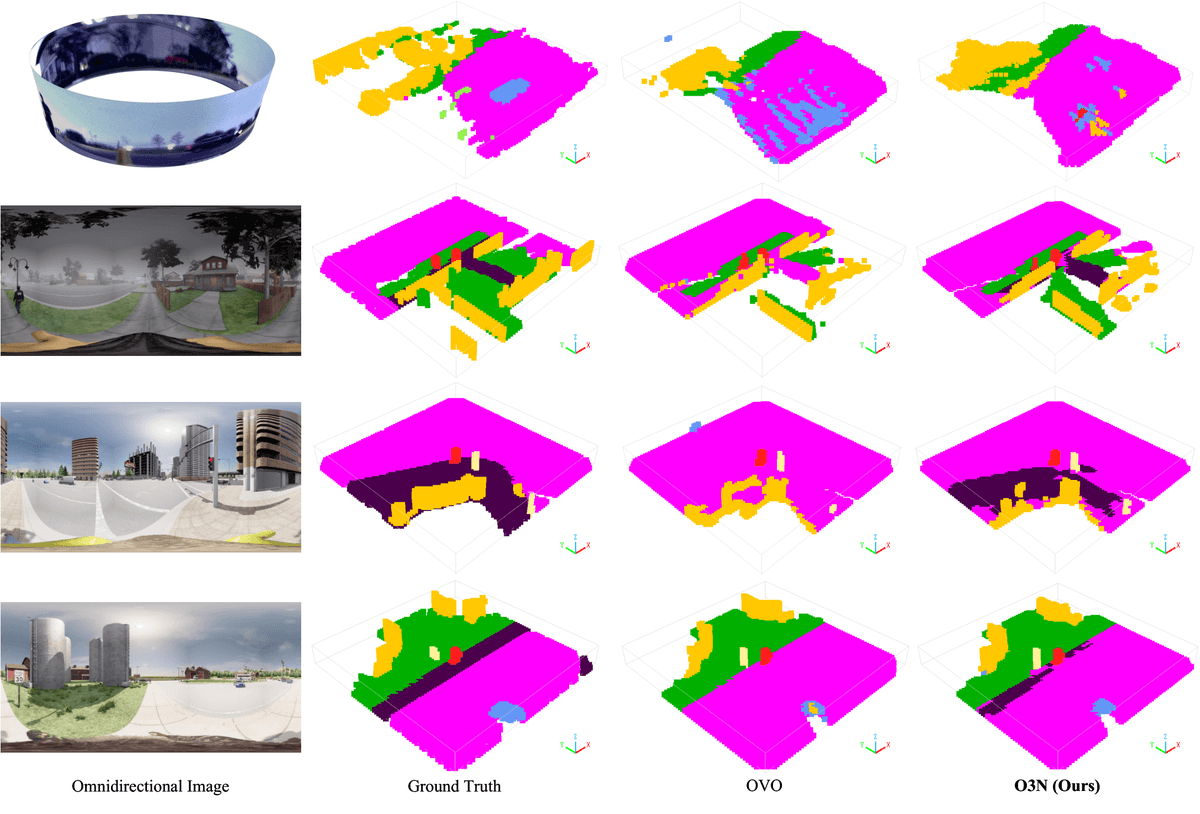
Categories are split into base and novel. On QuadOcc, vehicle, road, and building are designated as novel classes, together accounting for approximately 68% of the annotated non-empty voxels, meaning the model has to hallucinate labels for the majority of the interesting scene content from text alone.
| Method | Input | mIoU | Novel mIoU | Base mIoU |
|---|---|---|---|---|
| OVO (baseline) | Camera | 14.33 | 18.15 | 10.52 |
| O3N (this work) | Camera | 16.54 | 21.16 | 11.92 |
| MonoScene (fully supervised) | Camera | 19.19 | 25.56 | 12.82 |
| OneOcc (fully supervised) | Camera | 20.56 | 27.53 | 13.59 |
The +3.01 point jump on novel classes matters more than the overall number because it is the metric that measures whether open-vocabulary generalization is actually working. Ablations back up each module: PsM alone adds 0.34 mIoU, OCA on top adds another 0.58, and NMA closes the gap with a final 1.14 point boost. The full model runs at 9.41 FPS with about 5 GB of memory during inference on the QuadOcc setup.
Where it breaks
O3N inherits two structural weaknesses. First, it uses the FLoSP 2D-to-3D projection from MonoScene, which is depth-agnostic. The FLoSP method is insensitive to overall spatial depth, so in the first case, nearly all methods using FLoSP exhibit misalignment in spatial range perception. Failure cases include confusing pole with sidewalk in dim light and getting fooled by rain reflections at dusk. Second, the vision-language backbone was trained on pinhole images, so the extracted features carry a domain gap when applied to equirectangular panoramas.
On the very rare novel classes, results also collapse. In H3O the truck, bus, and two-wheeler categories each represent under 1% of voxels, and O3N scores 0.00 mIoU on all three despite doing well on the more common road and sidewalk classes. Open-vocabulary generalization here still needs enough related pixels in training to anchor the semantic prototype.
Why this matters for embodied systems
The interesting shift is not just about panoramic input, it is about combining full-surround geometry with a semantic vocabulary that can be extended at test time by editing a text prompt. A delivery robot that can be told to also look for a stroller or a scooter, without retraining, is closer to actually being useful in a real neighborhood. The FoV robustness experiments show that O3N was trained once at 360 degrees and works reasonably down to narrower forward-only crops, so the same weights could deploy on pinhole, fisheye, or full panoramic hardware.
The source code is slated for public release. Anyone building on top of MonoScene or SGN backbones should be able to plug in the PsM, OCA, and NMA modules with minimal surgery, since the authors report gains on both backbones without touching their original hyperparameters.