
Hunan University's MedEyes Beats GPT-4o on Medical Image Diagnosis by 8.5%
A new reinforcement learning framework teaches vision-language models to scan and drill through medical images like human radiologists, gaining 8.5 points on VQA benchmarks.
 Pro
Takeaways
- MedEyes is a hybrid RL framework that teaches medical VLMs to scan and drill through images like radiologists.
- Average gain of 8.5 percentage points across five medical VQA benchmarks, reaching 65.9 average accuracy.
- Gaze-guided Reasoning Navigator switches between global scanning and focused drilling based on confidence deltas.
- Dual-stream GRPO decouples on-policy and off-policy advantage normalization to prevent expert trajectories from dominating gradients.
- Built on Qwen2.5-VL-3B with MedPLIB as visual expert, trained on six RTX 3090 GPUs.
- Code released at github.com/zhcz328/MedEyes; paper on arXiv.
Medical vision-language models keep hitting the same wall: they write confident-sounding diagnostic paragraphs that are subtly wrong. A team from Hunan University wants to fix that by teaching the model to actually look at the image the way a radiologist does, one region at a time. Their framework, called MedEyes, uses reinforcement learning with off-policy expert trajectories to model progressive visual focus, and it reports an average gain of 8.5 percentage points across five medical VQA benchmarks.
Why on-policy reasoning breaks in the clinic
The current recipe for reasoning VLMs is reinforcement learning with verifiable rewards (RLVR), the same idea behind DeepSeek-R1 style training. It works well when the reasoning chain can be checked against a ground-truth answer. But purely on-policy learning tends to reinforce superficially coherent but clinically inaccurate reasoning paths, because the model only ever learns from its own rollouts.
The authors describe two specific failure modes. Supervised fine-tuning overfits to memorized chains and produces vague answers. On-policy RL suffers from what they call advantage collapse: plausible but substantively incorrect paths that lead to erroneous conclusions. Weak base models get stuck in repetitive low-quality loops the authors label cognitive traps.

Scanning and drilling, borrowed from eye-tracking studies
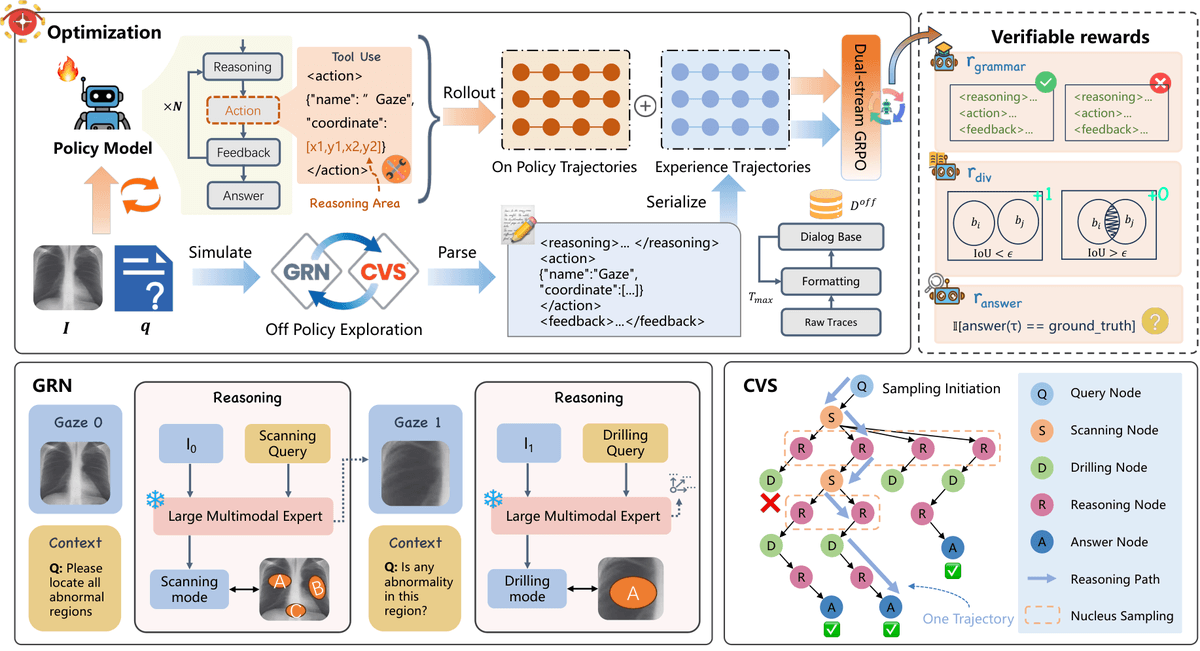
MedEyes is built around two observations from radiologist eye-tracking research: experts first scan the whole image for candidate abnormalities, then drill into specific regions for closer analysis. The framework encodes this as a two-mode exploration loop inside a Gaze-guided Reasoning Navigator (GRN).
- Scanning mode prompts a visual expert model with something like locate all abnormal regions, producing a set of candidate bounding boxes with confidence scores.
- Drilling mode zooms into one candidate region and asks for a targeted pathological analysis, refining the confidence estimate.
- Mode switching is driven by the relative change in confidence between steps. If drilling keeps sharpening the finding, it continues; otherwise the model returns to scanning for broader coverage.
The visual expert supplying region proposals and segmentation masks is MedPLIB, a biomedical multimodal LLM with pixel-level grounding. Each reasoning cycle is serialized into tagged blocks such as <reasoning>, <action> with a Gaze coordinate, and <feedback> containing the cropped image region.
Diverse but credible expert trajectories
To keep the expert trajectories from being a single deterministic script, a Confidence Value Sampler (CVS) applies nucleus sampling over GRN's top region candidates, generating multiple variable-length paths per case. Each trajectory terminates when local confidence exceeds a threshold or a maximum of a few steps is reached. In the final configuration the team uses six expert trajectories per prompt with a step budget of three, which the ablations show is the sweet spot before longer chains start accumulating errors.
Dual-stream GRPO to avoid one signal drowning out the other
The most technically interesting piece is how these expert trajectories are blended into training. Standard GRPO normalizes advantages across all rollouts in a group. If you drop high-reward expert trajectories into that pool, they dominate the gradient and the model just imitates them, losing the ability to explore.
MedEyes uses a dual-stream GRPO that computes advantages separately for on-policy rollouts and off-policy expert trajectories, each normalized against its own mean and standard deviation. Importance ratios are also computed source-adaptively. The authors argue this prevents both reward assimilation and entropy collapse, keeping exploration alive while still transferring expert behavior. The reward itself is a weighted mix of accuracy (0.7), grammar for the tagged reasoning format (0.2), and a diversity term (0.1) that rewards exploring multiple non-overlapping regions.
Numbers on five medical VQA benchmarks
Built on top of Qwen2.5-VL-3B and trained on six RTX 3090s, MedEyes was evaluated on VQA-RAD, SLAKE, PathVQA, PMC-VQA, and the Health and Medicine subset of MMMU. The average accuracy of 65.9 beats every baseline in the paper, including GPT-4o, InternVL-2, LLaVA-Med, and the RL-tuned Med-R1 and MedVLM-R1. It surpasses the best medical-specific model GMAI-VL by 8.5 percent and the strongest reinforcement learning method MedVLM-R1 by 13.4 percent.

Ablations back up the design choices. Removing GRN drops performance by 8.7 percent, and single-mode variants underperform: scanning-only fails on fine-grained tasks while drilling-only lacks systematic exploration. CVS removal costs 5.5 percent. Removing off-policy learning entirely costs 10.5 percent, which is the strongest evidence that expert trajectories act as the cognitive anchor the authors claim.
Where it still fails
The failure case analysis is refreshingly honest. MedEyes struggles with quantitative measurement, for example sizing a tumor, because it substitutes anatomical proportion estimates for real pixel-to-centimeter calibration. It also confuses fine-grained pathological subtypes with shared morphology, such as aneurysmal changes versus dissecting aneurysms. Both point to the same limitation: the framework can direct attention very well, but it inherits whatever domain knowledge the underlying VLM and visual expert already have.
Getting the code
The implementation is open source at github.com/zhcz328/MedEyes. The training recipe is modest for a modern RL setup: AdamW at a learning rate of 1e-6, three epochs on six NVIDIA GeForce RTX 3090 GPUs, 80 iterations with a rollout batch size of 98 and 8 rollouts per prompt. If you are working on medical VQA or any domain where progressive visual grounding matters more than long text chains, MedEyes is a concrete blueprint for wiring off-policy experts into GRPO without letting them take over.