
HumanGS Builds Animatable 3D Human Avatars 12,500x Faster at 60 FPS
HumanGS turns sparse multi-view photos into an animatable 3D human in under a second, rendering novel poses at 60+ FPS without further network calls.
 Pro
Takeaways
- HumanGS predicts canonical 3D Gaussians attached to SMPL-X vertices from sparse multi-view images in one forward pass. Paper
- Animation uses linear blend skinning with no further network inference, enabling rendering at over 60 FPS.
- Modeling takes ~0.96s vs ~12,000s for Animatable Gaussians; per-frame synthesis is 0.037s vs 0.287s for HumanRAM.
- Each vertex gets 5 Gaussians: 1 tight anchor plus 4 free ones that model clothing and hair off the body surface.
- Matches state-of-the-art quality on THuman 2.1, THuman 4.0, and AvatarReX, and stays robust in 1- to 2-view settings.
- Code and pre-trained weights are open source at github.com/Devdoot57/HumanGS.
Building an animatable 3D human avatar has historically forced a trade-off: either optimize a bespoke model per person for hours, or run a neural network for every single frame you want to render. A new method called HumanGS, from researchers at IIIT Hyderabad and IISER Thiruvananthapuram, sidesteps both. It takes a handful of RGB images plus SMPL-X body pose parameters, and in roughly one second predicts an explicit 3D Gaussian avatar that can then be re-posed and rendered at real-time speeds without touching the neural network again.
The paper reports that this approach matches state-of-the-art reconstruction quality while running roughly 8x faster per frame than the previous best feed-forward method, HumanRAM, and about 12,500x faster than the leading optimization-based approach, Animatable Gaussians. Code and pre-trained models are on GitHub.
Why animatable avatars have been slow
Optimization-based approaches such as Animatable Gaussians achieve high-quality animatable reconstructions using 3DGS but require costly per-subject test-time fitting, which limits scalability. Feed-forward methods like GHG and GPS-Gaussian skip that per-person step, though they rely on convolutional architectures that restrict them to a fixed number of input views and assume a fixed human pose across the inputs, which is unrealistic for casual capture.
The current transformer-based champion, HumanRAM, handles varying poses and viewpoints well, but formulates animation as per-frame image generation, requiring a full network forward pass for each target pose and camera viewpoint. Every new frame is a fresh inference call, which piles up compute and rules out interactive use.
Predicting Gaussians on a T-pose skeleton
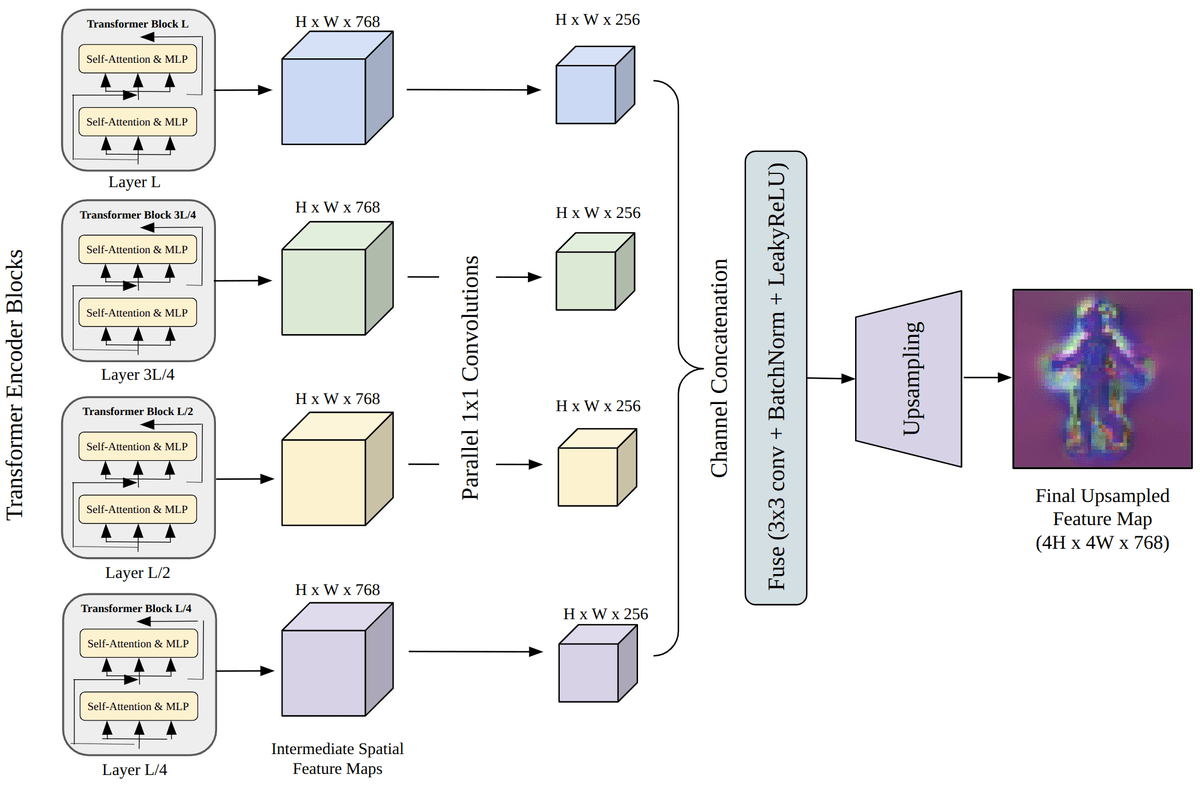
HumanGS attacks the problem by separating the expensive part (understanding the person) from the cheap part (posing and rendering them). Given sparse multi-view images and their SMPL-X parameters, a transformer-based Large Reconstruction Model predicts a set of 3D Gaussian primitives attached to each vertex of the SMPL-X body mesh in a canonical T-pose. SMPL-X is the standard parametric body model with 10,475 vertices covering the body, hands, and face; a T-pose is the neutral, arms-out zero configuration.