
Huawei's ST-VLA Fixes Robot Arm Failures With 3D Spatial Guidance
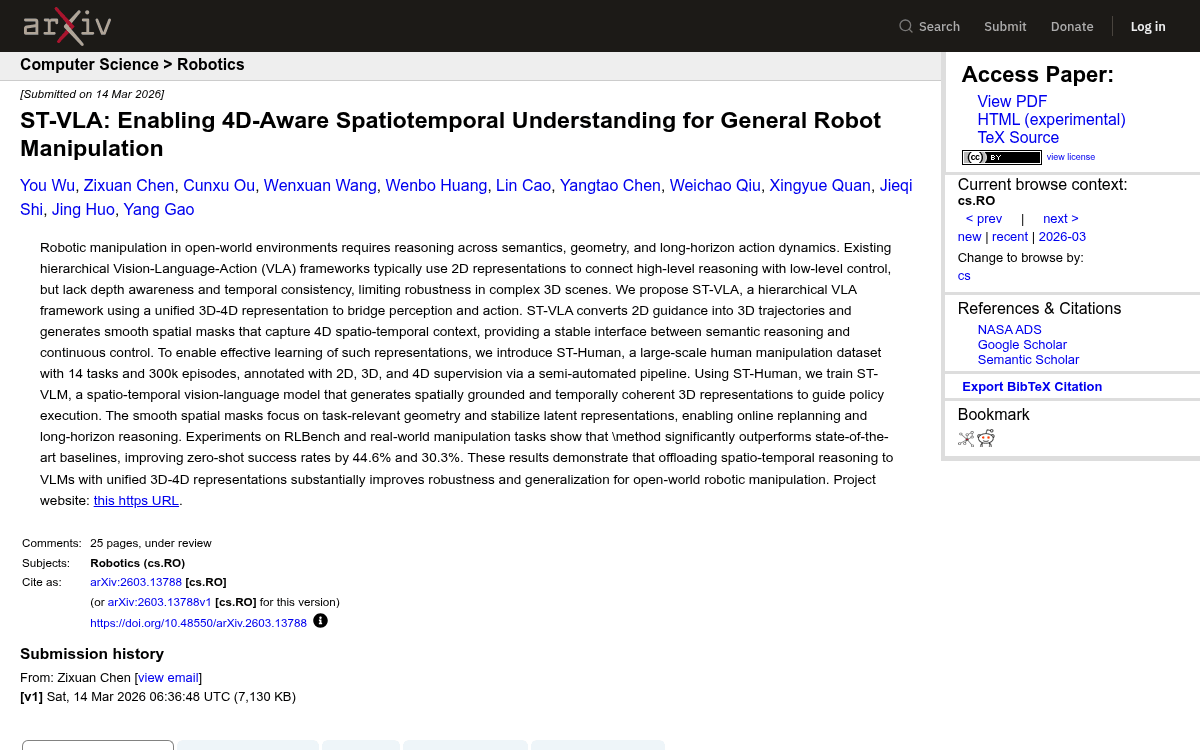
Researchers at Nanjing University propose ST-VLA, a robotic manipulation framework that swaps flat 2D guidance for 3D trajectories and time-aware masks.
 Pro
Takeaways
- Nanjing University researchers propose ST-VLA, a hierarchical VLA framework using unified 3D-4D representations.
- Replaces lossy 2D waypoints with explicit 3D trajectories and smooth spatial masks for stable long-horizon manipulation.
- Introduces ST-Human dataset: 300k episodes across 14 tasks with 2D, 3D, and 4D supervision.
- ST-VLM built on a fine-tuned 4B Qwen3-VL; outperforms GPT-5.2 and Gemini-3-flash on spatial tasks.
- Improves RLBench zero-shot success by 44.6% and real-world Franka manipulation by 30.3%.
- Code and dataset marked as coming soon on the project website.
A team from Nanjing University, Southeast University, and Huawei's Noah's Ark Lab has released ST-VLA, a hierarchical vision-language-action framework that targets a persistent weakness in robot manipulation systems: the middle layer between a language model that understands what to do and a low-level policy that actually moves the arm. The paper argues that the 2D waypoints and bounding boxes most systems use to connect these two layers discard exactly the information a robot needs, and it proposes a unified 3D-and-time representation instead.
The setup is familiar to anyone who has looked at recent hierarchical VLAs. A high-level vision-language model handles semantic reasoning while a low-level policy executes continuous control, an arrangement meant to improve generalization across manipulation tasks. The catch is that the VLMs at the top of the stack are trained on 2D images and visual question answering, so their spatial outputs often fail to align with the continuous 3D space the robot has to operate in, causing deviations, instability, and failed tasks.

Where flat guidance breaks down
Previous work patched around this with 2D waypoints, bounding boxes, or segmentation masks as intermediate signals. The authors point out that these planar representations cannot capture depth and geometric constraints, and frame-wise signals ignore temporal continuity. The consequences are action jitter, ambiguity when a single 2D path could correspond to several 3D trajectories, and brittleness in long-horizon tasks where the robot needs to remember what it just did.
ST-VLA's fix has two moving parts:
- 3D trajectories instead of 2D paths. The high-level model predicts a 2D path, then lifts it to 3D by anchoring to a starting depth from the RGB-D input and predicting relative depth offsets along the waypoints.
- Smooth spatial masks. Rather than hard-cropping around the target object, the system inpaints task-irrelevant regions with a smoothing operator that preserves local RGB and depth continuity. Discrete cropping, the authors argue, introduces discontinuities in the latent manifold that produce jittery outputs and hallucinations.
Guidance refreshes every H timesteps, which is how the framework handles long-horizon planning and disturbance recovery without paying full VLM inference cost at every step.
The dataset doing the heavy lifting
To teach a VLM to actually produce these 3D-4D signals, the team built ST-Human, a human manipulation dataset with roughly 60k videos covering 300k episodes across 14 single-arm tabletop manipulation categories, captured with a fixed RGB-D sensor. Tasks range from pouring water and wiping surfaces to stacking cups, cutting Play-Doh, and swapping the spatial positions of two objects. Annotations flow through a semi-automated pipeline that generates supervision for three groups of tasks: 2D grounding and tracking, 3D geometric relations, and 4D reasoning about action progress over time.

The high-level model, ST-VLM, is a fine-tuned 4B-parameter Qwen3-VL trained on ST-Human alongside RoboPoint, FSD, and SAT. For the low-level policies, the authors plug in two existing 3D-aware backbones: 3D Diffuser Actor, which uses DDPM-style denoising, and 3D FlowMatch Actor, which uses rectified flow with only 5 denoising steps.
What the numbers show
On the VLM benchmarks, the 4B ST-VLM outperforms both open-source competitors and larger closed models on most tasks. The gap is largest where geometry matters: 46.67% accuracy in depth estimation versus 9.33% for the best baseline, and 92.00% on long-horizon planning against 88.00%. On ST-Human-Spatial it hits 98% against Gemini-3-flash's 84%. The one soft spot is CRPE, which focuses on fine-grained geometric ordering rather than action-oriented spatial reasoning.
The full ST-VLA results on RLBench are the headline claim. Averaged across the Close Jar, Light Bulb In, and Put Groceries tasks in the multi-task setting, the fine-tuned version reaches 69.5% on seen variations and 69.7% on unseen ones with a 3DFA backbone, versus 62.6% and 16.7% for the baseline. On a long-horizon push-button task, the policy trained only on single-button presses reaches a 93.3% success rate on sequential 2-3 button pressing when guided by ST-VLA.
Real-world tests on a Franka Emika Panda show average success rate improvements of 30.3% in zero-shot generalization and 40.8% in distractor robustness over baseline 3D policies, and over 70% success on triple-placement sequences despite training only on short-horizon demonstrations.
Retrofitting existing policies
The most useful property for practitioners may be the frozen-policy variant. In that configuration, an off-the-shelf imitation learning policy trained on raw, unaugmented data still benefits from ST-VLA's spatial masking without any task-specific retraining. The mask acts as an attention filter that concentrates the policy on task-relevant geometry, so an existing 3D policy can be retrofitted rather than trained from scratch.
The stated limitations are honest. Performance may degrade in extreme clutter where SAM2 struggles with ambiguous segmentation, and the current interface is optimized for single-view execution. Multi-view perception and broader low-level backbone support are on the roadmap.
Code and the ST-Human dataset are listed as coming soon on the project page, so anyone hoping to reproduce or build on the work will have to wait for the release before serious integration is possible.