
Huawei's EDU-PRM Matches Top AI Reasoning Checks With 1.5% of the Data
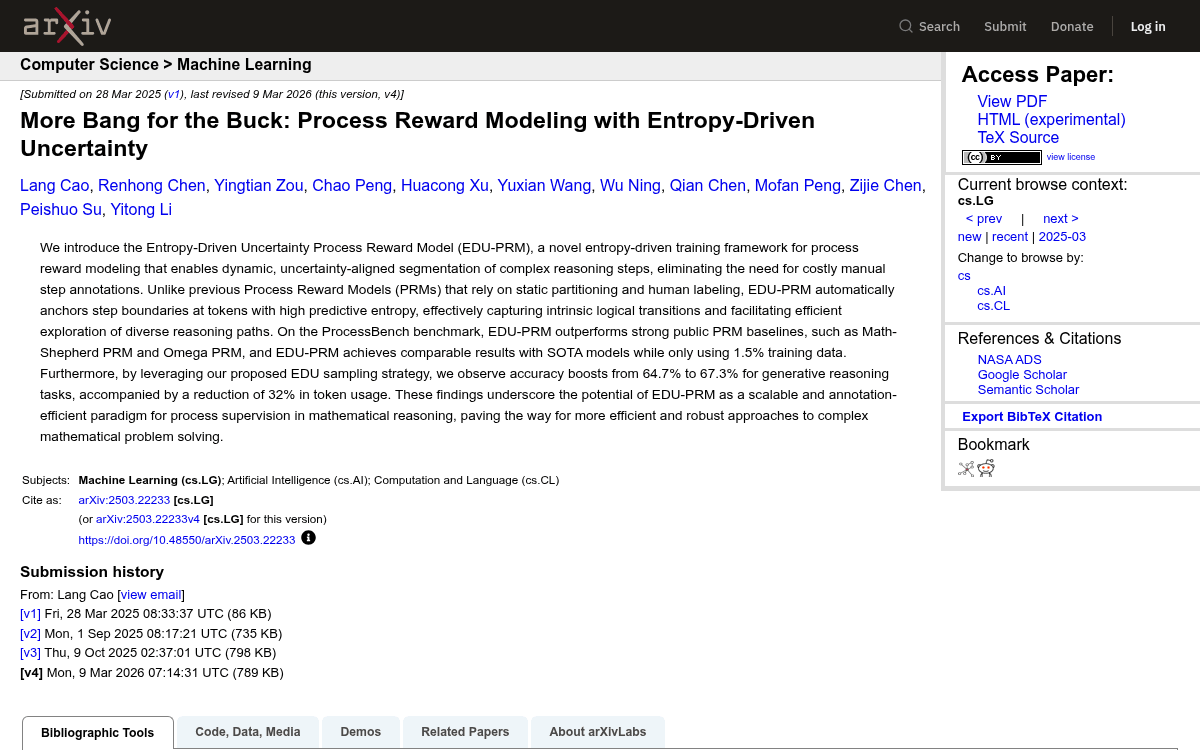
EDU-PRM trains a step-level math reasoning verifier using token entropy as a guide, matching state-of-the-art accuracy with just 1.5% of the training data and cutting token usage by 32%
 Pro
Takeaways
- Data efficiency: EDU-PRM matches state-of-the-art PRM accuracy using only 1.5% of the training data required by Qwen2.5-Math-PRM.
- Entropy-guided steps: Instead of human labels, the model uses its own token-level prediction uncertainty to automatically identify reasoning step boundaries.
- Token savings: EDU Sampling at inference time cuts token usage by ~32% while maintaining or improving accuracy over standard high-temperature sampling.
- Benchmark results: EDU-PRM-72B achieves 88.4% accuracy on MATH ProcessBench, outperforming Qwen2.5-Math-PRM-72B (87.8%) trained on far more data.
- Pruning variant: A P-EDU mode prunes low-confidence branches early for further token savings, useful in compute-constrained settings.
- No code release: Experiments run on Huawei Ascend 910B hardware; no public model weights or code repository released with the paper.
Training a model to check its own reasoning, step by step, is one of the most expensive problems in AI today. The leading approach, called a Process Reward Model (PRM), requires labeling every intermediate reasoning step in a math solution as correct or incorrect. OpenAI's PRM800K dataset, for instance, required thousands of hours of human annotation. A new paper from Huawei introduces EDU-PRM, a framework that sidesteps this bottleneck entirely by using the model's own uncertainty as a guide.
The annotation bottleneck killing PRM progress
Process Reward Models have emerged as a promising approach for process supervision in mathematical reasoning, but their development faces significant challenges, particularly in data annotation. The core problem is defining what a "step" even is. Most existing PRMs split reasoning traces at newlines or punctuation marks, which is a crude heuristic that misses the actual logical transitions happening inside a solution. Annotating and obtaining a high-quality training dataset incurs a high cost; PRM800K was the first process supervision dataset completely annotated by humans.
Automated alternatives like Math-Shepherd use Monte Carlo estimation (running many completions from a given step and checking how often they reach the right answer) to assign labels without humans. The Math-Shepherd approach truncates the solution at each intermediate step and generates multiple continuations using an LLM, estimating step quality as the fraction reaching the correct final answer. Although effective, it remains computationally expensive and indirect. OmegaPRM goes further with Monte Carlo Tree Search (MCTS), but still relies on rule-based step partitioning.
Entropy as a compass for reasoning structure
EDU-PRM's key insight is that the model already knows where the hard parts of a solution are. At every token position during decoding, you can compute the predictive entropy of the next-token distribution: a high-entropy token means the model is genuinely uncertain about what comes next, which tends to coincide with logical pivots in the reasoning chain. Words like "then", "if", "thus", and "so" cluster at these high-entropy positions, acting as natural step boundaries.
The framework has two phases:
- EDU Sampling: During solution generation, the model monitors token entropy at each decoding step. When entropy exceeds a threshold
τ, it branches into two paths using the top-2 candidate tokens, then continues greedily until the next high-entropy anchor. This builds a binary tree of reasoning trajectories without any human or LLM-as-judge labeling. - Monte Carlo Scoring: Each fragment between two entropy anchors is scored by whether the full solution branch it belongs to reaches the correct final answer. These fragment-level labels are propagated automatically, requiring only final-answer correctness as a signal.
The PRM is then trained on (question, solution fragment, correctness label) triples using standard cross-entropy loss. No step-level human labels are ever needed.

Matching SOTA at 1.5% of the data
The team trained EDU-PRM on top of Qwen2.5-72B-Base and Qwen2.5-7B-Base using 7,500 problems from the MATH training set, generating up to 100 candidate solutions per problem. This produced roughly 1.42M training instances. The results on the ProcessBench benchmark are striking:
- EDU-PRM achieves comparable results to the SOTA Qwen2.5-Math-PRM while using only 1.5% of its publicly reported process-level training data.
- On the MATH dataset, EDU-PRM-72B attains the highest judgment accuracy of 88.4%, outperforming Qwen-2.5-Math-PRM-72B (87.8%) by a margin of 0.6%.
- EDU-PRM-72B exhibits robust judgment accuracy on GSM8K (94.2%) and OlympicBench (77.2%).
- In Best-of-N selection, EDU-72B achieves up to a 3.7% lead on MATH and a 5.7% lead on OLY consistently across different sampling sizes, compared with SOTA baselines.
The 7B model tells a more nuanced story. The 7B models generally exhibit lower recall and F1 scores compared to their 72B counterparts, primarily attributed to the limited capacity of smaller models in handling the imbalanced label distribution inherent in the training data. The gains are concentrated at the 72B scale.
The inference trick: spending tokens where they matter
EDU-PRM is not just a better training recipe; it also changes how you generate solutions at test time. Instead of sampling N complete solutions at a fixed temperature (the standard Best-of-N approach), EDU Sampling branches only at high-entropy tokens and continues greedily otherwise. The result is a more structured search that avoids redundant computation.
On MATH, EDU sampling achieves 57.4% accuracy with 2,988 tokens, while high-temperature sampling achieves 57.2% accuracy with 4,338 tokens on average. That is roughly the same accuracy at 31% fewer tokens. On the harder OlympiadBench, EDU sampling attains 21.7% accuracy with 1,107 tokens, compared to 19.4% of high-temperature sampling with 1,655 tokens.
The paper also introduces Pruning-EDU (P-EDU), a variant that applies a PRM score threshold to cut low-confidence branches early. This trades a small accuracy drop for significant token savings, making it practical for resource-constrained deployments. MCTS performs competitively in the low-token regime but hits a distinct performance ceiling; unlike EDU methods, further increasing the token budget for MCTS does not yield proportional accuracy gains.
Why this matters beyond math
The deeper contribution here is a general principle: model uncertainty is a proxy for logical structure. By treating high-entropy tokens as natural step boundaries, EDU-PRM replaces both human annotation and expensive LLM-as-judge calls with a signal that is already present in the model's own output distribution. This makes the training pipeline dramatically cheaper to run and easier to scale.
There are real limitations to acknowledge. The computational cost of entropy calculation during inference adds a slight overhead compared to standard greedy decoding. The paper also focuses exclusively on mathematical reasoning, and the generalizability to other domains such as coding or creative writing requires further investigation. The quality of the PRM still depends on the base model's ability to generate valid reasoning traces in the first place.
No code or model weights have been released alongside the paper. The experiments were conducted on Huawei's Ascend 910B hardware using the MindSpeed training framework, which may limit reproducibility for teams outside that ecosystem. Still, the core idea is clean enough to reimplement: compute token entropy during rollouts, branch at peaks, label fragments by outcome, and train a classifier. The recipe is simple; the results suggest it punches well above its weight.