
Huawei's AA-HSFL-II Cuts Federated Training Time by 28% Without Sacrificing Accuracy
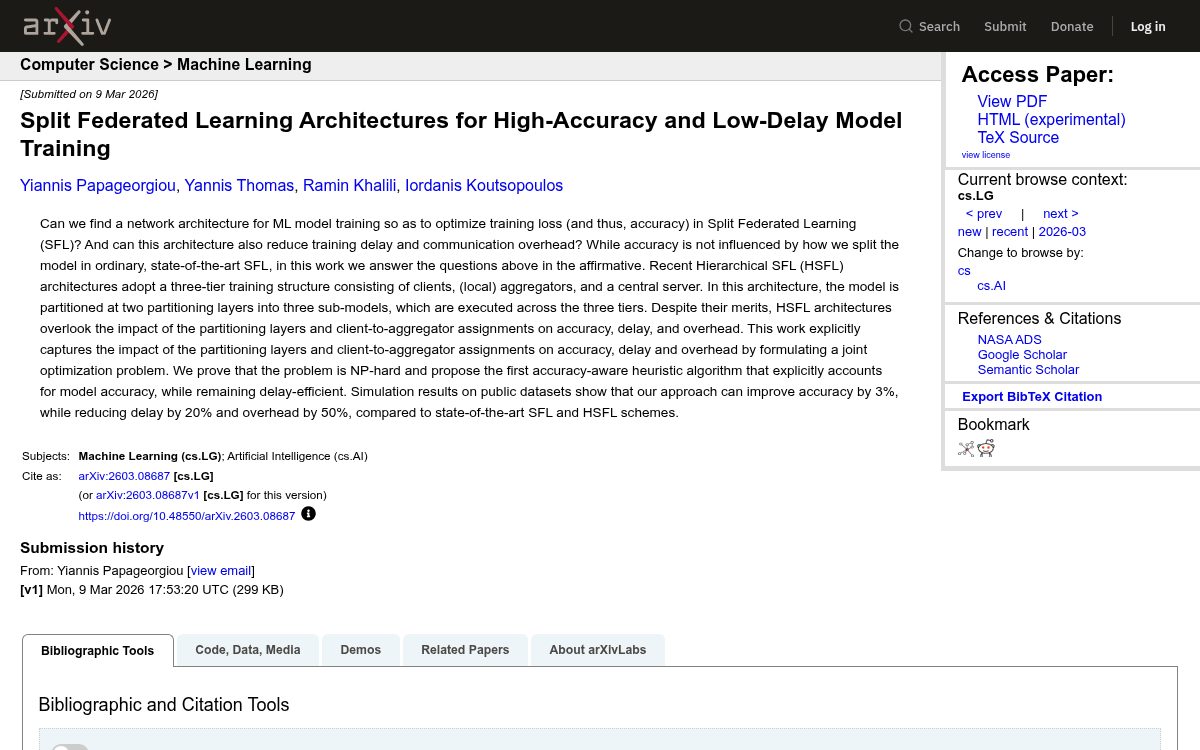
A new algorithm for hierarchical federated learning jointly picks where to split a model and which devices act as aggregators, cutting training time by 20% and bandwidth by 50% while boosting accuracy by 3%.
 Pro
Takeaways
- Researchers prove that where you split a neural network in hierarchical federated learning directly affects model accuracy, not just speed.
- New algorithm AA-HSFL-II jointly optimizes two split points and client-to-aggregator assignments in a three-tier training architecture.
- Results: +3% accuracy, -20% training delay, and -50% communication overhead vs. state-of-the-art SFL baselines.
- The joint optimization problem is NP-hard; the proposed heuristic runs in O(log L × N²) and stays within 12% of optimal at 100 clients.
- Tested on AlexNet, VGG-11, VGG-19, and ResNet-101 across MNIST, CIFAR-10, and CINIC-10 with heterogeneous simulated devices.
- Code to be released on paper acceptance; full pseudocode available in the paper.
In federated learning, your model never leaves the device -- but that privacy guarantee comes at a steep cost in training time and communication overhead. A new paper from researchers at Athens University of Economics and Business and Huawei Munich tackles a surprisingly overlooked question in this space: does it actually matter where you cut a neural network when splitting it across devices? The answer turns out to be yes -- and exploiting that fact unlocks simultaneous gains in accuracy, speed, and bandwidth.
The three-body problem of distributed training
To understand what's going on, you need a quick map of the landscape. Federated Learning (FL) lets many clients train on local data and send only model weights to a central server -- no raw data ever leaves. Split Learning (SL) goes further: it cuts the model in half at a "cut layer," so the client only runs the first half and offloads the rest to the server, saving compute on weak devices. Split Federated Learning (SFL) combines both ideas.
But SFL has two well-known pain points:
- Backward locking: After a forward pass, clients sit idle waiting for the server to compute gradients and send them back before backpropagation can proceed.
- The straggler effect: In a heterogeneous fleet -- say, a mix of Samsung phones and Raspberry Pis -- fast clients waste time waiting for slow ones to finish their portion.
The state-of-the-art fix is Hierarchical SFL (HSFL): add a middle tier of "local aggregators" (stronger clients that volunteer to help weaker neighbors). The model is now sliced into three pieces at two boundaries -- an aggregator layer and a cut layer -- and trained across clients, aggregators, and a central server in parallel. Local aggregators also aggregate models more frequently, which improves accuracy. The problem? Prior HSFL work treated the choice of those two split points, and which client gets assigned to which aggregator, as fixed design decisions with no impact on accuracy.

The hidden accuracy trap nobody was measuring
The paper's first contribution is empirical: the authors show that cut layer selection does affect accuracy in local-loss-based training, and the effect is non-trivial. When training AlexNet and VGG-11 across 100 clients, choosing convolution layer 2 as the cut point produces measurably lower final accuracy than choosing convolution layer 5. The reason is subtle -- in local-loss learning, clients compute gradients at the cut layer rather than at the final output layer. The quality of those local gradients depends heavily on how semantically rich the features are at that layer. Cut too early, and you're backpropagating noise.
This means the joint problem of picking the aggregator layer, the cut layer, and the client-to-aggregator assignments is not just an engineering tradeoff -- it directly determines how well the model learns.
An NP-hard problem, solved greedily
The authors formalize this as a joint optimization: minimize total training round delay subject to an accuracy constraint. They prove the problem is NP-hard (it reduces to the Restricted Facility Location Problem, a classic combinatorial hardness result), which rules out exact solvers at scale. The search space alone is O(N^N * L^2) for N clients and L layers -- exhaustive search is infeasible beyond toy sizes.
Their solution, AA-HSFL-II (Accuracy-Aware Hierarchical SFL), is a two-phase heuristic:
- Phase 1 -- Find good cut layers offline: Before full training begins, a small subset of clients run a short offline training sweep (typically fewer than 5 rounds) across all candidate cut layers. An auxiliary network head is attached to each layer to compute local-loss accuracy. The server averages these scores and identifies a set of "candidate" cut layers whose accuracy falls within a tolerance threshold of the best observed.
- Phase 2 -- Jointly optimize the rest: Given the candidate cut layers, a greedy binary-search procedure finds the aggregator layer
hthat balances computation between weak clients and their assigned aggregators. For each candidate configuration, clients are sorted by compute throughput, the top fraction are nominated as aggregators, and remaining clients are greedily assigned to the aggregator that minimizes their expected delay. The algorithm iterates until the delay gap between the client-side and aggregator-side pipelines converges.
The complexity of Phase 2 is O(log L * N^2) -- polynomial and practical for real deployments. In benchmarks against exhaustive search, the heuristic finds the optimal solution for up to 60 clients and stays within 12% of optimal at 100 clients, while running up to 40x faster.
What the numbers look like
The algorithm was evaluated on four model-dataset pairs: AlexNet on MNIST, VGG-11 and VGG-19 on CIFAR-10, and ResNet-101 on CINIC-10 (a harder variant of CIFAR-10). The simulated network modeled 100 heterogeneous clients -- 30% strong (Samsung Exynos, ~17.6 GHz) and 70% weak (Raspberry Pi 2, ~2.4 GHz) -- connected over links sampled between 20-25 Mbps.
Compared to the best-performing baselines (including FedSplitX, LocSFL, DTFL, and Multihop SFL):
- Accuracy: +3% on AlexNet (94% vs 91% for DTFL within the same training window)
- Training delay: -20% to reach 94% accuracy on AlexNet; -28% on VGG-11 at 70% accuracy
- Communication overhead: -50% on AlexNet (0.06 TB vs 0.12 TB for Multihop SFL)
- ResNet-101: -20% delay at 70% accuracy target vs DTFL (36,100 vs 44,800 seconds)
The gains hold across model sizes. For deeper architectures like VGG-19, the algorithm automatically pushes both split points deeper into the network and increases the aggregator fraction, redistributing more computation away from weak clients.
Where it fits -- and where it doesn't
AA-HSFL-II is purpose-built for heterogeneous edge deployments: IoT fleets, hospital networks of mixed-capability devices, or mobile networks where some nodes are significantly more powerful than others. The three-tier structure is particularly valuable when you have a natural middle tier -- think edge servers, 5G base stations, or powerful phones that can act as local coordinators.
There are real constraints to keep in mind. The offline Phase 1 sweep adds upfront compute before training starts, though the authors note it typically requires fewer than 5 rounds and is amortized over the full training run. The current formulation also assumes stable network topology and compute throughput during a training round -- though the paper shows the algorithm can be re-run between rounds when conditions change, limiting delay increases from background tasks to roughly half of what a static policy would suffer.
The algorithm also assumes i.i.d. data distribution across clients. The authors acknowledge that non-i.i.d. distributions (the more realistic case in production) may affect convergence, though the optimization itself is agnostic to data distribution since it only depends on compute and communication parameters.
Code will be released upon paper acceptance, per the authors' note. Until then, the full paper includes both algorithms in pseudocode with enough detail to reimplement. The core insight -- that cut layer selection is an accuracy-sensitive decision, not just a latency knob -- is likely to influence how future HSFL systems are designed, especially as edge AI deployments grow more heterogeneous.