
Huawei Catches Top AI Research Agents Failing on the Invisible Web
A new benchmark exposes a massive blind spot in AI research agents: information that search engines simply never index
 Pro
Takeaways
- Researchers from Huawei, HKU, and UCL identify Unindexed Information Seeking (UIS): questions answerable only via dynamic pages, embedded files, or deeply buried content search engines never index.
- Top agents like Memento (O3 + GPT-4.1) drop from 79.4% on GAIA to 25.5% on the new UIS-QA benchmark -- a 54-point collapse.
- UIS-QA is the first dedicated benchmark: 110 expert-annotated QA pairs requiring real browser interactions, no predefined starting URL, and provably unindexed answers.
- UIS-Digger is a 4-agent framework (planner, web searcher, dual-mode web surfer, file reader) that achieves 27.27% -- best in class -- using a ~30B backbone.
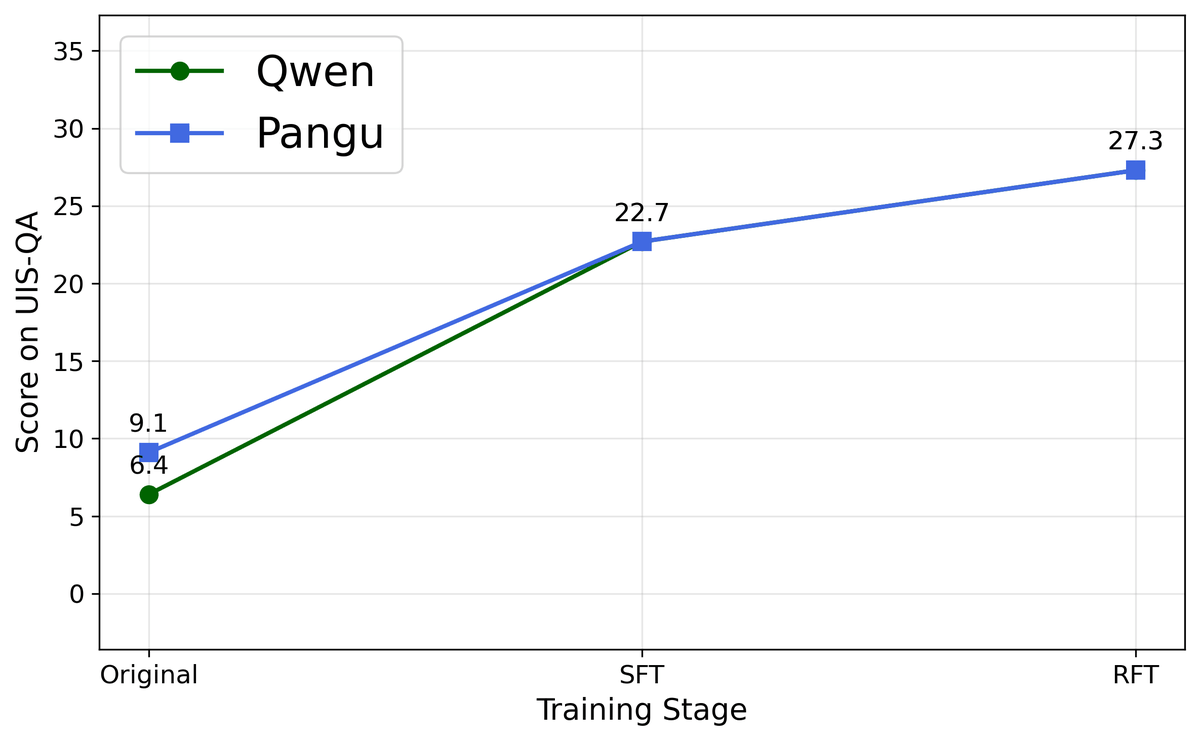
- A two-stage SFT then RFT training pipeline triples accuracy from 9.1% (untrained) to 27.3%, and generalizes to GAIA and BrowseComp-zh as well.
- The dataset and benchmark toolkit are open-sourced on Hugging Face; the full paper includes failure analysis and training recipes.
Every major AI research agent -- OpenAI Deep Research, Gemini Deep Research, WebSailor, and the rest -- has been quietly cheating on its exams. The benchmarks they dominate, like GAIA and BrowseComp, are built around information that search engines have already indexed. But a huge swath of the real web is invisible to Google's crawler: buried PDFs, dynamic dashboards that require login interactions, date-picker filtered tables, and pages that simply never got ranked. A team from Huawei, the University of Hong Kong, and UCL just named this problem formally, built the first benchmark to measure it, and proposed a new agent architecture to start tackling it.
The blind spot nobody was measuring
Recent LLM-based information-seeking agents have achieved record-breaking performance on established benchmarks, but they remain heavily reliant on search-engine-indexed knowledge, leaving a critical blind spot. The researchers call this gap Unindexed Information Seeking (UIS) -- the class of questions where the answer exists on the web but cannot be retrieved by typing a query into Google and crawling the top results.
The UIS problem covers vital information not captured by search engine crawlers, such as overlooked content, dynamic webpages, and embedded files. Think of a government portal where you have to select a fiscal year from a dropdown before the data table renders, or a company annual report buried three clicks deep inside an investor relations section that was never crawled. Standard agents hit a wall here because their action space stops at "search and read the top result."

A benchmark that actually tests this
To address this gap, the authors introduce UIS-QA, the first dedicated UIS benchmark, comprising 110 expert-annotated QA pairs. Building it was deliberately hard. An expert team manually navigated deep into authoritative websites -- performing multi-round clicks, filter selections, intra-site searches, and file downloads -- then wrote questions whose answers could only be found through those interactions. Each question was independently verified by three annotators using Google Search to confirm it was genuinely unindexed, and a separate offline LLM (DeepSeek-R1) filtered out anything answerable from parametric knowledge alone.
The 110 questions span government announcements, product documentation, source code repositories, game statistics, and company annual reports. The benchmark has five key properties that distinguish it from existing evaluations:
- Real live web: agents face actual websites with ads, outdated content, and complex layouts
- No starting URL: agents must figure out which site to visit from scratch
- Unindexed dependence: the answer is provably not in any search snippet
- Short-form, deterministic answers: numerical values, dates, proper nouns -- no subjective scoring
- Temporal stability: questions were chosen so the answer doesn't change over time
The performance cliff
Even state-of-the-art agents experience a drastic performance drop on UIS-QA -- from 70.90 on GAIA and 46.70 on BrowseComp-zh to 24.55 on UIS-QA -- underscoring the severity of the problem. The numbers in the full results table are striking. Systems that look competitive on standard benchmarks collapse almost uniformly:
| System | Backbone | GAIA | BrowseComp-zh | UIS-QA |
|---|---|---|---|---|
| Tongyi DeepResearch | TongyiDR-30B + GPT-4o | 70.9 | 46.7 | 23.6 |
| Memento | O3 + GPT-4.1 | 79.4 | -- | 25.5 |
| WebSailor | WebSailor-32B + Qwen3-72B | 53.2 | 25.5 | 7.3 |
| OWL | O3-mini + 4o + Claude-S3.7 | 69.7 | -- | 4.6 |
| UIS-Digger (Qwen) | Qwen3-32B | 47.6 | 32.5 | 27.3 |
Memento, powered by O3 and GPT-4.1, drops from 79.4% on GAIA to 25.5% on UIS-QA -- a 54-point collapse. The pattern is consistent enough to be a structural finding, not noise.
UIS-Digger: four agents, two browser modes, two training stages
UIS-Digger is a multi-agent system engaging four agents -- planner, web searcher, web surfer, and file reader -- each equipped with a set of tools and assigned to a specific category of sub-tasks, working in an iterative problem-solving process inspired by the ReAct paradigm. Here is how the pieces fit together:
- Planner: receives the user query, decomposes it into sub-tasks, coordinates the other three agents, and synthesizes the final answer
- Web Searcher: runs search engine queries and crawls indexed pages in parallel; escalates to the surfer or file reader when indexed results are insufficient
- Web Surfer: operates a real browser with a full action space -- click, scroll, type, select dropdowns, submit forms, download files, take screenshots. Crucially, it can switch between textual and visual (screenshot) modes while sharing a single browser state and memory
- File Reader: handles downloaded PDFs, XLSX, and DOCX files, reading them chunk by chunk when they exceed the context window

The dual-mode web surfer is one of the key design choices. Most browser agents commit to either pure text or pure screenshots. UIS-Digger's surfer defaults to text (faster, cheaper) but can switch to visual mode when it needs to read a chart, interpret a rendered table, or understand a complex UI element -- all while keeping the same browser session open. This avoids the synchronization overhead of maintaining two separate browser states.
Training: cold start, then self-improvement
The backbone LLM (either Pangu-38B or Qwen3-32B) is trained in two stages. First, a Supervised Fine-Tuning (SFT) stage uses a powerful teacher model to generate correct trajectories on synthesized QA pairs, which are then filtered by a judge LLM for correctness and non-triviality. This gives the model a cold start -- it learns that crawling and browser interaction are even options. Second, a Rejection Sampling Fine-Tuning (RFT) stage has the SFT model generate multiple trajectories per question at temperature 0.4, keeps only the correct ones, and overweights harder questions. This bootstraps the model toward more efficient navigation strategies.
The training data itself comes from two sources: real websites (over 100 domains across government, finance, product catalogs, and code repos) and three types of simulated virtual websites built to target specific weaknesses like date pickers and radio button filters. The SFT dataset ended up with 4,501 trajectories across 1,482 queries; the RFT set used 4,467 trajectories from 3,317 queries after difficulty-weighted sampling.
The gains are measurable at each stage. On the Pangu backbone, the untrained model scores 9.1% on UIS-QA. After SFT it jumps to 22.7%, and after RFT it reaches 27.3% -- a 3x improvement from scratch. The same two-stage pipeline also improves performance on GAIA and BrowseComp-zh, showing it generalizes rather than overfitting to UIS-QA.
Why the best systems still fail
The paper's error analysis is one of its most useful contributions. By tracking whether agents ever visited the correct root domain during their search, the authors identified three dominant failure modes:
- Missing retrieval: the agent never finds the right website in search results at all -- theoretically unsolvable from that point
- Wrong source selection: the correct site appears in results but the agent picks a third-party or outdated alternative instead
- Failed interaction: the agent reaches the right site but can't execute the multi-step interaction needed (e.g., navigate to a sub-page, set a filter, read a graph)
Tool usage patterns shift visibly across training stages. The untrained model never invokes the crawl tool at all. After SFT it starts using it; after RFT, successful trajectories show fewer browsing actions (more targeted navigation) while failed trajectories show more (prolonged retries that never converge). This "learn then streamline" pattern is a useful signal for future training research.

What this means in practice
The use cases where UIS matters most are exactly the ones where agents are being deployed commercially right now: financial due diligence (pulling figures from annual reports), regulatory compliance (checking government portals for updated rules), competitive intelligence (reading product specs from vendor sites), and technical research (accessing data behind interactive dashboards). In all of these, the information exists -- it just requires the agent to actually operate a browser rather than read a search snippet.
The ceiling is still low: 27.27% is the best anyone has achieved on UIS-QA, and even raw O3 without any framework only reaches 30.9% in ablations. The authors are candid that a distribution gap between synthetic training data and real test questions limits transfer, and that sparse supervision from final-answer-only feedback can reinforce low-quality trajectories. Reinforcement learning on live web interactions is the obvious next step they flag.
The UIS-QA dataset is publicly available on Hugging Face, and the full paper includes the complete benchmark construction pipeline, training recipes, and failure case analyses. For anyone building or evaluating research agents, UIS-QA is now the test that actually measures whether your agent can find things that aren't already on the first page of Google.