
HPE's John Martinis Reveals the Most Detailed Quantum Supercomputer Blueprint Yet
A 100+ author roadmap from HPE, Qolab, Quantum Machines and Nvidia lays out how to bridge the gap between today's noisy qubits and million-qubit fault-tolerant systems.
 Pro
Takeaways
- A 50+ author consortium including HPE, Qolab, Quantum Machines and Nvidia published a full-stack roadmap to million-qubit superconducting quantum supercomputers.
- Current scaling pace could delay million-qubit machines by decades without a major shift in approach.
- Core proposal: fabricate qubits in 300mm CMOS foundries with subtractive window junctions, then wafer-scale integrate 20k qubits per module.
- Sensitivity analysis shows two-qubit gate fidelity dominates surface-code performance more than SPAM or coherence improvements.
- FeMoco ground-state energy estimation drops from 1.4 years to 97 days by combining better hardware with qubitization algorithms.
- Architecture integrates QPUs, GPUs and probabilistic processing units through CUDA-Q and low-latency PCIe for real-time decoding.
A sprawling collaboration led by John Martinis (of Google quantum supremacy fame) and Masoud Mohseni at HPE has published what may be the most detailed public blueprint yet for a superconducting quantum supercomputer. The paper, co-authored by researchers at HPE, Qolab, Quantum Machines, 1QBit, Nvidia, Applied Materials, Synopsys, Fermilab and several universities, spans qubit fabrication, wafer-scale integration, real-time decoding, and full-stack HPC integration, and ends with concrete resource estimates for chemistry problems that would take a real machine to solve.
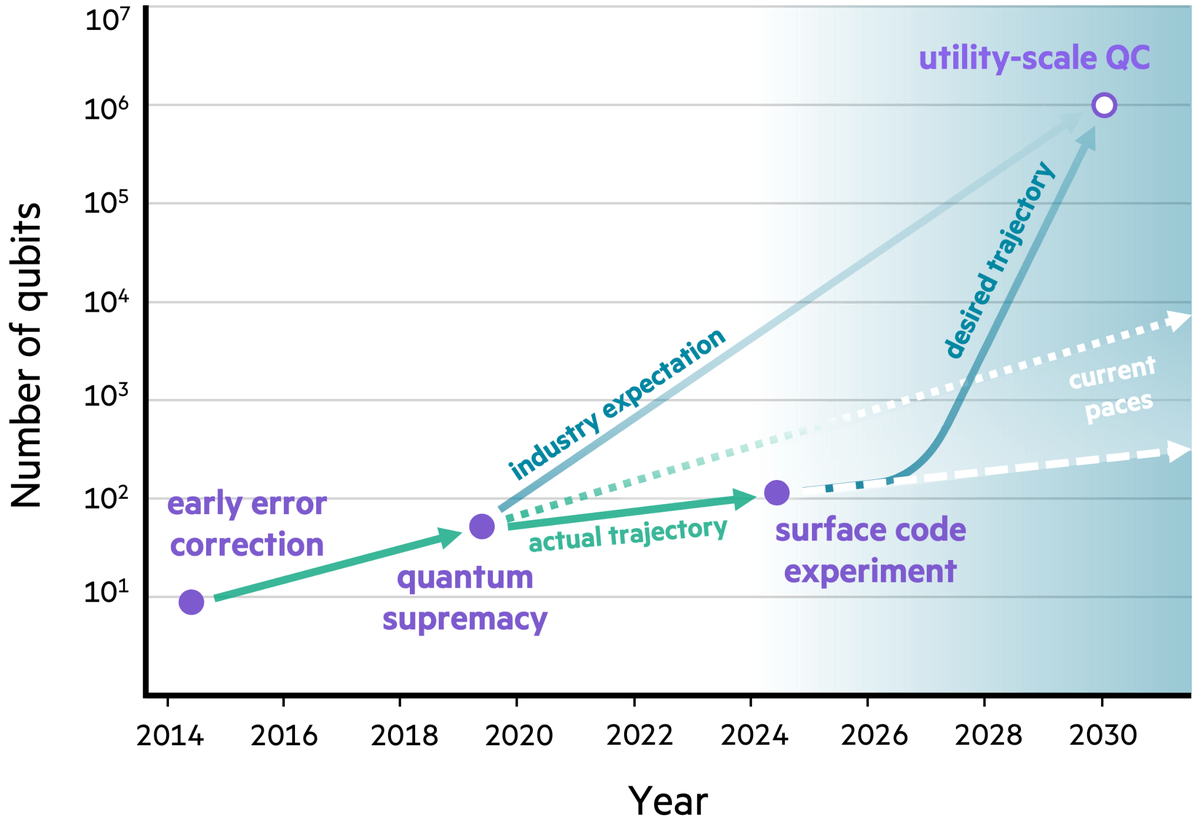
The framing is blunt. After the 2019 quantum supremacy experiment, industry leaders projected one million qubits by the end of the decade, but the current pace of hardware progress suggests that goal might be postponed by several decades even in an optimistic scenario. To arrive at utility-scale quantum computers in the 2030–2035 time frame, a major increase in the rate of progress over the next five years is needed. The authors argue that piecemeal academic-style optimization of single qubits will not close that gap. Instead, they propose treating the whole stack, from junction fabrication to HPC scheduling, as one systems-engineering problem.
Why the current path stalls
The paper enumerates scaling challenges in bands of 100, 1k, 10k, 100k, and 1M+ qubits. A few of the underappreciated ones stand out:
- Fat-tailed error distributions. Researchers typically report their best qubits. On published Google and IBM data, the worst 10% of T1 times drop 30–100 times below what a Gaussian fit would predict, meaning a 1000-qubit device is dominated by its outliers, not its median.
- Wiring cost. A cryostat for a 150-qubit processor with coaxial wires runs about $5M, with $4M of that in wiring alone. Scaling that approach linearly is a non-starter.
- Recalibration. Two-level-system defects drift, forcing full recalibration roughly once per day for 100-qubit systems. At 1000 qubits, the outlier rate makes the machine effectively unusable without constant retuning.
- Decoder latency. State-of-the-art decoders take about 60 microseconds for distance-7 surface codes, but stabilizer rounds run every ~0.5 microseconds, so the end-to-end loop must land under 10 microseconds to avoid choking the logical circuit.
Borrowing from CMOS, hard
The hardware thesis is that superconducting qubits should be manufactured like transistors. The authors propose fabricating qubits on 300mm wafers in a prototype foundry using standard cluster tools, replacing the traditional Josephson junction liftoff process with a subtractive "window junction" flow. Liftoff leaves organic residues that harbor dielectric two-level-system defects, which produce the heavy tails in T1 distributions that make large arrays unusable. Eliminating liftoff, R. McDermott's group at Wisconsin has demonstrated T1 times averaging 100–200 microseconds with a hero device at 800 microseconds.
On top of the qubit die sits a 300mm superconducting wiring wafer, bump-bonded to the qubit chip and micromachined for thermal isolation between the 20 mK qubit stage and the 3 K control stage. Niobium striplines at 0.3 micron width and 1.5 micron pitch pack roughly 92,000 wires across the wafer, and on-chip Josephson photomultiplier readout eliminates the bulky circulators and parametric amplifiers that dominate current cryostat volume. A single 14x14 cm die tiles about 20,000 qubits, with 5–10 tiles per dilution refrigerator.
What actually moves the needle
One of the more useful contributions is a sensitivity analysis of what hardware improvements matter most for surface-code performance. The team benchmarks three parameter sets, labeled baseline (today's state of the art), target (near-term goal), and desired, against the exponential error suppression rate Lambda of the surface code.
| Parameter set | Two-qubit gate error | T1 time | Suppression rate Lambda |
|---|---|---|---|
| Baseline | 0.003 | 100 microseconds | 2.34 |
| Target | 0.0005 | 200 microseconds | 9.3 |
| Desired | 0.00029 | 340 microseconds | 18.0 |
The counterintuitive finding: improving gate control error yields dramatically larger Lambda gains than improving state-preparation-and-measurement errors or idling coherence. Gate fidelity, in other words, is the dominant lever. A second finding is that the standard deviation of the T1 distribution matters as much as its mean, so foundries should optimize for uniformity, not hero devices.
Resource estimates that hurt to read
The heart of the paper is a set of physical resource estimates for real applications, generated using 1QBit's TopQAD toolkit and cross-checked against Microsoft's AzureQRE. The team estimates costs for ground-state energy of para-benzyne and FeMoco (the iron-molybdenum cofactor of nitrogenase, a canonical quantum chemistry target), catalyst design for CO2-to-methanol conversion, NMR spectral prediction of peptides like mastoparan-X, and 2D Fermi-Hubbard simulation up to 32x32 lattices.
For FeMoco at chemical accuracy (1.6 mHa) using the double-factorized qubitization algorithm, baseline hardware needs about 120 million physical qubits and 1.4 years of runtime. Target hardware brings that down to 13 million qubits and 122 days. Desired hardware: 7.7 million qubits and 97 days. Better algorithms compound the gains: switching from Trotterization to qubitization on target hardware cuts runtime by roughly 50x compared to Trotterization on baseline hardware. For 2D Fermi-Hubbard ground-state estimation with plaquette Trotterization, a 32x32 lattice fits in about 9 million physical qubits and 9 seconds of runtime, thanks to a T-count that saturates around 10^6 regardless of lattice size.
The bottom line: quantum simulation begins to plausibly outperform classical FCI beyond roughly 25 orbitals, and beats state-of-the-art DMRG somewhere north of 50 orbitals, though the exact crossover depends heavily on how strongly correlated the system is.
A stack, not a chip
The authors are equally emphatic that the classical side of the machine is not a footnote. Their proposed architecture wires QPUs into HPC nodes via low-latency PCIe links, using Nvidia's CUDA-Q platform and Quantum Machines' OP-NIC (a round-trip feed-forward latency benchmarked at under 3.8 microseconds) for real-time decoding on Grace Hopper and Blackwell GPUs. The stack extends the HPE Cray Programming Environment with a quantum interface library so C, C++ and Fortran HPC codes can invoke quantum kernels through vendor SDKs like Qiskit, Cirq and Classiq without rewriting the application.
More unusual is the inclusion of Probabilistic Processing Units (PPUs) as first-class accelerators alongside GPUs and QPUs. These are FPGA or ASIC-based p-bit networks that natively perform Gibbs sampling for combinatorial optimization, energy-based models, and neural quantum states. A demonstrated multi-FPGA prototype trained a neural quantum state ansatz on the 1D transverse-field Ising model with 5000 spins at 15 MHz p-bit update rates, and a heterogeneous FPGA-GPU architecture using peer-to-peer PCIe achieved sampling throughput of 167 Gflips per second, a 3585x speedup over GPU-only sampling for deep Boltzmann machine training on MNIST. The claim is that PPUs cover the sign-problem-free regime of many-body simulation, freeing scarce QPU time for the truly quantum-hard cases.
What this is, and what it isn't
This is a position paper, not a product announcement. No million-qubit machine is being shipped. But it is arguably the most complete public accounting of what such a machine would require, backed by concrete simulations of surface-code performance, decoder latency budgets, and end-to-end resource estimates for problems people actually care about. For anyone reasoning about quantum timelines, the paper's central message is that hardware quality, systems integration, and algorithm choice each contribute roughly an order of magnitude, and only stacking all three gets you to utility scale within the decade.