
HP-GP-TS Beats Bayesian Optimization's Dirty Secret With Tighter Regret Bounds
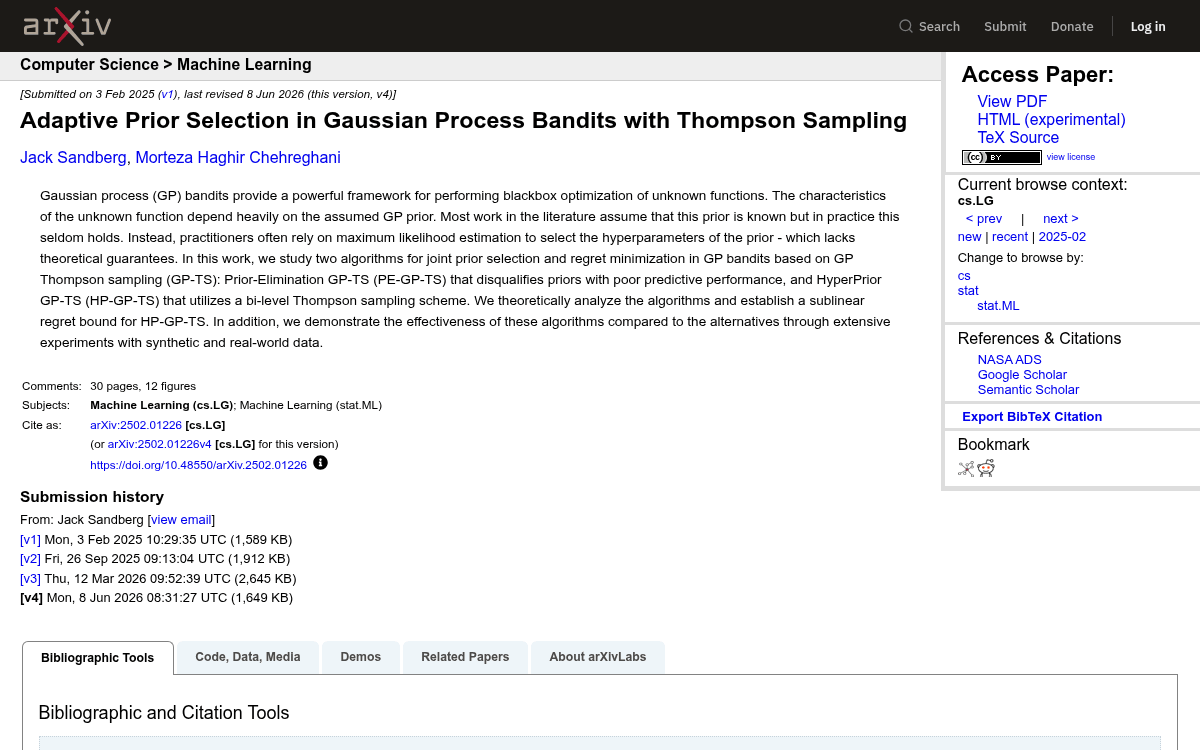
Two Thompson sampling variants let Gaussian process bandits pick their own prior, cutting regret and correcting flawed theory from prior work.
 Pro
Takeaways
- New paper proposes PE-GP-TS and HP-GP-TS for GP bandits with unknown priors, both based on Thompson sampling.
- HP-GP-TS uses bi-level posterior sampling: draw a prior, then a function, then an arm.
- Regret bound depends on hyperprior-weighted information gain, not worst-case, so scales with |P| better.
- Authors identify and fix technical flaws in the prior MixTS and EGP-TS regret proofs.
- Across synthetic and real-world data (Intel, PeMS, PNW), HP-GP-TS matches or beats all baselines.
- PE-GP-UCB's double optimism causes it to overselect the smoothest kernel more than 96% of rounds.
Bayesian optimization built on Gaussian processes has a dirty secret: almost every regret guarantee in the literature assumes you already know the correct prior. In practice you don't, so people fit hyperparameters with maximum likelihood and hope it works. A new paper tackles this head-on with two Thompson sampling algorithms that jointly select the prior and the arm, and along the way fixes flawed proofs in two influential earlier works.
Why the prior is the whole ballgame
A Gaussian process (GP) bandit is a multi-armed bandit where the arms are correlated and the expected reward is a sample from a GP. The kernel decides everything downstream: how smooth the reward function is, how far correlations reach, and how aggressively the agent should explore. GP bandits are used in areas including hyperparameter tuning, online advertising, and portfolio optimization, but the guarantees typically assume the exact prior is given.
Practitioners paper over the gap with maximum likelihood estimation on the hyperparameters. In a sequential decision making problem MLE is not guaranteed to recover the correct parameters which can hurt the performance. The two algorithms in this paper give you the same data-adaptive flavor as MLE but with actual regret bounds attached.
The double-optimism trap
Before this work, the state of the art for arbitrary unknown priors was PE-GP-UCB, which selects the prior and arm that maximize a joint upper confidence bound and eliminates priors with poor predictive performance. The catch: the joint upper confidence bound induces a double optimism in PE-GP-UCB that can lead to extra exploration. You are being optimistic about the arm and about the prior at the same time, which compounds.
The paper proposes two ways to shed that optimism:
- PE-GP-TS (Prior-Elimination GP-TS): keeps the elimination scheme but replaces UCB with Thompson sampling, removing one layer of optimism.
- HP-GP-TS (HyperPrior GP-TS): a fully Bayesian bi-level Thompson sampler that draws the prior from a hyperposterior, then draws a function from that prior's posterior, then picks the arm.
How HP-GP-TS actually runs
The main loop is compact enough to describe in one paragraph. At each step, sample a prior p_t from the current hyperposterior P_t, sample a function f_t from the GP defined by that prior, pick the arm that maximizes f_t, observe the noisy reward, then update the hyperposterior by weighting each prior by the likelihood it assigns to what you just saw. Computing the posterior is tractable albeit computationally costly for large t with a complexity of O(t³|P|). Compared to fully Bayesian methods that integrate over the hyperposterior via MCMC, HP-GP-TS only needs one sample per step.

A tighter regret bound, and a correction
The theoretical contribution is where this paper earns its keep. HP-GP-TS is equivalent to EGP-TS from Lu et al. 2023, and its original analysis was broken. So was the analysis of MixTS from Hong et al. 2022a, whose regret was analyzed in the standard bandit and linear setting. The paper identifies the specific technical failures (issues with conditioning on an auxiliary event that breaks the Thompson sampling probability-matching property) and produces a corrected sublinear regret bound.
The headline improvement: instead of depending on the worst-case maximum information gain across all priors, HP-GP-TS's bound depends on a hyperprior-weighted MIG. Concretely, the regret bound of order O(√(T·γ̄_T(P_1)·log T)) uses a sum of maximum information gains weighted by the hyperprior probability, and γ̄_T(P_1) < |P|·γ̂_T generally holds. If your hyperprior puts weight on simpler kernels, the bound gets tighter automatically. Maximum information gain here measures how much you learn about the function from your best possible observations, and its growth rate depends heavily on the kernel.
What the experiments show
The setup uses three synthetic families of priors (different kernels, different lengthscales, different active subspaces in 16D) plus three real-world datasets: the Intel Berkeley sensor data, California PeMS traffic measurements, and Pacific Northwest daily precipitation. Each real dataset has a train/test split so the test distribution has shifted, mimicking the case where the true prior is genuinely unknown.
Key findings:
- HP-GP-TS and EEI have lower regret than the other methods and perform close to the oracle GP-TS across all three synthetic experiments.
- HP-GP-TS selects the correct kernel 63.2% of the time compared to around 17% for elimination-based methods.
- Regret of HP-GP-TS empirically does not scale with the number of priors, matching the theory.
- PE-GP-UCB selects the Matérn-3/2 kernel more than 96% of the rounds because it produces much wider confidence intervals leading to excessive optimistic exploration. PE-GP-TS shows a milder version of the same bias, confirming that dropping one layer of optimism helps.

Where this fits in your toolkit
HP-GP-TS is useful when you have a small-to-moderate set of candidate priors (kernels, lengthscales, mean functions estimated from historical buckets) and want a principled way to pick among them online. The cubic-per-prior update cost means it is not for continuous hyperparameter spaces without MCMC, and the theory assumes finite prior sets. If your problem naturally suggests one prior with well-tuned hyperparameters, standard GP-TS is still simpler. If your prior space is combinatorial or you need lengthscales to keep shrinking indefinitely, algorithms like LB-GP-UCB may be a better fit.
The bigger takeaway is methodological: in sequential decision making, stacking optimism on top of Bayesian model selection is often worse than doing straight posterior sampling at both levels. The empirical gap between HP-GP-TS and PE-GP-UCB, along with the corrected proofs, is a strong argument for defaulting to Thompson sampling when you can afford it.