
Hong Kong Robotics Lab Fixes Dual-Arm Precision With One Unified Math Model
A new Lie-algebraic framework jointly calibrates both coordinate transforms and joint parameters for dual-arm robots, cutting the error accumulation that hurts precise collaboration.
 Pro
Takeaways
- Unified Lie-algebraic framework jointly calibrates coordinate transforms and joint kinematics for dual-arm robots.
- Uses product-of-exponentials to fold every unknown into one differentiable chain, eliminating error accumulation.
- Closed-form analytical Jacobian derived from Lie derivatives enables standard manifold solvers to converge stably.
- Jacobian rank analysis proves which parameters are identifiable, so joint optimization is well-posed.
- Certifiably correct initializer built on semidefinite relaxation verifies near-global optimality a posteriori.
- Beats prior AXB=YCZ baselines in accuracy; initializer alone outperforms coordinate-only solvers.
Anyone who has tried to get two robot arms to cooperate on a precise task, whether assembling a large structure or handing an object between grippers, knows the pain. Even after painstaking calibration, the arms miss each other by millimeters the task cannot tolerate. A new paper out of the Hong Kong Centre for Logistics Robotics attacks the root cause: existing pipelines model the geometry of the system and the imperfections of the joints as independent problems, and the errors quietly compound.
The authors propose a unified calibration framework that folds every unknown into a single Lie-algebraic optimization, then bootstraps it with an initializer that can certify its own near-optimality. Under identical visual measurements, the method beats prior baselines, and the certifiable initialization consistently outperforms several coordinate-only alternatives.
Why dual-arm calibration is a mess
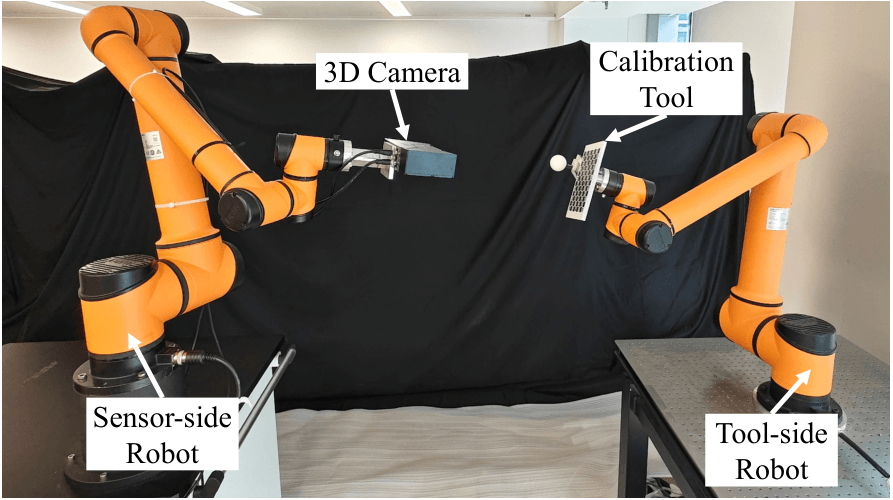
In a vision-based dual-arm setup, a camera or tracker watches a tool attached to one arm while a second arm holds a sensor. To get the two arms working together, you need to know several unknown rigid transforms plus the true kinematics of each arm. The canonical pose chain is written AXB = YCZ, where X, Y, and Z are the unknown coordinate transformations (flange-to-sensor, base-to-base, and flange-to-tool), A and C are end-effector poses from robot kinematics, and B is the tool pose measured by the sensor.

The trouble is that A and C are not exact. Real joints have small offsets in their axes and angles, so the forward kinematics you plug into the equation is already wrong. Recent dual-robot calibration methods have achieved strong results by simultaneously solving multiple coordinate transformations, but they either treat kinematic errors as implicit noise or handle them through separated error modeling, resulting in non-negligible accumulated errors. The field split a coupled problem in half and paid for it in accuracy.
One error model to rule them all
The authors construct a consolidated error model grounded in the product-of-exponentials formula, which integrates the coordinate and kinematic parameters in twist forms, introducing no artificial error separation and greatly mitigating error propagation. The product-of-exponentials (PoE) formula writes a robot's forward kinematics as a chain of matrix exponentials, one per joint, where each joint is described by a six-dimensional twist vector. Because coordinate transforms live in the same Lie group as joint motions, PoE lets you drop everything, both the unknown frames and the joint calibration parameters, into one differentiable expression.
From that expression the team derives an analytical Jacobian using Lie derivatives, and then does something unusual for a calibration paper: they analyze the rank of that Jacobian to prove which parameters are actually identifiable from the measurements. Exploring the Jacobian rank property, they show that the joint optimization is well-posed under mild conditions, which allows off-the-shelf iterative solvers to stably optimize these parameters on the manifold space. That matters in practice, because it means you can hand the problem to a standard nonlinear least-squares library without worrying that some parameters are numerically ghosts.
An initializer that certifies itself
Nonlinear optimization on manifolds only works if you start close enough. To ensure robust convergence of the joint optimization, the authors develop a certifiably correct algorithm for initializing the unknown coordinates, relying on semidefinite relaxation to yield a reliable estimate whose near-global optimality can be verified a posteriori.
The idea, popularized in robotics through work like SE-Sync for pose-graph SLAM, is to relax a hard non-convex problem into a convex SDP that can be solved to global optimality, then read off a solution and check whether the relaxation was tight for this instance. If it was, you have a certificate that your starting point is essentially globally optimal for the relaxed problem.

What actually improves
The paper reports two headline wins:
- Joint optimization wins on accuracy. Under identical visual measurements, the unified PoE model beats prior dual-robot baselines that either ignore kinematic errors or model them in a decoupled way.
- The initializer beats coordinate-only solvers on its own. Even before running the joint refinement, the SDP-based initializer produces a better estimate of the unknown coordinate transforms than baselines that solve for coordinates alone.
The comparison is against the recent lineage of AXB = YCZ solvers, including convex-optimization and Lie-derivative approaches that simultaneously solve for the coordinate transforms but leave the joint kinematics untouched.
When it is worth using
This is a targeted contribution, not a general-purpose tool. It matters most when:
- You are running a dual-arm system where one arm carries a sensor and the other carries a tool, with vision-based measurements linking them.
- Sub-millimeter accuracy in coordinated manipulation matters, so the joint offsets from the manufacturer's nominal model are large enough to show up in the final task.
- You want an optimization you can hand to a standard manifold solver without hand-tuning initial guesses.
It is less useful if your dual-arm task is loose enough that vanilla hand-eye calibration already meets tolerance, or if you only have one arm, since the coupling that motivates the unified model does not exist. The paper also focuses on rigid-body kinematic errors; joint compliance, backlash, and thermal drift are outside its scope.
No open-source release is announced in the paper. For teams building precise bimanual manipulation, the practical takeaway is architectural: stop calibrating geometry and kinematics in separate passes, and stop trusting nonlinear least squares from an unverified initial guess. Fold everything into one PoE expression, prove your parameters are identifiable, and start from a solution you can certify.