
Hong Kong PolyU's QA-Dragon Beats Visual AI Hallucinations by 6% With Smarter Search
A modular RAG framework routes visual questions across text and image search agents, then reranks results in two stages to beat baselines by up to 6.35%.
 Pro
Takeaways
- QA-Dragon is a modular multimodal RAG system built for the Meta CRAG-MM Challenge at KDD Cup 2025.
- Uses domain, search, and tool routers to dynamically pick between text search, image search, or direct answering.
- A two-stage coarse-to-fine multimodal reranker filters retrieved evidence before answer generation.
- Beats baselines by 5.06%, 6.35%, and 5.03% on single-source, multi-source, and multi-turn tasks.
- Runs under the challenge constraints of Llama backbones on a single 48GB L40s GPU.
- Full source code available at github.com/jzzzzh/QA-Dragon.
Multimodal LLMs are still notoriously bad at answering questions that require knowledge outside the image in front of them. Ask a smart glasses assistant about the history of the statue you are looking at, or the ingredients in a bottle on the shelf, and the model will often confidently make something up. A team from Hong Kong Polytechnic University built QA-Dragon, a retrieval-augmented generation system that tries to fix this by dynamically deciding when to search, what to search, and how to combine the results.
The work was submitted to the Meta CRAG-MM Challenge at KDD Cup 2025, a competition built around a new benchmark for multimodal, multi-turn visual question answering. Existing RAG methods typically retrieve from either text or images in isolation, which limits complex queries that need multi-hop reasoning or up-to-date facts. QA-Dragon adds a domain router to identify the query's subject domain and a search router that dynamically selects retrieval strategies, orchestrating text and image search agents in a hybrid setup to support multimodal, multi-turn, and multi-hop reasoning.
The challenge that shaped the design
The CRAG-MM benchmark is not your typical VQA dataset. It is the first MM-RAG challenge for KDD Cups, features egocentric images from wearable devices, covers entity recognition, OCR, query rewriting, and answer generation across many domains, and includes multi-turn conversations for smart assistant use cases. The images were collected from Ray-Ban Meta Smart Glasses from a first-person perspective, so the queries reflect real-world messiness: low-quality shots, obscure long-tail entities, and follow-up questions that reference earlier turns.
Constraints were tight. Participants had to build on Llama models, any non-Llama models were capped at 1.5B parameters, and all submissions had to run on a single NVIDIA L40s with 48GB of VRAM on AWS. That effectively rules out throwing a giant frontier model at the problem, which is why the interesting engineering happens in the retrieval pipeline.
How QA-Dragon routes a query
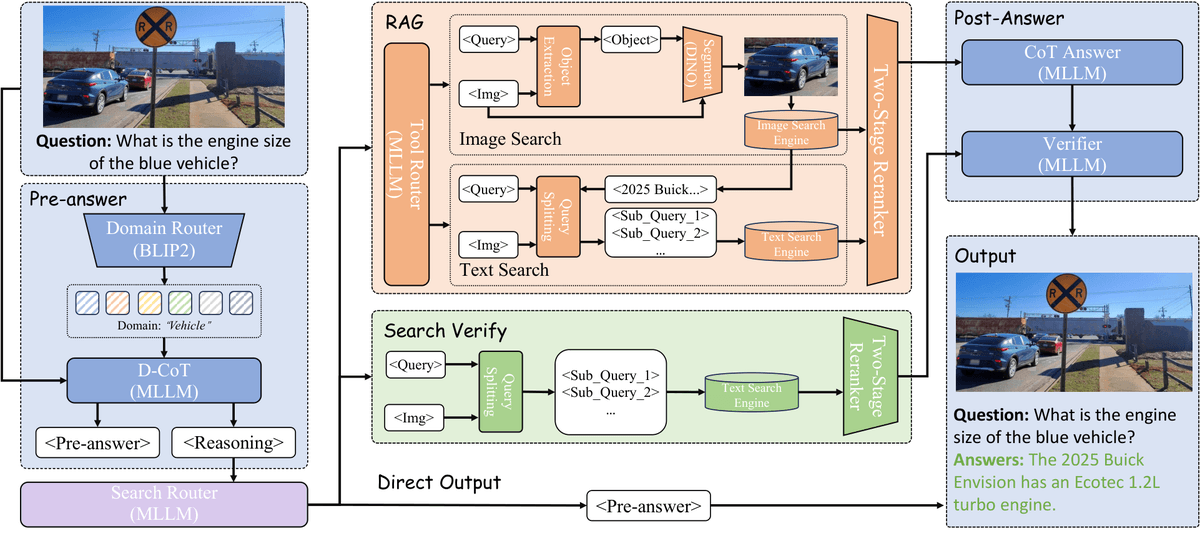
Rather than a monolithic RAG pipeline, QA-Dragon breaks the problem into specialized routers and agents. The system incorporates three reasoning branches and modular components including a Pre-Answer Module, Search Router, Tool Router, Image and Text Retrieval Agents, a Multimodal Reranker, and a Post-Answer Module, which dynamically select the optimal retrieval strategy based on domain-specific query characteristics, with the Search Router interpreting query intent and dispatching to the appropriate retrieval pathway.
Concretely, the repo exposes several routers, each with a narrow job:
- Domain Router that automatically detects query domains using BLIP2-based classification
- Complexity Router that assesses query complexity to pick a processing strategy
- Answerable Router that decides if a query can be answered directly or needs retrieval
- A Hybrid Search that combines text and image modalities, plus a Verifier that validates answer reliability before it goes out
Downstream of routing, three answer agents handle different scenarios: a Reasoning Agent for complex domain-aware tasks, a Direct Answer Agent for simple queries, and a Chain-of-Thought Agent for harder problems. The system essentially decides, per query, whether to answer from parametric memory, run a text search, run an image search, or do both and cross-check.
Coarse-to-fine reranking
Retrieval is only half the battle. The team argues that grounding answers in high-quality evidence requires filtering the retrieved passages, so they added a two-stage reranker. The multimodal reranker uses a coarse-to-fine refinement process that grounds final responses in high-quality evidence. The coarse stage prunes obvious mismatches from image and text search APIs, and the fine stage does a tighter multimodal scoring pass before the context builder assembles the final prompt.

What the numbers look like
On the three CRAG-MM tracks, QA-Dragon shows consistent gains over strong baselines. The framework outperforms baselines by 5.06% on the single-source task, 6.35% on the multi-source task, and 5.03% on the multi-turn task, measured on both answer accuracy and knowledge overlap.
Those margins are notable in a competition setting because everyone shares the same retrieval APIs and Llama backbone. Both APIs include hard negative data to simulate real-world challenges, so the improvements come from smarter orchestration, not from access to better data.
Where it fits, and where it will struggle
QA-Dragon is a useful reference architecture if you are building any assistant that combines a camera feed with external knowledge, whether that is smart glasses, a shopping app, or a museum guide. The router-heavy design lets you swap in different backbones per domain and cap latency by short-circuiting easy queries through the Direct Answer Agent.
The trade-offs are worth naming. Every additional router is another classification step that can misfire, and BLIP2-based domain detection will struggle on the same long-tail entities that CRAG-MM was designed to expose. Multi-hop chains that require several retrieval rounds also inflate token budgets and latency, which matters on the constrained hardware the challenge required. And because the whole system is tuned for the CRAG-MM tasks, expect to spend real time reworking the routers and prompts for a different domain.
Available to build on
The full implementation is open source on GitHub, including the router modules, RAG tools, and YAML configuration for plugging in your own LLM. The repo ships example initialization for the multi-source variant:
agent = QADragon4Multi(
    domain_aware=True,
    all_text_verify=True,
    enable_saver=True,
    use_black_list=True,
    logging_level="INFO"
)
For teams working on knowledge-intensive VQA, the more interesting takeaway is architectural. A dynamic, query-aware pipeline with lightweight routers and a two-stage reranker can extract meaningful gains from the same base model and same retrieval sources, without any additional training. That is a cheap lever to pull before reaching for a bigger model.