
Honda's Scale-Plan Beats Every Robot Planning Baseline by 25 Points
Scale-Plan filters robot environments down to task-relevant objects before planning, beating LLM and hybrid PDDL baselines by up to 35% on complex tasks
 Pro
Takeaways
- Scale-Plan is a new LLM-assisted framework for multi-robot task planning that filters irrelevant objects and actions before planning begins, reducing hallucinations and combinatorial complexity.
- It builds an action graph from a PDDL domain offline, then uses a backward depth-first search guided by shallow LLM reasoning to extract only task-relevant actions and objects at runtime.
- On the new MAT2-THOR benchmark, Scale-Plan achieves 78% overall task completion rate, beating the strongest baseline (LaMMA-P) by 25 percentage points.
- Gains are largest on complex tasks (+35% TCR over LaMMA-P), showing the approach scales better as task difficulty increases.
- The team also released MAT2-THOR, a cleaned 49-task benchmark fixing missing ground-truth conditions and evaluation inconsistencies in the original MAT-THOR dataset.
- Key remaining failures: missing affordance reasoning (e.g., forgetting to open a cabinet) and manipulation constraint violations (e.g., not releasing a held object before picking up another).
Getting a team of robots to reliably execute a long sequence of tasks in a cluttered room is harder than it sounds. Tell a robot arm and a mobile base to "wash the fork, put it in the bowl, and turn off the light," and the planning system has to figure out which of the dozens of objects in the scene actually matter, assign subtasks to the right robot, and sequence everything without deadlocking. Scale-Plan, a new framework from Honda Research Institute and UC Riverside, attacks this problem by aggressively pruning irrelevant information before any planning happens at all.
The result is a system that outperforms every tested baseline across all task categories on a freshly cleaned benchmark, with task completion rates jumping as high as 25 percentage points over the strongest prior method.
Why robots get confused in cluttered rooms
Long-horizon planning for robot teams has two established camps, and both have serious problems in real-world settings. Conventional PDDL planners provide rigorous guarantees but struggle to handle ambiguous or long-horizon missions, while LLMs can interpret instructions and propose plans but may hallucinate or produce infeasible actions. PDDL (Planning Domain Definition Language) is a formal language for describing what actions a robot can take, what conditions must hold before each action, and what changes after. Think of it as a strongly-typed recipe book for robot behavior.
The grounding problem is the crux of it. LLM-generated plans sometimes consist of hallucinatory output, when the planner uses objects or actions that do not exist in the environment. In a room with 50 objects, an LLM asked to plan a task involving 4 of them will often reference objects that are nearby but irrelevant, or miss a required precondition like opening a cabinet before placing something inside it. Recent surveys identify hallucination, latency, scalability, and real-world adaptability as deployment risks for LLM-based multi-robot systems.
The hybrid approach, where an LLM generates a PDDL problem file that a classical solver then executes, sounds like the best of both worlds. In practice, constructing PDDL world models is difficult in real-world scenarios, where object and environment states are often revealed at runtime, requiring human assistance for effective policy exploration. Even small errors in predicate definitions or object lists cause the classical planner to fail entirely.
Filter first, plan later
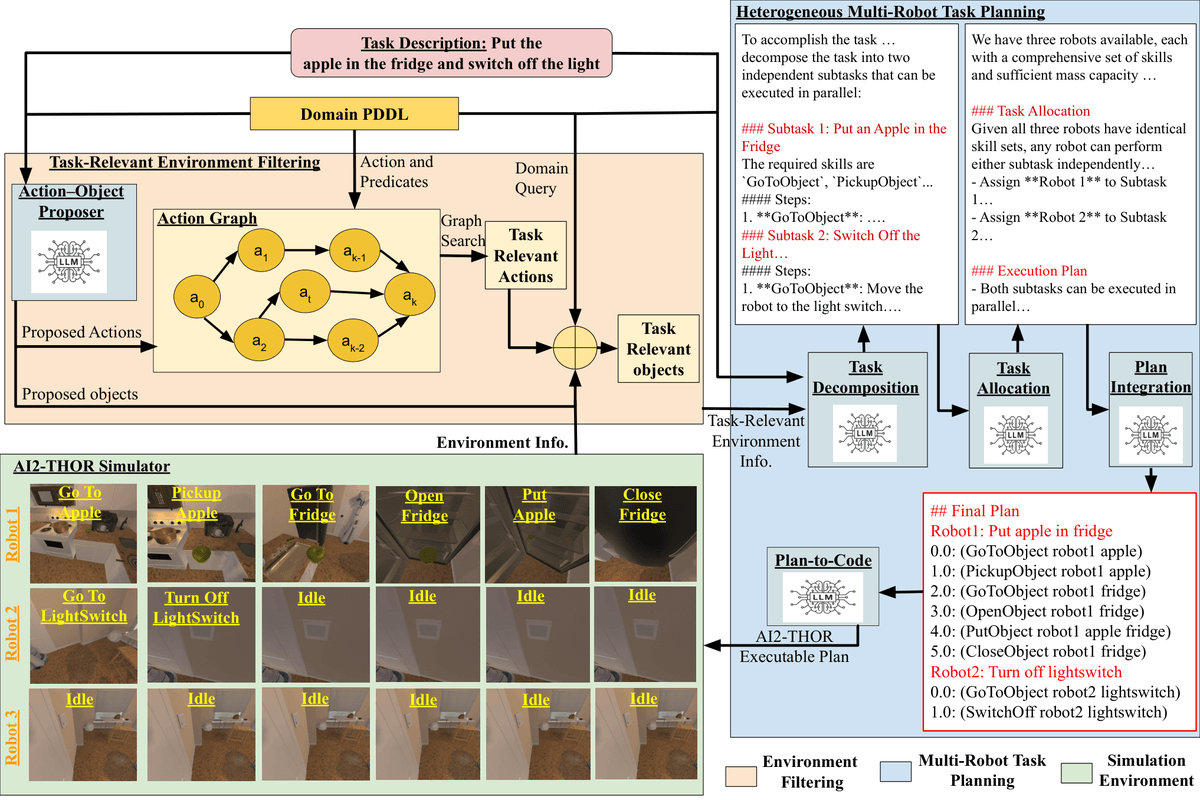
Scale-Plan's core insight is simple: before you plan, figure out which objects and actions are even relevant to the task, and throw everything else away. The framework does this through an action graph built offline from the PDDL domain specification.
Here is how the pipeline works, step by step:
- Build the action graph (offline). Each node in the graph is a parameterized action schema (like
PickUp(?robot, ?object, ?location)). Directed edges encode logical dependencies: action A points to action B if A's effects satisfy B's preconditions. Two edge types are used: a strict edge when A's effects fully cover B's preconditions, and a relaxed edge when there is only partial overlap, ensuring the graph stays connected without becoming too dense. - Shallow LLM filtering (at runtime). Given a natural language instruction, the LLM proposes a small set of candidate terminal actions and relevant object parameters. This is a lightweight call, not a full planning query.
- Backward depth-first search. Starting from those terminal actions, Scale-Plan walks backward through the action graph to find every predecessor action needed to satisfy preconditions. This yields a minimal, dependency-consistent action subgraph. Objects are then inferred from the parameters of selected actions, producing a filtered environment.
- Task decomposition. The filtered domain and object set are handed to an LLM-based pipeline that breaks the overall instruction into manageable subtasks, each with a candidate action sequence.
- Task allocation. Subtasks are matched to robots based on their capability sets. Independent subtasks get assigned to different robots for parallel execution.
- Plan integration and execution. A combiner enforces ordering constraints between dependent subtasks while enabling concurrency where possible. The final plan is converted to executable code and run in the AI2-THOR simulator.

A key design choice is that Scale-Plan never generates an intermediate PDDL problem file. Since problem PDDLs are highly sensitive to object definitions, predicate formats, and goal specifications, even small inconsistencies can lead to infeasible plans. By eliminating explicit problem file generation, Scale-Plan reduces such errors and improves scalability and robustness in complex, object-rich environments.
A benchmark that actually works
The team also noticed that the existing MAT-THOR benchmark, the standard testbed for this kind of work, had significant quality issues. They found missing or incorrect ground-truth goal conditions, duplicate tasks, and linguistic inconsistencies that made evaluation results unreliable. So they built MAT2-THOR, a cleaned version with 49 tasks across three categories:
- Simple (25 tasks): Short-horizon tasks with one or two subgoals, e.g., "Put the apple in the fridge and switch off the light."
- Complex (17 tasks): Longer-horizon tasks requiring coordinated multi-robot execution, e.g., "Put the book in the box, turn on the mobile phone, and clear the desk."
- Vague (7 tasks): Underspecified instructions requiring implicit goal inference, e.g., "Prepare ingredients for cooking a sandwich tomorrow."
They also introduced a new metric parameter, num_contains, to handle ambiguous containment goals like "put two vegetables in the fridge" without requiring a specific pair of vegetables.
The numbers
Scale-Plan was evaluated against four baselines: a pure LLM planner, LLM+P (LLM generates a PDDL problem file solved by Fast Downward), and two variants of LaMMA-P (a structured modular pipeline, with and without LLM correction). All methods used GPT-5.2.
Scale-Plan achieves the best performance across all metrics and task categories. Compared to the strongest baseline, LaMMA-P (LLM-corrected), the method improves TCR by 16% on simple tasks, 35% on complex tasks, and 28% on vague tasks, demonstrating consistent and increasing gains as task difficulty and ambiguity increases.
| Method | Simple TCR (%) | Complex TCR (%) | Vague TCR (%) | Overall TCR (%) |
|---|---|---|---|---|
| LLM as a Planner | 44 | 18 | 57 | 37 |
| LLM+P (PDDL-based) | 48 | 24 | 43 | 39 |
| LaMMA-P (PDDL only) | 36 | 18 | 57 | 33 |
| LaMMA-P (LLM-corrected) | 76 | 24 | 43 | 53 |
| Scale-Plan (Ours) | 92 | 59 | 71 | 78 |
The ablation study confirms that the action-graph-based environment filtering is the key driver. Replacing it with pure LLM-based shallow filtering drops overall TCR from 78% to 67%, and removing filtering entirely drops it to 66%. The gains are most pronounced on complex tasks, where structured filtering improves TCR from 41-44% (no filtering) to 59%.
There is a planning time trade-off worth noting. Scale-Plan averages about 62 seconds of total planning time, comparable to LaMMA-P's 64 seconds, but much slower than the 12-second pure LLM baseline. More LLM inference calls for decomposition, allocation, and coordination are the price of better plans.
Where it still fails
The failure analysis is instructive. Most errors fall into three recurring patterns:
- The robot navigates to the most likely location of an object rather than its actual location, due to LLM hallucinations in object localization.
- The robot tries to pick up a new object without first releasing the one it is already holding.
- The robot attempts to place an object inside a closed receptacle without opening it first.
The cabinet example is telling: the plan correctly identifies that a plunger needs to go in the cabinet, but omits the OpenCabinet action because the LLM lacks explicit affordance reasoning.
These errors arise from missing semantic reasoning about object affordances. Incorporating a structured knowledge graph that encodes properties such as openable, movable, and cookable could mitigate these issues by enforcing affordance-aware action sequencing.
The authors point to their own concurrent work on knowledge-graph-guided planning as a natural next step.
What this unlocks
Scale-Plan is most useful when you have a PDDL domain already defined for your robot system and need to handle natural language instructions in environments with many irrelevant objects. Concretely, that covers:
- Household service robots operating in fully furnished rooms
- Warehouse logistics with heterogeneous fleets (mobile bases + arms)
- Disaster response coordination where scene complexity is high and tasks are long-horizon
- Any setting where you want LLM flexibility without sacrificing the logical guarantees of symbolic planning
The real breakthrough here is not just better numbers. It is the demonstration that filtering at the domain level (actions and their logical dependencies) rather than the instance level (specific objects in a specific scene) is a more principled and scalable approach. Prior work filtered scene graphs by expanding or contracting nodes based on room semantics. Scale-Plan instead reasons about what actions are logically necessary, then derives which objects matter as a consequence. That separation makes the filtering step reusable across different room configurations without retraining.
No code or model weights have been released alongside the paper. The MAT2-THOR benchmark is described in the paper but a public repository link is not yet available. The work has been submitted to IEEE for publication.