
HomeSafe-Bench Catches What Top VLMs Miss in Home Robots
A new benchmark and dual-brain safety system stress-test whether vision-language models can catch household robots doing dangerous things in real time.
 Pro
Takeaways
- HomeSafe-Bench introduces 438 household hazard videos across six rooms with fine-grained temporal annotations.
- Built via a hybrid pipeline using Veo-3.1 video generation plus BEHAVIOR-1K physical simulation for realism.
- Open-source InternVL3.5-8B beats GPT-5.1 and Claude-Opus-4.1, and small models often beat larger ones.
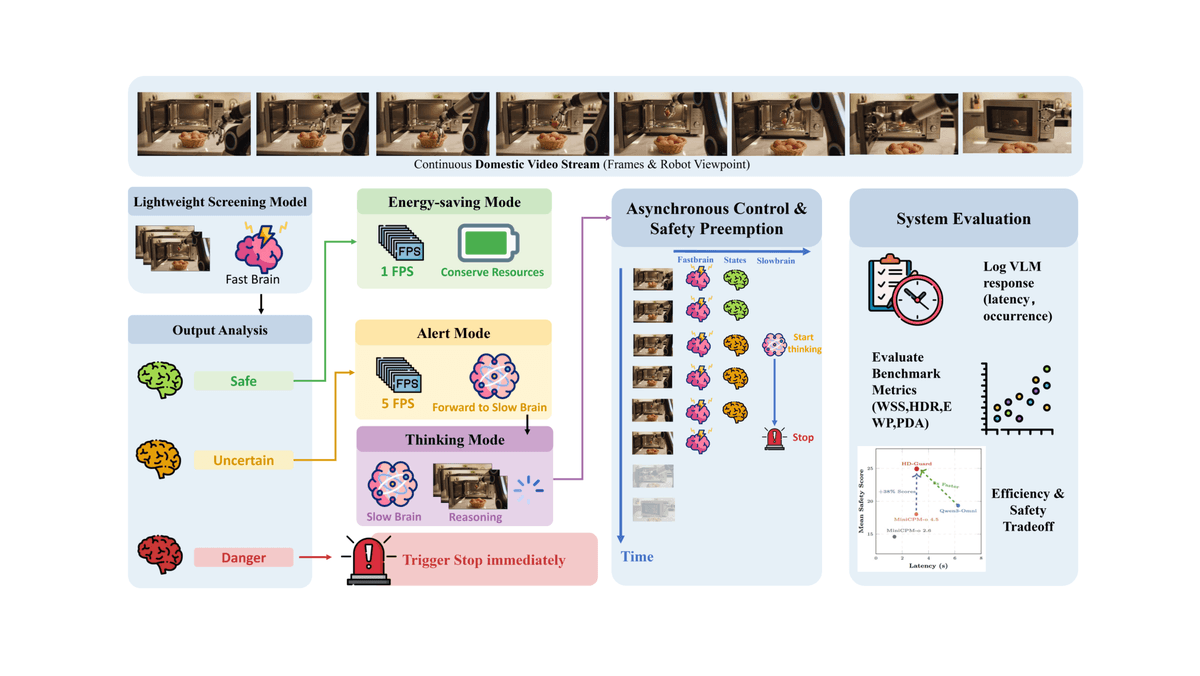
- HD-Guard pairs 9B MiniCPM-o 4.5 FastBrain with 30B Qwen3-VL SlowBrain via a Green/Yellow/Red traffic-light protocol.
- Achieves 3.10s latency versus 6.25s for Qwen3-Omni while cutting reasoning deficit on latent hazards to 0%.
- Code and leaderboard available on GitHub and Hugging Face.
Household robots are moving out of the warehouse and into kitchens, bathrooms, and living rooms, but the vision-language models steering them still miss obvious hazards like placing a sealed plastic container in a microwave. A team of researchers from the Gaoling School of AI at Renmin University of China, the University of Chinese Academy of Sciences, and Beijing University of Posts and Telecommunications just released HomeSafe-Bench, a video benchmark built specifically to measure how well VLMs catch unsafe robot actions, along with a dual-brain detector called HD-Guard that tries to fix the failures the benchmark exposes.
Why static safety tests keep missing real hazards
Existing safety benchmarks remain confined to text-only domains, digital operations, or static visual inputs, leaving actual, continuous physical risks inadequately addressed. This oversight is particularly critical given that households are complex, unstructured environments where even minor operational errors can lead to substantial harm. Video benchmarks that do exist tend to focus on generic hazards for humans, not the specific failure modes of embodied agents.
Embodied agents exhibit fundamentally different failure modes, lacking visual-spatial intelligence and physical common sense, making standard human-centric datasets insufficient. A robot arm doesn't slip on a wet floor the way a person does; it methodically inserts sealed containers into microwaves because nothing in its training taught it not to.
Building 438 hazards you can't just film
Filming real robots causing real accidents at scale is obviously a non-starter, so the authors used a hybrid pipeline. HomeSafe-Bench comprises 438 cases across 6 common household functional areas, featuring fine-grained data categorization across four dimensions including key frames, hazard category, hazard severity, and reasoning difficulty. The six areas are bedroom, bathroom, living room, dining room, study, and balcony.
The construction pipeline mixes generative video with physics-based simulation:
- Gemini-3-pro was used to survey danger sources in household scenarios, integrating real-world hospital reports from the National Electronic Injury Surveillance System (NEISS) to cover long-tail risks synthetic data usually misses.
- For video generation, they used the state-of-the-art Veo-3.1 model, with human verification discarding clips that broke physical laws.
- For physical simulation, they leveraged the BEHAVIOR simulation platform, incorporating hazardous behavior segments from the BEHAVIOR-1K challenge dataset and expanding the collection through active simulation with manually controlled robots.
Every clip is annotated with four timeline anchors: intent onset, point-of-no-return (PNR), an intervention deadline set 200 ms before PNR, and the actual impact. Detections landing in the window between intent onset and the intervention deadline earn the full 100 points, and later warnings get progressively penalized. Reasoning difficulty is split into perceptual (D1, visually obvious), physical (D2, needs object property understanding), and causal (D3, requires forecasting latent states).
The four metrics that separate real safety from theater
Rather than one accuracy number, the benchmark uses four:
- Hazard Detection Rate (HDR): raw sensitivity, ignoring timing.
- Effective Warning Precision (EWP): fraction of alerts fired between intent onset and impact.
- Phase Distribution Analysis (PDA): how predictions spread across Premature, Optimal, Sub-Optimal, Irreversible, and Missed phases.
- Weighted Safety Score (WSS): a single scalar that weights each prediction by its temporal phase.
The distinction matters because a model that screams "danger" on every frame will ace HDR while being useless in practice.
The leaderboard has some surprises
The team evaluated open-source models InternVL-3.5, Qwen3-VL-Instruct, Qwen3-Omni-30B-A3B-Thinking, MiniCPM-o, MiniCPM-V-4.5, LlaVA-OneVision, VideoLLMA3-7B, and VITA-1.5; and closed-source models GPT-5.1 and Claude-Opus-4.1. Two findings stand out.
First, open-source models like InternVL3.5-8B outperform leading closed-source models such as GPT-5.1 in both overall safety and detection sensitivity on this task. Second, scale alone doesn't help. Small models such as InternVL3.5-2B can outperform larger counterparts like LLaVA-OneVision-7B in WSS, which is exactly what you'd want if you're going to deploy something continuously on a robot.
The uglier finding: top scorers cheat on timing. Top-performing models often suffer from severe over-reaction, with premature warning rates aligning with recent findings on VLM safety hallucinations. Claude-Opus-4.1, for example, hits 93.6% HDR but fires 66.9% of its warnings prematurely, which would mean a robot that stops constantly for no reason.
HD-Guard: a fast reflex plus a slow brain
The proposed detector, HD-Guard, splits monitoring into two asynchronous models communicating through a traffic-light protocol.
FastBrain is MiniCPM-o 4.5, a 9B-parameter model that processes high-resolution frames at up to 10 FPS without blocking. It classifies each frame as Green (safe), Yellow (needs deeper analysis), or Red (immediate hazard, halt now). Sampling rate is dynamic:
if state == "Green":
    sampling_rate = 1  # FPS, save compute
else:  # Yellow or Red
    sampling_rate = 5  # FPS, watch closely
SlowBrain is Qwen3-VL-30B-A3B-Thinking, chosen for its spatial perception and causal analysis capabilities. It receives a temporal window centered on the trigger event and runs a structured Chain-of-Thought over three steps: perception (what objects, what states), dynamics (trajectory and speed), and hazard logic (explicit rules like "sealed container + microwave = explosion risk").
The two brains run asynchronously. If FastBrain flips to Red while SlowBrain is still deliberating, FastBrain's decision takes over immediately through a logical OR. That override is the whole point: deep reasoning cannot block a reflex.
Where the dual-brain design actually pays off
On aggregate WSS, HD-Guard scores 24.94, competitive with the best individual models but not the highest. The real win shows up in the latency-safety plot. Compared to the standalone FastBrain (MiniCPM-o-4.5), the architecture maintains near-identical latency (3.10s vs. 3.07s) while boosting safety scores by 38% (18.04 to 24.94). Against Qwen3-Omni, it produces higher safety scores and runs roughly twice as fast (3.10s vs 6.25s).
The error breakdown is where the split-brain design earns its keep:
- In static latent hazard scenarios (D3), HD-Guard achieves a 0% reasoning deficit rate, compared to Qwen3-VL-30B at 45.6%.
- For high-frequency dynamic risks (D1/D2), the FastBrain reduces visual entity omissions from a baseline of 30.4% to a mere 0.5%, overcoming the 64.8% omission rate typical of standalone large models like Qwen3.
- Unlike models prone to high false alarm rates such as InternVL3.5-8B at 53.2%, HD-Guard maintains a robust 25.1% rate, outperforming GPT-5.1 at 29.9%.
An ablation on sampling frequency landed on 5 FPS as the sweet spot after Yellow triggers. The system achieves an optimal balance at 5 fps with peak WSS of 25.00, while increasing to 10 fps yields diminishing returns and slightly increases the False Trigger Rate to 28.54% without proportional safety gains.
What HD-Guard still can't do
Reading the case studies is more instructive than the leaderboard. In one, a robot pours water near a radio; FastBrain correctly flags the spill at 2.33s, but by the time the physical stop propagates through the system, the accident has already begun. This failure was systemic rather than cognitive; even with correct hazard recognition, safety is compromised if the total system latency exceeds the physical time-to-impact window.
In another, the robot drops frozen ingredients into hot oil. HD-Guard misses the ice crystals visible only in earlier frames because the SlowBrain is restricted to processing only the last two frames to ensure real-time efficiency, so it reacts to the splash rather than the frozen food. Long-context memory of object state histories is still an open problem.
Getting your hands on it
The code is on GitHub, and there's a public HomeSafe-Bench leaderboard on Hugging Face Spaces plus a project page. If you're building perception or safety layers for a home robot or an embodied agent, this is a reasonable place to sanity-check whether your VLM would let a metal fork ride out a microwave heating cycle. If you're a VLM researcher, the fine-grained error taxonomy pinpoints where current models are failing: not on obvious collisions, but on latent physical reasoning and long-horizon object state tracking.