
Hoi3DGen Beats Rivals 15x at Generating 3D Humans Holding Real Objects
A new pipeline fine-tunes text-to-image models on 400 carefully curated interaction samples to produce textured 3D humans grasping, sitting, and lifting objects with correct contacts.
 Pro
Takeaways
- Hoi3DGen generates textured 3D humans interacting with objects from text prompts, with an aligned animatable SMPL body model.
- The method reports 4-15x better text consistency and 3-7x better 3D quality than TRELLIS and InterFusion baselines.
- Core trick: fine-tune SANA on just 400 carefully curated samples with multimodal LLM-generated captions from InternVL and LLaMA 3.1.
- View-conditioned sampling generates three angles (front, ±45°) and lifts to 3D via Hunyuan3D, avoiding occlusion failures.
- Contact accuracy reaches 90% overall and 100% on hand-based contacts, versus 10-45% for the base SANA model.
- Code, data, and pretrained models will be released via the project page.
Generating a 3D character holding a briefcase or sitting on a stool sounds like a solved problem given how good text-to-3D has become. It isn't. Existing systems either produce clean humans, clean objects, or a mangled combination where the person has three arms and the briefcase floats six inches from their hand. A team from the University of Tübingen, the Max Planck Institute for Informatics, and TU Nürnberg has released Hoi3DGen, a text-to-3D pipeline that focuses specifically on human-object interactions and reports large gains in how faithfully the output actually matches the prompt.
The headline numbers from the paper: the method surpasses baselines by 4-15x in text consistency and 3-7x in 3D model quality, and in a user study, participants preferred it 91% of the time for text alignment and 86% for visual quality over TRELLIS and InterFusion.
Why interaction breaks current text-to-3D
Most text-to-3D methods rely on score distillation sampling, or SDS, a technique that pulls 3D geometry out of a pre-trained 2D image diffusion model by rendering candidate 3D shapes, scoring them against text prompts, and iteratively refining. It works well for a single object, but it inherits the Janus problem: because the 2D model has no true 3D awareness, it happily generates a face on both sides of a head, or two right hands on the same character.
For interactions, the situation is worse. SDS-based results suffer from the Janus problem and do not follow text prompts faithfully due to the scarcity of high-quality interaction data. Prior work like CG-HOI and InterFusion tried to tackle 3D human-object interaction directly, but they inherit SDS artifacts and, in InterFusion's case, require a user-supplied SMPL body mesh rather than generating the pair from scratch. Interaction datasets exist, but they typically cover a narrow slice of object categories and lack the fine-grained textual captions needed to train a modern text-conditioned generator.
Building captions with a decomposition trick
The core insight is that you do not actually need a lot of interaction data if the captions are good. The authors argue that the interaction capability is already latent in general-purpose text-to-image models. It just needs to be surfaced by a small amount of highly structured data.
They built an automatic annotation pipeline on top of the ProciGen interaction dataset. Instead of asking a multimodal LLM to caption an entire interaction in one shot, they split the job into three subtasks:
- Appearance labeling: Render human and object separately from four orthogonal views, then prompt InternVL to describe clothing, hair, footwear for the human and color, texture, and form for the object.
- Interaction labeling: Ask InternVL to pick an action from a predefined list rather than propose one freely, which the authors found led to hallucinations. Contact points are computed geometrically by finding SMPL body parts within 4 cm of the object.
- Caption fusion: LLaMA 3.1 (70B) stitches the human, object, action, and contact labels into a single natural-sounding description.
Applied across ProciGen, this pipeline produces over 750,000 caption-mesh pairs. But the team then aggressively filters. They bucket samples into eight distinct contact configurations (on back, right hand, left hand, right leg, left leg, both hands, no contact, others), throw out interpenetrating or physically implausible cases, and keep just 50 samples per bucket. The final fine-tuning set is 400 examples.

From caption to textured mesh
With the curated data in hand, the pipeline runs in stages:
- Fine-tune SANA, an efficient latent diffusion text-to-image model, on the 400 samples. The prompt is augmented with a view token from {front, left diagonal, right diagonal}, corresponding to azimuth 0°, -45°, +45°.
- Sample three views of the same interaction. Different angles resolve occlusions such as legs hidden behind a table.
- Retexture with Flux to counter the fine-tuning dataset's limited texture diversity.
- Lift to 3D with Hunyuan3D, producing a single textured mesh per view.
- Segment the combined mesh into human and object using Grounded-SAM 2 across a 360° camera sweep, with per-vertex majority voting.
- Register a SMPL body model using CameraHMR followed by Chamfer-distance refinement, giving an animatable rig with skinning weights.
The view conditioning is worth pausing on. When only one view is used, Hunyuan3D preserves prompt-specified contacts 78 to 79% of the time. Sampling three views and taking the best pushes that to over 90% on generated images and 94.7% on ground-truth ProciGen renderings. Occlusion, not model capacity, was the bottleneck.
The benchmarks
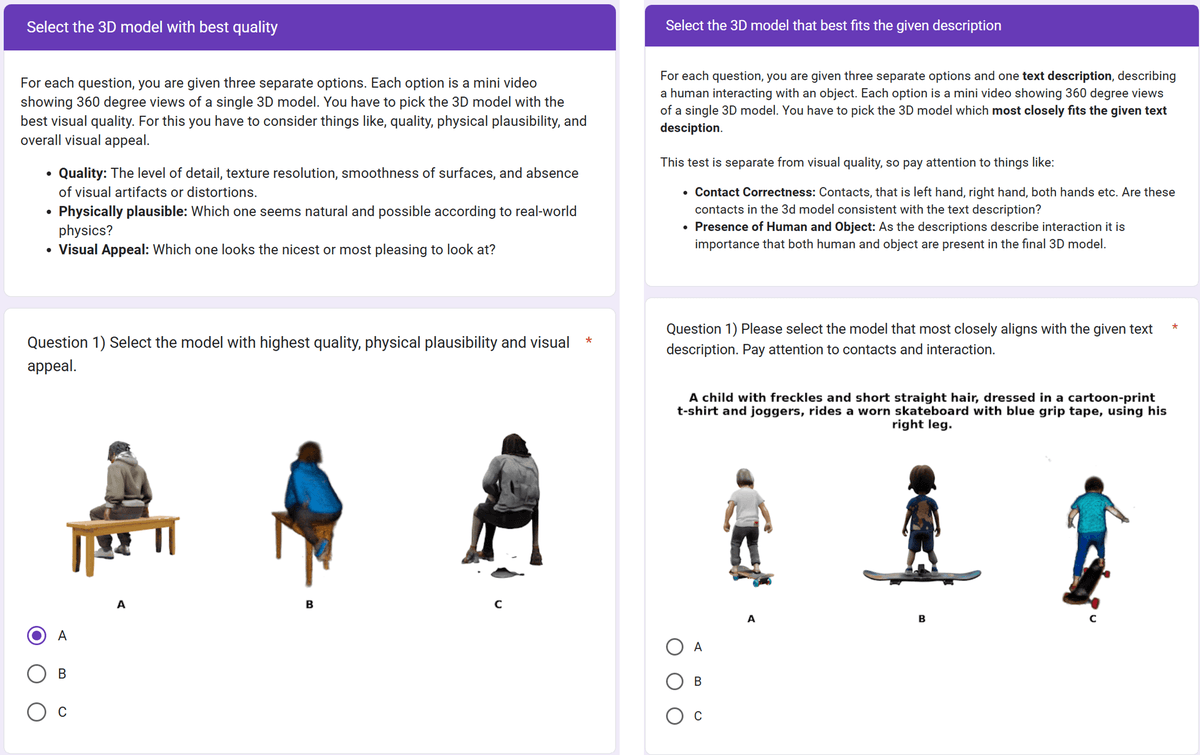
The team evaluated on 100 ChatGPT-generated interaction prompts using GPT-4V as a judge (following InterFusion's protocol), CLIP score, and a contact accuracy metric derived from the SMPL registration. They also ran a user study with 33 participants.
| Method | GPT text | Contact acc. | User text | User 3D |
|---|---|---|---|---|
| TRELLIS | 0.04 | N/A | 3.44% | 10.16% |
| InterFusion | 0.15 | N/A | 5.47% | 3.28% |
| Hoi3DGen | 0.81 | 90% | 91.09% | 85.56% |
One quirky finding: CLIP score is a poor metric here. The fine-tuned model scored slightly lower on CLIP than the base SANA, but generated dramatically more accurate interactions. The authors attribute this to CLIP's limited sensitivity to fine-grained physical interactions, a known weakness of vision-language models. Per-body-part contact accuracy also shows the base model has strong biases. SANA nails right hand and both legs contacts but achieves only 10% accuracy on both hands, while Hoi3DGen hits 100% on all three.

Where it falls short
The authors are candid about limitations. The model handles contacts well but struggles with complex human pose descriptions. Body-part contacts are geometrically unambiguous, whereas prose like "crouched and leaning forward with arms extended overhead" leaves too much room for interpretation. A dedicated text-to-pose module, similar to ChatPose or InterFusion's approach, would likely help.
The training set covers 100 human subjects and 18 object categories from ProciGen. Generalization to novel objects works, but the pool of primitives is smaller than what general-purpose 3D generators see.
What is now practical
The immediate use cases are asset creation for AR/VR, gaming, and animation. Because the pipeline returns segmented human and object meshes plus a registered SMPL rig with skinning weights, the output slots directly into standard animation tools. The authors demonstrate the character running through motion sequences while continuing to carry the generated backpack or swing the generated racket.
A more interesting downstream use is data generation. Because the model can independently vary the human description, object description, action verb, or contact region while keeping the other components fixed, it can be turned into a controllable synthesizer for interaction training data, an area that has historically been bottlenecked by expensive motion-capture campaigns.
The authors state that code, data, and pretrained models will be released, with the project page at virtualhumans.mpi-inf.mpg.de/hoi3dgen serving as the hub.