
HKUST's V-Bridge Beats Million-Sample AI Image Restorers With Just 1,000 Photos
V-Bridge repurposes pretrained video generative models for image restoration with just 1,000 training samples, matching methods trained on a million.
 Pro
Takeaways
- V-Bridge turns pretrained video models into image restorers using only 1,000 training samples.
- Reformulates restoration as a pseudo-video from degraded frame to clean frame via linear interpolation.
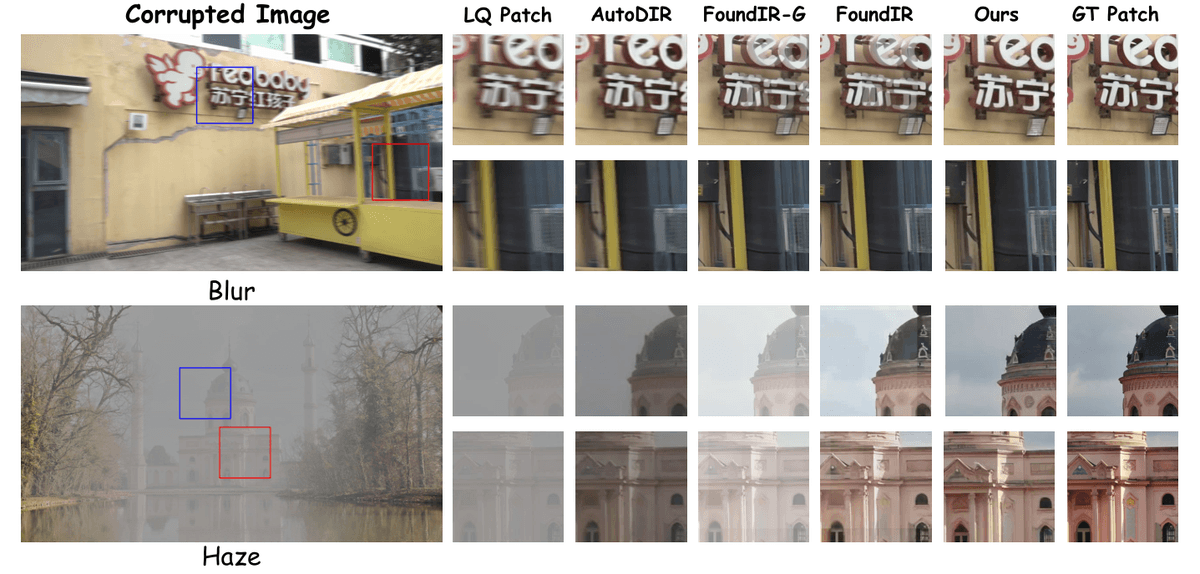
- Beats FoundIR-G (trained on 1M images) by 1.6dB average PSNR across 20 degradation types.
- Uses Wan2.2-TI2V-5B as backbone with progressive 512/720/960 resolution curriculum and drift correction module.
- Generalizes to unseen tasks like snow removal better than million-sample baselines.
- Paper available on arXiv; inference cost remains a practical limitation.
Image restoration models tend to be data-hungry specialists. Training a haze remover typically means feeding it tens of thousands of hazy/clean pairs, and the same routine repeats for rain, blur, low-light, and JPEG artifacts. A new paper called V-Bridge argues that all of that hand-labeled supervision is largely unnecessary if you already have a large-scale video generation model sitting around.
The researchers, from HKUST, Harbin Institute of Technology (Shenzhen), and CUHK, show that a pretrained video model can be nudged into becoming a versatile image restorer with only 1,000 training samples. That is less than 2% of existing restoration methods, and their single model handles blur, noise, haze, rain, raindrops, low-light, JPEG compression, and combinations of the above.

Why restoration has been stuck
Traditional image restoration treats each degradation as its own regression problem. You collect paired data, train a specialist, and repeat. All-in-one models like PromptIR, AutoDIR, InstructIR and DiffBIR try to consolidate everything into a single network, but they still lean on massive supervision. FoundIR, the current heavyweight, was trained on roughly one million samples.
The V-Bridge team makes the case that this pipeline ignores an obvious source of visual knowledge. Modern video generators are trained on enormous corpora and already internalize structural regularities, lighting, object dynamics, and long-range spatial coherence. Those are exactly the priors a restorer needs. The trick is figuring out how to talk to a video model in the language of image restoration.
Restoration as a video, not a mapping
The core reframing is elegant. Instead of learning a one-step mapping from degraded to clean, V-Bridge treats the degraded image as frame 0 and the ground truth as frame T of a short video, then teaches the model to hallucinate the frames in between.
The intermediate frames are built by plain linear interpolation in pixel space between the low-quality and high-quality images. That gives a smooth, monotonic quality progression the video model can imitate. In effect, the paper turns static image pairs into a pseudo-video stream, so the network learns an entire low-to-high quality trajectory rather than a single jump.

How the framework is put together
V-Bridge builds on Wan2.2-TI2V-5B as the backbone video model, and adds three ingredients on top:
- Pseudo-temporal data construction. Each LQ/HQ pair becomes a sequence of T+1 frames via linear interpolation, providing temporally consistent supervision.
- Progressive curriculum training. The model is fine-tuned in three stages at increasing resolutions (512, then 720, then 960), so it first nails global structure and later refines high-frequency detail.
- Drift correction. A lightweight second model corrects for a systematic bias the paper calls resolution drift, where outputs from a video generator pretrained around 720p lose fidelity when the target is 4K.
The drift correction module is trained on short pseudo-temporal sequences that interpolate between the base model's output and the true high-resolution image. Think of it as a specialist that only cleans up the last mile.
The numbers
On the FoundIR test set covering 20 degradation categories, V-Bridge posts an average PSNR of 25.18 dB and SSIM of 0.7729, edging out FoundIR's generalist model that was trained on a million samples. The data scale comparison is where things get uncomfortable for the incumbents.
| Method | Training data | Avg PSNR | Avg SSIM |
|---|---|---|---|
| PromptIR | 77K | 22.49 | 0.7209 |
| DiffUIR | 30K | 23.27 | 0.8105 |
| InstructIR | 15K | 22.18 | 0.7426 |
| FoundIR-G | 1M | 23.57 | 0.8199 |
| V-Bridge | 1K | 25.18 | 0.7729 |
The paper reports a 1.6dB gain over baselines trained on 15x to 1,000x more data. Generalization to out-of-distribution benchmarks (Dense-Haze, UHD-LL, NH-Haze, UAV-Rain1K, HQ-NightRain) is where V-Bridge really pulls ahead, and on HQ-NightRain it more than doubles the PSNR of the next-best method.
A surprising finding about frame count
The ablations turn up an interesting quirk: more frames do not help. The 9-frame setting consistently beats 33 and 61 frames. The authors interpret this as evidence that the video model's contribution is mainly a structural and semantic prior, not dense temporal reasoning. Neighboring frames in a smooth restoration trajectory become semantically redundant, so extra frames just add compute without adding signal.
The progressive resolution curriculum also matters. Training at 512 then 720 then 960 beats fixed-resolution training, while a decreasing schedule (720 then 512) hurts performance because the model prioritizes global appearance and drops fine detail.
What V-Bridge is good and bad at
The strengths cluster around data efficiency and cross-task transfer. With just 200 samples the model already matches full-data baselines, and it transfers to snow removal, a task it never saw during training, better than FoundIR-G trained on a million images.
The weaknesses are honest and worth flagging:
- Inference cost. The authors explicitly note they did not add acceleration to keep the analysis clean. Running a 5B-parameter video diffusion model with 50 sampling steps for each image is not real-time restoration.
- Pixel-fidelity metrics. V-Bridge wins on averages but sometimes trails specialized models on isolated tasks like noise or JPEG when SSIM is the yardstick.
- Task coverage. Generalization is strong but not universal; on the WeatherBench snow subset the average PSNR sits below several dedicated baselines.
Why it matters
The real headline is not that V-Bridge beats FoundIR. It is that a video generation model, with no restoration-specific architecture, can be activated as a competitive restorer using a rounding-error amount of task data. That collapses the boundary between generative modeling and low-level vision and hints at a design pattern for other pixel-level problems, from matting to super-resolution to relighting.
The authors describe V-Bridge as an open-source project in the paper header, though at the time of writing the repository has not been publicly linked. If you already have infrastructure for running large video diffusion models like Wan, HunyuanVideo, or CogVideo, this points to a low-data recipe for turning them into general-purpose visual repair tools.