
HKUST's MoE-ACT Beats Billion-Parameter Robot Policies With a 33% Gain
A lightweight bimanual robot policy adds sparse Mixture-of-Experts routing to ACT, lifting multi-task success rates by 33% over the original.
 Pro
Takeaways
- MoE-ACT adds sparse Mixture-of-Experts to the ACT encoder for multi-task bimanual manipulation, keeping inference lightweight.
- Top-2 expert routing decouples task action distributions and avoids negative transfer across jointly trained tasks.
- FiLM conditioning and multi-scale cross-attention in the decoder anchor actions to language and low-level visual detail.
- Beats ACT by 33% average success on RoboTwin 2.0, and outperforms RDT and BAKU too.
- Real dual-arm tests on AIRBOT MMK2 reach 60% average, running inference on a single RTX 3050 GPU.
- Code is not yet released; see the project page and arXiv paper.
Training a single robot policy to handle many manipulation tasks tends to break in a predictable way: tasks interfere with each other, gradients pull in opposite directions, and the model ends up mediocre at everything. A group from Hong Kong University of Science and Technology (Guangzhou) is proposing a small architectural fix that borrows a trick from large language models. Their system, called MoE-ACT, plugs sparse Mixture-of-Experts layers into the Action Chunking Transformer and reports a 33% average jump in success rate on bimanual tasks.
Why one policy for many tasks keeps falling over
The paper builds on ACT, a popular imitation learning architecture that predicts short chunks of future actions from an encoder-decoder Transformer trained as a CVAE. ACT works well on single tasks but was never designed for multi-task training. When several tasks share one policy, conflicts between objectives and entanglement among action distributions tangle the decision space, and straightforward imitation learning starts to degrade.
The alternative the field has been chasing is large Vision-Language-Action models. Representative examples such as pi_0 and RDT typically contain billions of parameters, which brings high training costs, heavy GPU memory consumption, and slow inference that makes real-time control awkward. MoE-ACT aims for the middle ground: keep the compact ACT backbone, but add capacity that only activates when needed.
The architecture, in three moves

MoE-ACT layers three modifications onto vanilla ACT:
- Sparse MoE encoder. The feed-forward networks in the Transformer encoder are replaced with a routed pool of expert FFNs. A sample-level routing strategy sends all image tokens from the same observation frame to the same expert subset, ensuring spatial consistency in feature processing. The router selectively activates the top-k experts with the highest logits, and k is set to 2.
- FiLM task conditioning in the decoder. A language instruction is classified into a task embedding, which produces scale and shift parameters that modulate the action query tokens at every decoder layer. This keeps generated actions locked to the current task instruction rather than drifting between tasks.
- Multi-scale cross-attention. Standard ACT decoders only attend to the final encoder output. MoE-ACT adds a second cross-attention block that queries intermediate features from the ResNet-18 backbone and lower encoder layers, so the policy sees both raw visual details and high-level semantics.
To prevent the router from collapsing onto a single expert, training adds three auxiliary losses on top of the usual reconstruction and KL terms: an entropy loss to encourage exploration across experts, a load-balancing loss that penalizes uneven expert usage, and an orthogonal loss that pushes expert weight matrices to learn distinct features.
What the numbers look like
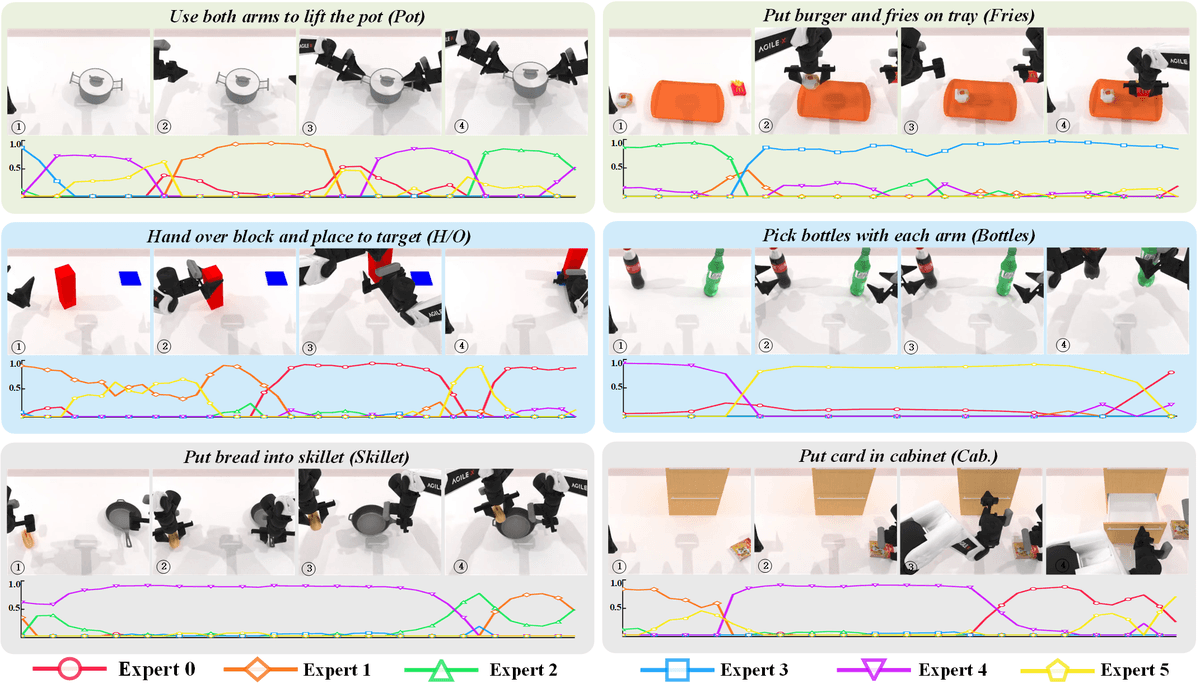
The team evaluated on the RoboTwin 2.0 benchmark with six bimanual tasks, training a single unified policy on all of them with 50 episodes per task. Averaged across the six tasks, ACT hit 22%, Diffusion Policy 19%, BAKU 31%, and RDT 49%. MoE-ACT reached 55%, outperforming ACT by 33 points, RDT by 6, and BAKU by roughly 24.
Ablations show both new decoder pieces matter: removing FiLM drops the average by 9 points, and removing the multi-scale cross-attention drops it by 8. Attention heatmaps offer a sanity check on the multi-scale idea. With low-level features, attention is broader and captures global scene context. With final-level features, attention concentrates spatially on the robot arms and target objects.
Real-world tests used the AIRBOT MMK2 dual-arm platform with three RealSense D435i cameras, running inference on a single RTX 3050. On two tasks, handing over a bottle and placing cubes in a box, MoE-ACT averaged 60% success, versus 35% for ACT and 47% for BAKU. The gain on cube placement was the most dramatic, going from 26% to 52%.
Where it still stumbles
The authors are candid about the failure modes. Most cube-placement failures happen during grasping because the cubes are small, and performance degrades sharply when the initial object positions shift meaningfully from what the model saw during training. They attribute this to limited dataset size and lack of placement diversity in the 50 teleoperated demonstrations per task, and flag data augmentation as future work.
A few other caveats worth noting:
- The expert count and other hyperparameters were tuned empirically, with no principled recipe for choosing them.
- All experiments cap at six simulated tasks and two real tasks, so the "multi-task" claim is still narrow compared to VLA-scale generalist policies.
- The project page lists code as "coming soon," so anyone wanting to reproduce numbers today is stuck reading the paper.
A cheap experiment for stalled ACT stacks
The interesting takeaway is less about MoE-ACT specifically and more about what it suggests: you can capture a meaningful chunk of the multi-task benefit that VLA giants promise by keeping an ACT-sized model and routing image tokens to specialized FFNs. If you already run ACT or a variant like BAKU in your stack and are hitting a wall as you add tasks, swapping the encoder FFNs for a top-2 MoE block plus a FiLM-conditioned decoder is a cheap experiment that stays within the same inference budget. It offers a pragmatic middle path between overfitting a per-task policy and paying the latency tax of a billion-parameter generalist.