
HKUST's FLUX Sends Robots Through Crowds 47% Faster Without Fine-Tuning
A new navigation policy uses rectified flow to plan trajectories in a single sweep, cutting inference latency by nearly a third versus diffusion baselines.
 Pro
Takeaways
- FLUX is the first flow-based unified navigation policy, replacing diffusion's iterative denoising with straight-line rectified flow.
- Inference latency drops 29% versus NavDP diffusion and 47% versus FlowNav at the same sampling budget.
- DynBench adds physically-valid pedestrian simulation with Markov FSM behaviors in Isaac Sim, spanning six navigation tasks.
- Two-stage training combines static imitation learning with GRPO fine-tuning in dynamic crowds, using trajectory candidates as the GRPO group.
- Zero-shot sim-to-real transfer works on Unitree Go2-W, Go2, and G1 humanoid with only an RGB-D camera.
- Code, environments, and dataset are open on GitHub and Hugging Face.
A team from HKUST and NUS has released FLUX, a generative navigation policy that replaces the slow iterative denoising of diffusion-based planners with straight-line trajectory generation. Alongside it comes DynBench, a simulation benchmark for both static goal-reaching and crowd navigation. The pair are aimed at a stubborn problem in robot learning: policies that handle empty warehouses well tend to fall apart around moving pedestrians, and vice versa.
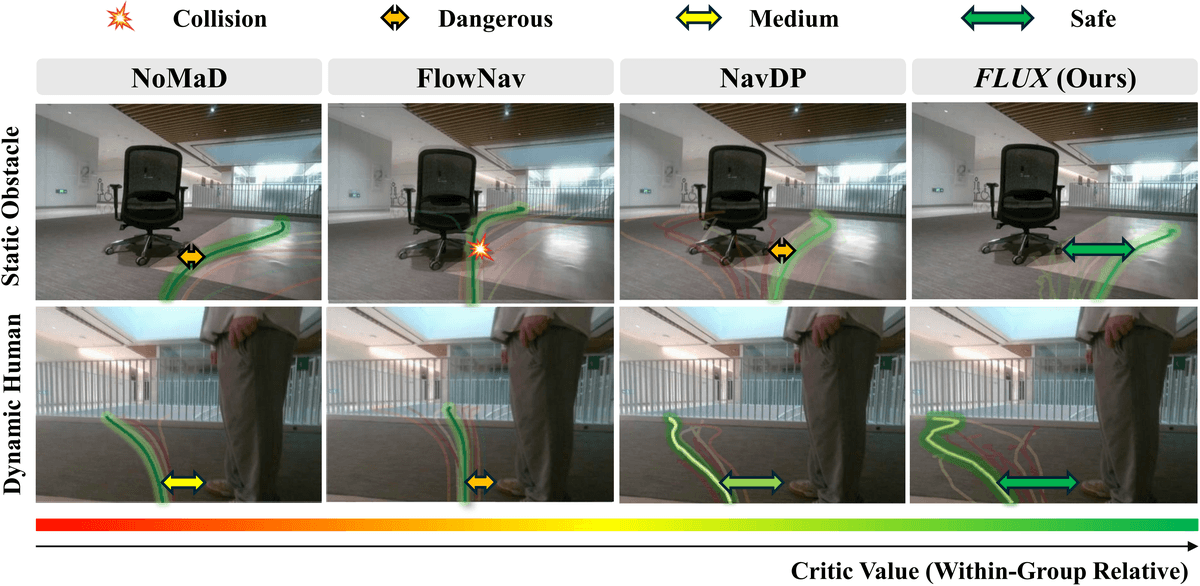
FLUX stands for FLow-based Unified policy for X-platform navigation, and the authors describe it as the first flow-matching policy built to cover both regimes in one model. They report state-of-the-art numbers across six navigation tasks and, more interestingly, zero-shot transfer to three physically different robots without any per-platform fine-tuning.
Why diffusion policies stall in crowds
Modern navigation policies increasingly lean on generative models because a single scene often has multiple valid escape routes, and collapsing that to one predicted action tends to produce brittle behavior near obstacles or people. Diffusion-based planners like NoMaD and NavDP capture that multi-modality well but pay for it at inference: every action requires many denoising steps, which is painful when a pedestrian is walking toward you at 1.1 m/s.
The FLUX authors argue that most social-navigation benchmarks make the problem worse. Existing simulators either use random walks, scripted routines, or ORCA planners that assume every pedestrian is perfectly cooperative, which produces unnaturally coordinated crowds. And static-scene benchmarks skip pedestrians entirely, so a policy trained there never sees the recovery behaviors it needs on a real hallway.
Straight lines instead of noisy detours
The core technical bet is rectified flow. Instead of a diffusion process that adds noise step by step and learns to reverse it along a curved stochastic path, rectified flow trains a neural network to predict a constant velocity field that pushes a noise sample toward a data sample along a straight line. The training loss is a simple mean-squared error between the predicted velocity and the target vector (data minus noise).
At inference, sampling becomes a handful of Euler integration steps along that straight path. In pseudocode the loop is roughly:
tau = sample_gaussian_noise()
for k in range(K):
    t = k / K
    v = velocity_net(t, tau, obs_embedding)
    tau = tau + (1.0 / K) * v
trajectory = tau  # final predicted path
FLUX generates M candidate trajectories this way and hands them to a critic head that picks the safest one. By linearizing probability flow, FLUX replaces iterative denoising with straight-line trajectories, and the practical payoff shows up in latency numbers: 216.5 ms per inference at K=6 steps, versus 305.2 ms for NavDP and 408.6 ms for FlowNav at K=10 on the same hardware. That is a 29% speedup over the diffusion baseline and a 47% cut versus the prior flow-matching approach.
Static first, then thrown into a crowd
Training runs in two stages. Stage one is imitation learning on 3,000 static expert trajectories from Gibson scenes, which the paper notes is roughly 5% of the data used by NavDP. This stage teaches the model geometric priors like clearance and goal-seeking.
Stage two applies Group Relative Policy Optimization, the same RL method used in DeepSeekMath, to fine-tune the policy inside DynBench's dynamic environments. Because FLUX already emits M candidate trajectories per step, those candidates conveniently form the reference group that GRPO needs to compute relative advantages, so no separate value network is required. The reward blends goal progress, an asymmetric penalty for oscillation, and a proxemic-zone penalty based on Hall's classic intimate (0.45 m) and comfort (1.2 m) distances.
The authors report that this static-to-dynamic curriculum has a positive-transfer effect: after RL fine-tuning in crowded scenes, the policy also gets better at the original static tasks. Their reading is that seeing pedestrians teaches recovery behaviors that a purely static dataset never contains.
DynBench and the numbers
DynBench is built on NVIDIA Isaac Sim with rigid-body physics, hierarchical Markov finite state machines for pedestrian behavior, NavMesh-based global planning, and geometric local avoidance. Pedestrians cycle through GoTo, Idle, and LookAround states along fixed triangular paths, forcing the robot to handle non-linear encounters rather than predictable straight lines. Crucially, pedestrians move at 1.1 m/s while the robot is capped at 0.5 m/s, so reactive avoidance alone will not save you.
Across the six evaluation tasks, FLUX beats the previous best on every metric reported:
- PointNav: SR improves from 77.8 to 80.9, SPL from 74.8 to 78.6
- Dynamic PointNav: SR from 38.7 to 42.4, with successful trajectory length dropping from 31.9 m to 20.6 m
- Dynamic Exploration: exploration time up 26.4%, area up 37.4%
- SocialNav: SR from 59.3 to 64.0, collisions per episode from 21 to 16
The sensitivity analysis is worth flagging for anyone thinking of using this in production. Performance keeps climbing as the number of candidate trajectories M scales from 1 to 16 and saturates after, while more integration steps K quickly hit diminishing returns.

The authors settle on M=16 and K=6 as the default configuration, hitting near-peak accuracy while keeping inference under a quarter of a second.
One policy, three robots, no fine-tuning
The real-world test is where the paper gets interesting for anyone building physical systems. The same trained policy runs on a Unitree Go2-W (wheeled), a Go2 (quadruped with camera bounce from its gait), and a G1 humanoid whose 1.3 m camera height sits well above anything in the training data. All three use a single Intel RealSense D455 RGB-D camera, with inference offloaded to a remote RTX 4060.
The paper is honest about limits. There is no explicit model of human intent or etiquette, so the trajectories are risk-aware but not truly socially reasoning. Evaluation is limited to indoor pedestrian scenarios with simulated agents, and the sim-to-real gap for genuinely varied outdoor environments has not been closed.
Getting your hands on it
The team has released the method code, a separate repo for the Isaac Lab environment, and the DynBench dataset on Hugging Face. The full technical write-up lives on arXiv. The paper has been accepted to IROS, and the reference implementation targets a single RTX 4090 for training, which puts it inside reach for most robotics labs rather than requiring a cluster.