
HKUST's EgoIntent Exposes a Blind Spot Crippling Today's Best Video AI
A new first-person video benchmark tests whether multimodal models can infer moment-to-moment human intent, and even the best model scores just 33.31.
 Pro
Takeaways
- EgoIntent introduces step-level intent evaluation for egocentric video, covering What, Why, and Next dimensions.
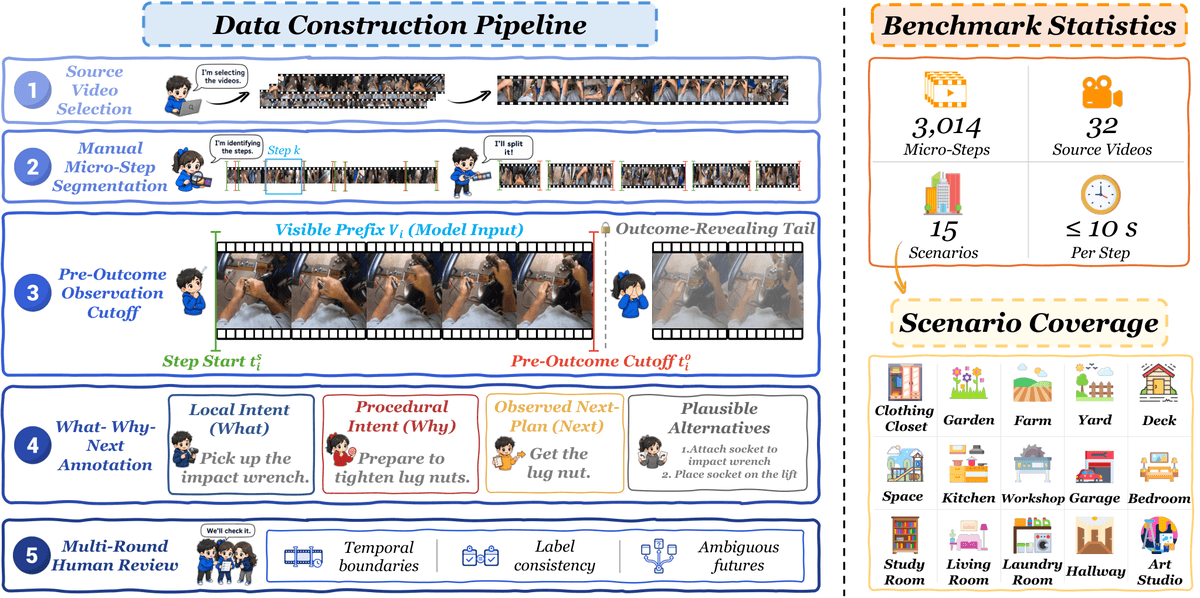
- Benchmark contains 3,014 hand-annotated steps across 15 indoor and outdoor daily-life scenarios.
- Clips are truncated before the key outcome (contact, grasp) to prevent future-frame leakage.
- Best model, Qwen3.5-plus, scores only 33.31 average, showing anticipatory intent remains unsolved.
- Models consistently do better on Why than on What or Next-step prediction.
- Built on Ego4D GoalStep; evaluated with a Qwen3-based semantic-consistency judge.
First-person video is where the next wave of AI assistants, AR guidance systems, and imitation-learning robots will live. But there is a quiet assumption baked into most current evaluations: that inferring what a person is doing over a three-minute clip is the same problem as inferring what they are trying to do right now, at this exact grasp. A new benchmark from researchers at HKUST (Guangzhou) argues those are very different problems, and current multimodal LLMs are surprisingly bad at the harder one.
The benchmark, called EgoIntent, evaluates step-level intent understanding in egocentric videos. It comprises 3,014 steps spanning 15 diverse indoor and outdoor daily-life scenarios, and evaluates models on three complementary dimensions: local intent (What), global intent (Why), and next-step plan (Next). The headline result: even the best-performing model achieves an average score of only 33.31 across the three intent dimensions.
Why episode-level intent is not enough
Prior egocentric benchmarks like EgoSchema, EgoPlan-Bench, and EgoGazeVQA generally reason at the clip or episode level, asking what someone is doing over an extended segment. The authors argue that in real procedural activities, intent evolves with every micro-action. Existing benchmarks focus primarily on episode-level intent reasoning, overlooking the finer granularity of step-level intent understanding. Yet applications such as intelligent assistants, robotic imitation learning, and augmented reality guidance require understanding not only what a person is doing at each step, but also why and what comes next, in order to provide timely and context-aware support.
Concretely, EgoIntent decomposes intent into three layers annotated on each step:
- Local intent (What): the immediate goal of this step (not a paraphrase of the visible action).
- Global intent (Why): the functional role of this step in the larger procedure.
- Next-step plan (Next): the action most likely to begin after the current step ends.
The trick: cutting the video before the punchline
The most interesting design choice is temporal truncation. Each clip is truncated immediately before the key outcome of the queried step (e.g., contact or grasp) occurs and contains no frames from subsequent steps, preventing future-frame leakage and enabling a clean evaluation of anticipatory step understanding and next-step planning. In other words, if the step is "pick up the drill," the clip ends before the hand actually touches the drill. This forces models to reason from pre-outcome cues like gaze direction, hand trajectory, and scene context rather than reading the answer off a completed action.
The benchmark is built on top of Ego4D GoalStep annotations, using GoalStep's step boundaries as the basic units and Ego4D narrations as an initial reference for local intent, which annotators then rewrote to reflect intent rather than surface description. Roughly 6.1% of global intent labels and 13.7% of next-step labels had to be rewritten because they leaked information from after the truncation point. The final task is open-ended generation, not multiple choice, and outputs are graded by a Qwen3-based semantic-consistency judge rather than exact string match.

How 15 models actually did
The team evaluated 15 multimodal LLMs, mixing closed and open-source systems, all under a unified prompt requiring three fixed output fields. To keep comparisons fair, they fed image sequences sampled at 6 FPS to closed-source models rather than raw video, since the native video APIs typically use 1 FPS and would miss transitions.
Top results across the three dimensions:
| Model | Overall | Local (What) | Global (Why) | Next |
|---|---|---|---|---|
| Qwen3.5-plus (closed) | 33.31 | 32.06 | 36.80 | 31.06 |
| Gemini-3-flash-preview | 32.17 | 30.82 | 34.33 | 31.36 |
| Qwen3.5-397B-A17B (open) | 31.68 | 30.94 | 34.05 | 30.06 |
| Qwen3-VL-8B-Instruct | 29.38 | 26.28 | 32.85 | 29.02 |
| InternVL3-8B | 24.95 | 22.94 | 29.01 | 22.90 |
| DeepSeek-VL-7B-Chat | 9.43 | 9.59 | 9.10 | 9.27 |
A consistent pattern shows up across the board: models score meaningfully higher on "why" than on "what" or "next." The authors read this as models being reasonably good at coarse functional reasoning over procedures, but weak at pinning down the immediate goal or predicting the next action, exactly the abilities you would want from a proactive assistant. The truncation setting amplifies the gap, because there is no completed-outcome frame to reverse-engineer intent from.
What this is useful for
EgoIntent is a diagnostic testbed, not a training set or a released model. It is most useful if you are:
- Building an AR or smart-glasses assistant that needs to jump in before the user asks, similar to the proactive-agent line of work behind systems like AI for Service.
- Training an imitation-learning robot that has to predict human sub-goals from partial demonstrations.
- Evaluating whether a video-LLM actually understands procedural structure or is just captioning frames.
Its limitations are worth being honest about. It is a benchmark of 3,014 hand-annotated steps drawn from Ego4D GoalStep, so it inherits Ego4D's activity distribution and skews heavily toward short steps (median 1.87 seconds). Scoring is done by an LLM judge, which trades exact-match brittleness for some evaluator bias. And crucially, no accompanying code, model, or public data drop is announced in the paper. The contribution here is the benchmark design and the empirical finding that step-level anticipatory intent is a real, unsolved bottleneck between today's video-LLMs and the proactive assistants they are being pitched as.