
HKUST's DVD Beats Video Depth AI Using 163x Less Training Data
A new framework turns a pretrained video diffusion model into a single-pass depth regressor, matching state-of-the-art accuracy with 163x less training data.
 Pro
Takeaways
- DVD adapts pretrained Wan2.1-1.3B video diffusion into a single-pass deterministic depth regressor via a new paper.
- Achieves SOTA zero-shot on KITTI (6.7 AbsRel), ScanNet (5.5), and Bonn (4.7) benchmarks.
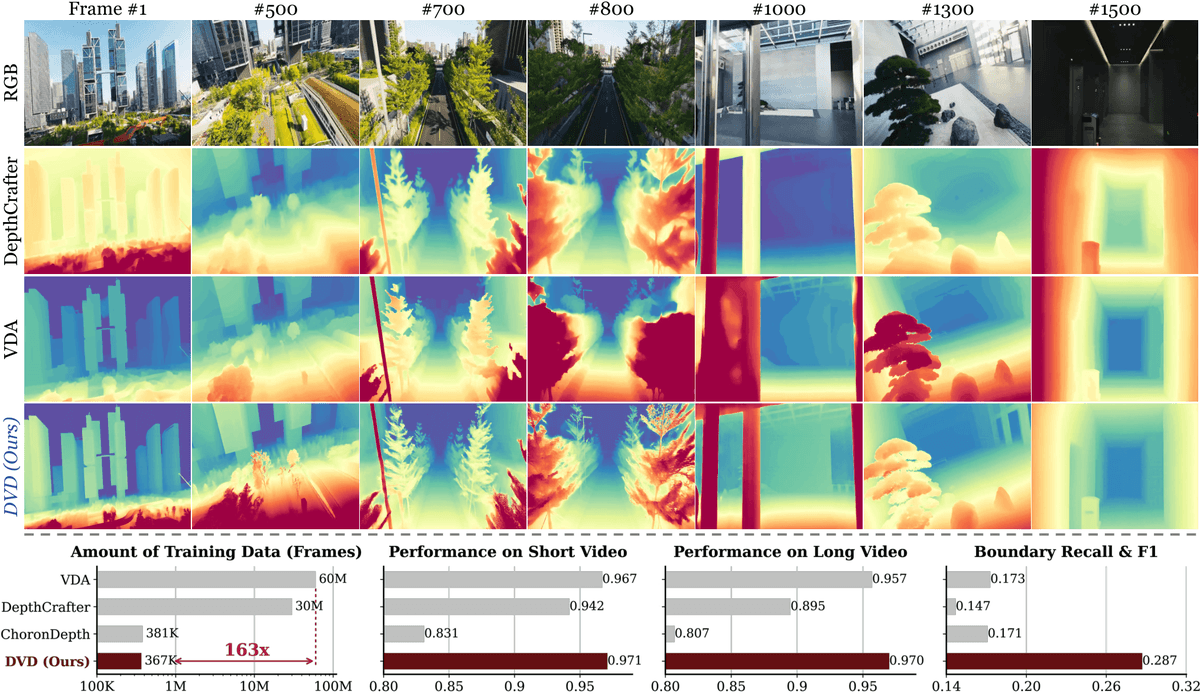
- Trains on 367K frames, 163x less data than VDA's 60M-frame dataset.
- Three key innovations: timestep as structural anchor, Latent Manifold Rectification, global affine coherence for long videos.
- Full code, weights (v1.0 and v1.1) and Gradio demo released at EnVision-Research/DVD.
- Training completes in under 36 hours on 8 H100 GPUs using LoRA fine-tuning.
Video depth estimation has been stuck in a frustrating dilemma. On one side sit diffusion-based generators that hallucinate geometry and drift over time. On the other are ViT regressors that stay stable but need mountains of labeled data. A new framework called DVD (Deterministic Video Depth) argues you can have both, by stripping the stochasticity out of a pretrained video diffusion model and using it as a deterministic single-pass regressor.
The paper from HKUST(GZ), HKUST, UCSD, Princeton, MBZUAI, and collaborators reports state-of-the-art zero-shot results on KITTI, ScanNet, and Bonn while using only 367K frames, which is 163x less task-specific training data than leading discriminative baselines like VDA (60M frames). The full training suite, weights, and a Gradio demo are already public.
The ambiguity-hallucination dilemma
To understand the contribution, you need to see the trap the field is in. Diffusion-based generative models like DepthCrafter leverage pretrained video foundation models to capture rich spatio-temporal priors, enabling impressive zero-shot generalization. But their reliance on stochastic sampling introduces temporal uncertainties, and the generative nature tends to prioritize visual plausibility over geometric accuracy, leading to geometric hallucination. Every denoising step is a new roll of the dice, so floors ripple and walls breathe across frames.
The alternative, discriminative ViTs like Video Depth Anything (VDA), gives you deterministic outputs but pays an enormous data tax. Because they learn geometry purely from dense annotations, they misread motion blur and textureless regions as real structural boundaries unless you feed them tens of millions of labeled frames. That is not something an academic lab or a small team can reproduce.
Repurposing a video diffusion model as a regressor
DVD builds on Wan2.1-1.3B, a pretrained video diffusion transformer, and fine-tunes it with LoRA so that instead of iteratively denoising Gaussian noise, it maps an RGB latent directly to a depth latent in one forward pass. The frozen VAE encoder projects both RGB frames and depth maps into the same latent space, and the DiT learns the mapping between them.

Three ideas make the deterministic conversion actually work. Each addresses a specific failure mode that shows up when you naively turn a diffusion backbone into a regressor.
Timestep as a structural anchor
In rectified flow training, the timestep t parameterizes how much noise has been added to a sample. In DVD there is no noise, but the authors keep t around anyway as a fixed conditioning value. Why? Because during pretraining, high t taught the network to reason about low-frequency global structure and low t taught it to resolve high-frequency detail. That spectral bias is baked into the weights.
The team ablated τ across the full range and found a sharp fidelity-stability trade-off. Extreme values collapse the model: on KITTI, τ=0.9 pushes AbsRel to 23.0 and τ=0.0 gives 13.8, while τ=0.5 lands at 6.7. Just as telling, they tried replacing the fixed sinusoidal embedding with a randomly initialized learnable one, and AbsRel jumped to 23.7. The pretrained geometric priors are entangled with the original frequency encoding, and a fresh embedding cannot unlock them.
Fighting mean collapse with Latent Manifold Rectification
Point-wise L2 regression has a well-known pathology called mean collapse. When multiple plausible depths could explain a pixel, minimizing squared error pushes the prediction toward the conditional average, which washes out sharp edges. In video, that smoothing propagates across frames as boundary erosion and motion flicker.
Latent Manifold Rectification (LMR) is a parameter-free fix that adds two extra loss terms:
- Spatial rectification: match the horizontal and vertical finite-difference gradients of the predicted and target latents to preserve sharp discontinuities.
- Temporal rectification: match the frame-to-frame latent differences so predicted motion follows the ground-truth flow.
Concretely, the full training loss is L2 + λ_sp * L_spatial + λ_temp * L_temporal, with both weights set to 0.5. Ablations show B-F1 on ScanNet climbing from 0.210 with L2 alone to 0.259 with LMR, while AbsRel drops from 8.5 to 7.3.
Long videos via global affine coherence
Long clips force sliding-window inference because a DiT cannot swallow thousands of frames at once. Generative models handle this badly: each window samples independently, so scale drifts non-linearly between windows and the geometry flickers. DVD is deterministic, so within the latent space the variance is exactly zero. The only remaining source of inter-window disagreement is the VAE decoder, whose context-dependent normalization causes small shifts in absolute depth values.
The paper's empirical finding is that these decoder-induced shifts are essentially a global scale-and-offset transform, not a complex non-linear warp. That means aligning adjacent windows reduces to a closed-form least-squares problem over the overlapping frames:
s = Cov(d_A_overlap, d_B_overlap) / Var(d_B_overlap)
t = mean(d_A_overlap) - s * mean(d_B_overlap)
W_B_aligned = s * W_B + t
No feature matching, no optical flow, no recurrent temporal module. Just a scalar scale and shift per window boundary.
What the numbers say
Across the standard zero-shot benchmarks DVD is either best or tied with VDA, despite training on a fraction of the data:
| Method | Train frames | KITTI AbsRel | ScanNet AbsRel | Bonn AbsRel |
|---|---|---|---|---|
| ChronoDepth | 381K | 15.2 | 17.1 | 16.8 |
| DepthCrafter | ~30M | 9.9 | 7.1 | 5.9 |
| VDA | 60M | 7.2 | 5.8 | 4.7 |
| DVD | 367K | 6.7 | 5.5 | 4.7 |
The boundary-sharpness gap is more dramatic. On KITTI, DVD hits a B-F1 of 0.285 versus VDA's 0.088 and DepthCrafter's 0.044. And on long-video splits, DVD holds up better than everyone: 5.3 AbsRel on Bonn versus 8.5 for DepthCrafter and 6.6 for VDA.

Efficiency and access
Training converged in under 36 hours on 8 H100 GPUs, an unusually cheap recipe for a foundation-model adaptation. Inference speed is competitive with discriminative baselines because there is no iterative sampling loop, and the demo runs on a single A6000.
The team has been aggressive about open-sourcing:
- Code is released under Apache 2.0 on GitHub, including training scripts, dataset construction code, and inference bash scripts.
- Pretrained weights (v1.0 and a v1.1 with better temporal consistency and reflective-surface handling) are on Hugging Face under CC BY-NC 4.0 (research use).
- An online Gradio demo is available, capped at 5-second clips, with local deployment supported for longer videos.
- A community ComfyUI node already exists.
Where it still breaks
The global affine coherence assumption is empirical, not a theorem. It holds when adjacent windows share substantial geometric overlap. On sequences with prolonged occlusions, rapid illumination changes, erratic camera motion, or hard scene cuts (say, an indoor desk followed by an outdoor tunnel), the affine model breaks and absolute depth drifts across disjoint segments. VDA has the same problem, and DVD still keeps sharper local geometry even when the global scale slips.
Two other honest limitations: the 1.3B DiT backbone is not fast enough for real-time on-device deployment (think under 100 ms per frame), and the 8x VAE downsampling caps how thin a structure the model can recover. Both are pointed at as future work, with distillation into linear-attention students as an obvious next step.
Why it matters
The real story here is not just another benchmark leader. It is a demonstration that a large pretrained video diffusion model already contains most of the geometric knowledge you need, and that unlocking it for a discriminative task takes a surprisingly small amount of extra data and a few carefully placed inductive biases. If the same recipe generalizes to other dense video tasks (normal estimation, segmentation, optical flow), the cost curve for building strong open-source video perception models could get a lot friendlier.