
HKUST's D²C Trains Image AI 233x Faster Using 0.8% of ImageNet
A two-phase Select-and-Attach framework trains SiT-XL/2 to FID 4.3 using just 10K ImageNet images and 40K steps.
 Pro
Takeaways
- D²C condenses ImageNet to 0.8% of its size and trains SiT-XL/2 to FID 4.3 in 40K steps.
- Reported speedups: 233x over vanilla SiT-XL/2 and 100x over SiT-XL/2 + REPA.
- Select phase ranks images by diffusion denoising loss, then uses interval sampling for diversity.
- Attach phase adds T5 text embeddings and DINOv2 visual features to each selected image.
- With 50K condensed images and CFG, D²C reaches FID 2.78 at 180K steps.
- Classification-oriented methods like SRe²L and RDED collapse on generative tasks (FID above 100).
Training a diffusion transformer from scratch is a punishing exercise: the standard recipe for SiT-XL/2 on ImageNet burns through 1.28 million images and seven million training steps before it hits a competitive FID. A new paper from HKUST (GZ), UESTC and HIT (SZ), published at CVPR 2026, argues that most of that data and compute is wasted, and proposes a dataset condensation framework called D²C that trains the same architecture to FID 4.3 in 40K steps using only 10K images, roughly 0.8% of ImageNet.
The authors frame the bottleneck as a data problem rather than a model problem. Diffusion models have achieved remarkable performance on a wide range of generative tasks, yet training them from scratch is notoriously resource-intensive, typically requiring millions of training images and many GPU days. Prior work has attacked this with architecture tweaks, attention shortcuts, reweighting schemes, or representation alignment. D²C instead builds a much smaller condensed dataset that carries enough signal to replace the full one.

Why classification-style condensation breaks for diffusion
Dataset condensation is not new, but it has almost exclusively been developed for classifiers. Methods like SRe²L and RDED either synthesize class-discriminative images through gradient optimization or crop patches that maximize classification signal. Pointed at a diffusion model, they fall apart. SRe²L and RDED, which perform well in classification task, fail on this generative task due to their focus on category-discriminative features. Under a 10K budget on DiT-L/2, RDED yields a gFID of 166.2 and SRe²L 104.2, while D²C hits 4.2.
The reason is simple. A classifier only needs features that separate cats from dogs. A diffusion model needs to learn the full pixel distribution, including textures, lighting, and layout. Synthetic images that look like adversarial mosaics train great classifiers and terrible generators.
Select: ranking images by how hard they are to denoise
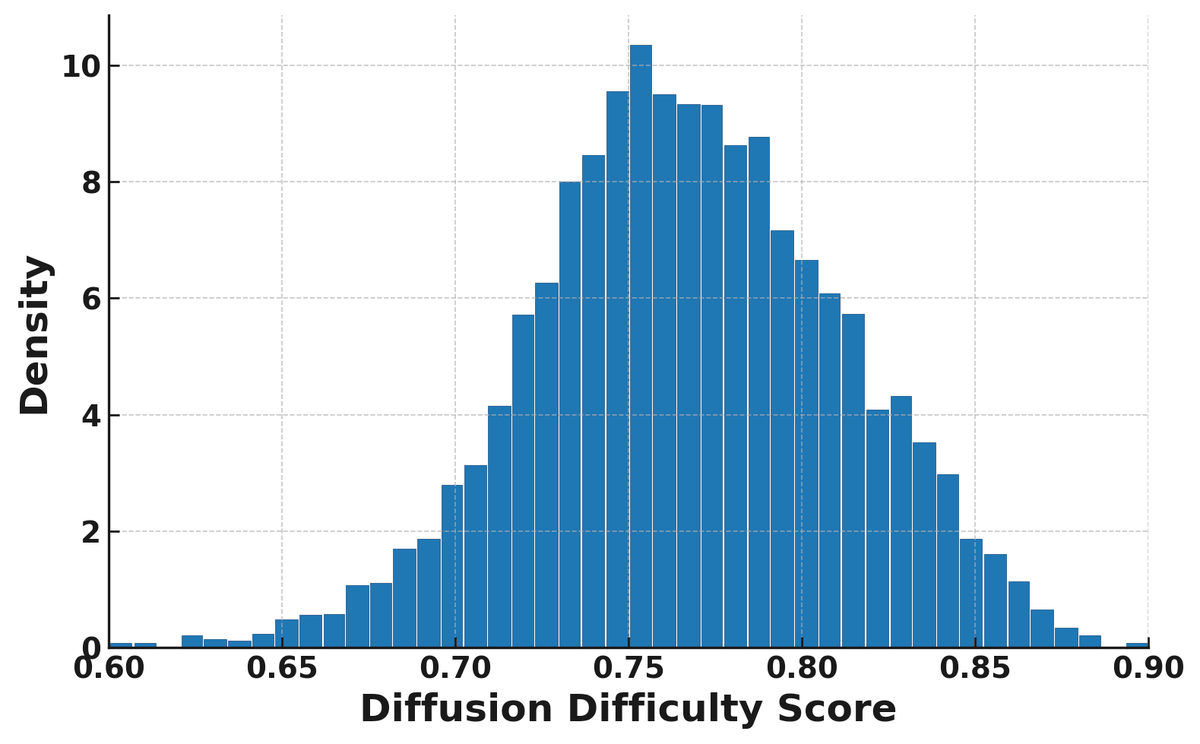
D²C runs in two phases. The first, Select, ranks every training image by a diffusion difficulty score. The idea leans on a known result that a class-conditional diffusion model implicitly encodes the posterior p(c|x) through its denoising loss. So for each image the authors compute the mean squared error between predicted and true noise, averaged over sampled timesteps, using a frozen pretrained DiT-XL/2 as the scorer. Lower loss means the sample is easy for the model to reconstruct given its class label.
Naively picking the easiest images gives you a subset of clean, boring, background-free photos with high learnability but almost no diversity. Picking the hardest gives cluttered, ambiguous images that destabilize training. The authors instead sort each class by difficulty and take every k-th image, an interval sampling strategy that covers easy, medium, and hard examples in proportion. Empirically the sweet spot scales with budget: k=96 for a 10K subset, k=16 for 50K.

Attach: enriching each surviving image with priors
The second phase, Attach, treats each selected image as a slot to be enriched with additional conditioning signals. Two things get bolted on:
- Dual Conditional Embedding. Instead of the usual one-hot class token trained from scratch, D²C encodes a prompt like "a photo of a cat" with a frozen T5 encoder, then fuses the resulting text embedding with a learnable class embedding through a 1D convolution and residual MLP. T-SNE plots in the paper show that one-hot class tokens have no semantic structure, while text embeddings naturally cluster related classes such as different dog breeds.
- Visual representation injection. A frozen DINOv2-B extracts patch-level features from each selected image, which are stored to disk alongside the sample. During training the diffusion transformer aligns its intermediate token features with these DINOv2 features through a cosine-similarity loss, the same trick used by REPA.
The full training loss is the standard denoising MSE plus this semantic alignment term with a weight of 0.5.
The numbers
The headline claim is a 233x speedup over vanilla SiT-XL/2 and 100x over SiT-XL/2 with REPA on ImageNet 256x256, reaching FID 4.3 at 40K steps with only 10K images. Pushing to 50K condensed images and 180K steps drops FID to 2.78. On ImageNet 512x512 with only 10K images, DiT-L/2 drops from FID 17.1 (random sampling) to 5.8 at 300K iterations.
| Config | Data | Iters | gFID |
|---|---|---|---|
| SiT-XL/2 vanilla | 1.28M | 7M | 8.3 |
| SiT-XL/2 + REPA | 1.28M | 4M | 5.9 |
| SiT-XL/2 + D²C | 10K | 40K | 4.3 |
| SiT-XL/2 + D²C | 50K | 180K | 2.78 |
Wall-clock is where the practical case gets interesting. With a pretrained scorer, the full pipeline runs 9.5 hours (2.1h scoring + 7.4h training) versus 750 hours for REPA, about 79x faster end-to-end. Even if you train the scoring network from scratch, the total is 35.5 hours, still 21x faster than REPA.
Ablations worth noting
The ablation table isolates each contribution. On DiT-L/2 with 10K images:
- Random sampling baseline: gFID 37.07
- Add Select phase alone: 14.96
- Add Select plus visual injection only: 10.37
- Add Select plus DC-Embedding only: 9.01
- Full D²C: 7.62
Interestingly, the Attach phase alone (no Select, just the enrichment applied to randomly chosen images) already beats REPA on the full dataset, reaching FID 5.6 in 40K iterations. Select on top of that pushes it to 4.3. Also, the scorer does not need to be state of the art: a DiT-L/2 scorer trained from scratch (base FID 11.5) yields 4.9, versus 4.3 from a strong DiT-XL/2 scorer.
Where it fits, and where it does not
D²C is validated on class-to-image generation with SiT and DiT backbones on ImageNet and CIFAR-10. The authors sketch a text-to-image extension using SDXL to score LAION pairs, showing a similar U-shaped difficulty distribution, but full T2I experiments are left as future work. The framework also inherits REPA-style alignment, meaning it assumes you have access to a strong self-supervised vision encoder like DINOv2 at training time.
Two limitations to keep in mind. First, you still need a pretrained diffusion model to compute difficulty scores, though the paper shows a weak one works fine. Second, this is condensation for training generators, not distillation for faster inference; the resulting SiT-XL/2 still runs at normal sampling cost.
Code and condensed subsets are not yet publicly released in an official repository, though a follow-up paper (GADC) that builds on D²C has released its implementation on GitHub and credits the D²C authors directly.