
HKUST's CausaDisco Uses Aristotle to Make LLMs Teach 70% Deeper
Researchers baked Aristotle's Four Causes into an LLM tutor's prompts to auto-generate follow-up questions, boosting engagement and depth in self-learners.
 Pro
Takeaways
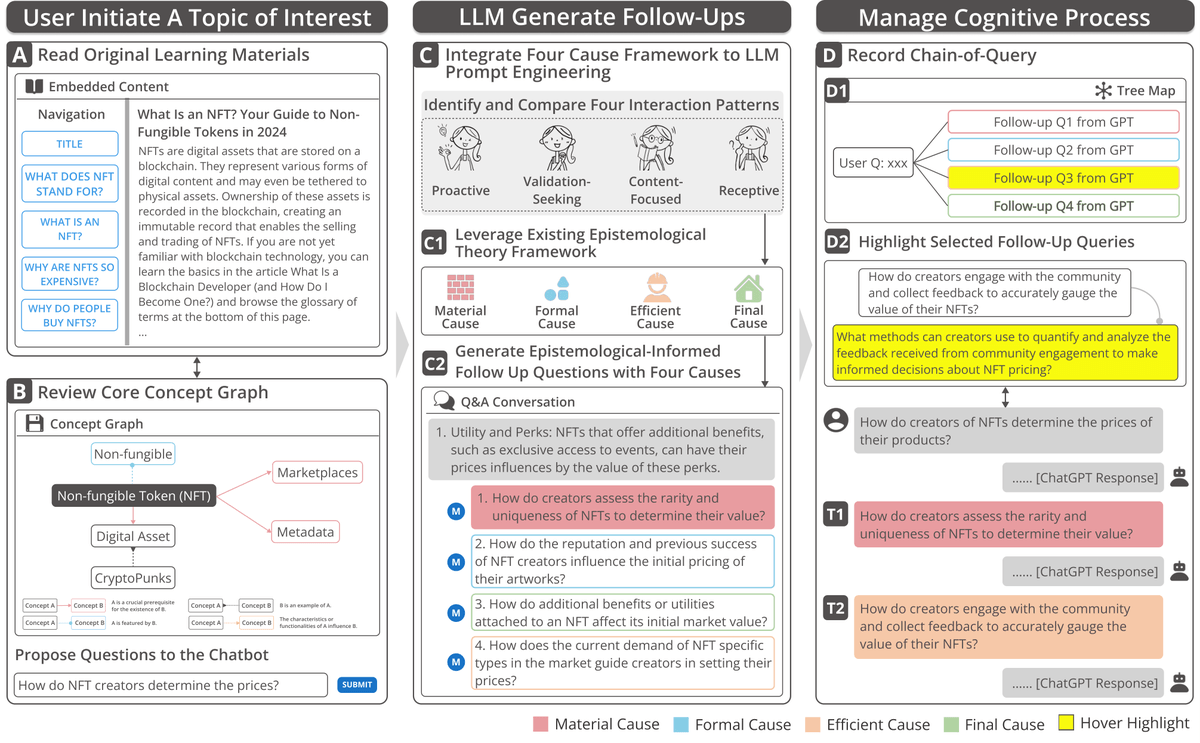
- CausaDisco integrates Aristotle's Four Causes into LLM prompts to auto-generate follow-up questions for self-learners.
- Formative study (N=26) identified four learner personas: proactive, validation-seeking, content-focused, and receptive.
- Controlled study (N=36) showed significant gains in engagement, coherence, and in-depth understanding versus baseline LLM tools.
- Dialogue turns nearly doubled with CausaDisco (6.97 vs 4.08 per session) compared to standard chatbots.
- Four Causes map cleanly to material components, defining attributes, mechanisms of change, and real-world purpose.
- Prototype is research-only, no code release, but the prompt pattern is trivial to replicate.
Most of us have tried to learn something new by chatting with an LLM, only to hit the same wall: the tool is only as useful as the questions you can think to ask. A team from HKUST, UNC Chapel Hill, and collaborators built CausaDisco, a self-learning system that pipes Aristotle's 2,300-year-old Four Causes framework into LLM prompts to generate follow-up questions automatically, so learners can go deeper without having to invent every next prompt themselves.
The prompt-crafting tax on learners
The researchers ran a formative study of 26 self-learners reading about NFTs while chatting with an LLM. Thematic analysis of 179 queries produced a two-axis map: how interactively users talk to the model, and how reflectively they think about knowledge itself. The output was a taxonomy of interaction patterns that surfaced epistemological differences and design requirements for supporting sensemaking.

Four personas fell out of the analysis:
- Proactive learners who treated the chatbot like a collaborator and scored 7-9/10 on quizzes.
- Validation-seeking users who mainly asked the LLM to confirm what they already believed.
- Content-focused readers who preferred the source text and used the LLM sparingly.