
HKUST's BiCo Mixes Visual Concepts Like Lego Bricks Without Masks
A one-shot method binds visual concepts to individual prompt tokens, letting creators mix subjects, motions, and styles from images and videos with prompt-level control.
 Pro
Takeaways
- BiCo binds visual concepts to specific prompt tokens using a hierarchical binder on top of a Wan2.1 DiT backbone.
- A Diversify-and-Absorb Mechanism uses a VLM to vary captions and a learnable absorbent token to soak up irrelevant details.
- A Temporal Disentanglement Strategy splits video training into spatial-only then dual-branch spatiotemporal stages for image-video compatibility.
- Scores 4.64/5 in human evaluation, a 54.67% improvement over DualReal on overall composition quality.
- Enables composing non-object concepts like style, plus decomposition and text-guided editing from the same trained binders.
- Fails on visually complex concepts far from token priors and on prompts needing common-sense reasoning; see paper and project page.
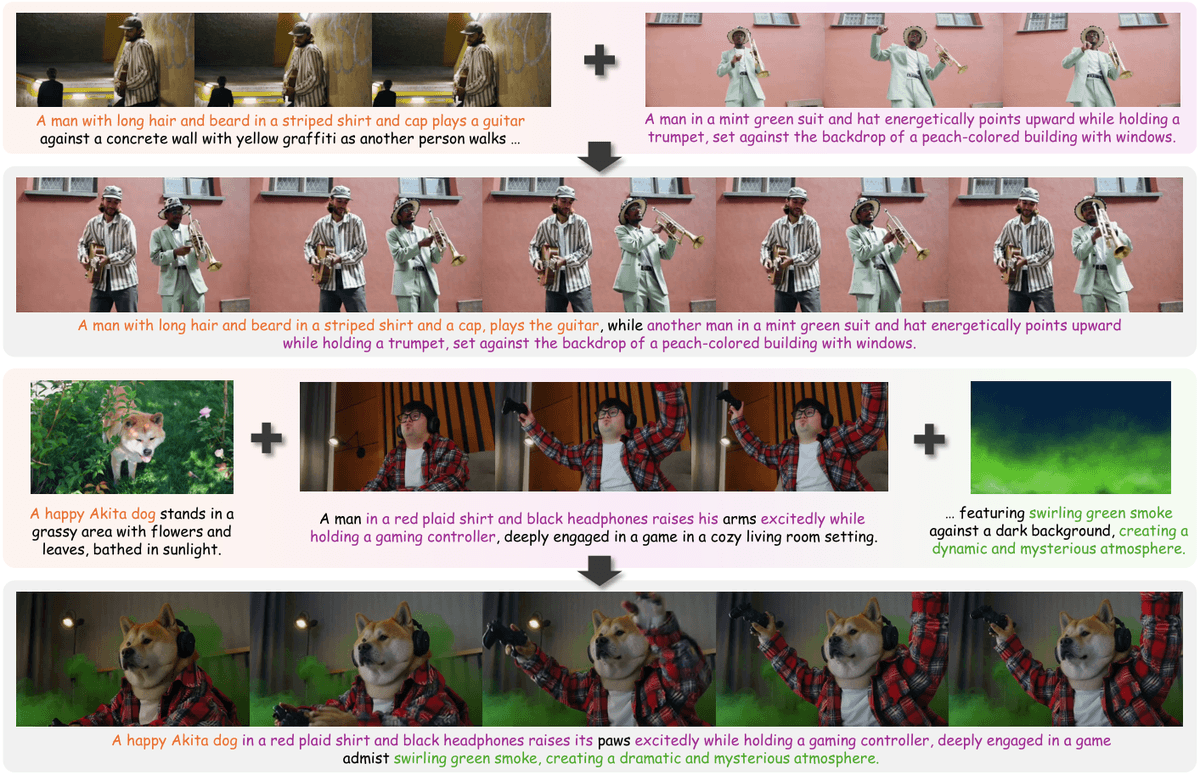
Mixing a character from one image with the motion from a video, a style from a sketch, and a lighting mood from a third clip has been a stubborn problem for personalization methods. Most existing approaches either lock you into a rigid pipeline (subject from image, motion from video) or force you to supply masks and hope the model separates concepts cleanly. A new paper from researchers at HKUST and CUHK introduces Bind & Compose (BiCo), a one-shot method that ties each visual concept to a specific prompt token and then lets you recombine those tokens like Lego bricks.
The composition problem, in plain terms
Visual concept composition aims to integrate different elements from images and videos into a single, coherent visual output, but current tools fall short in two specific ways. Mainstream methods use either adapters like LoRA or learnable embeddings with explicit or implicit masks to realize concept selection, which fall short in decoupling complex concepts with occlusions and temporal alterations, and extracting non-object concepts such as styles. And when it comes to mixing image and video sources, previous works are confined to animating designated subjects from images with motion from videos, so you cannot easily grab a visual style from a video and paint it onto a subject from an image.
Binding tokens instead of masking pixels
BiCo skips masks entirely. The idea: for each reference image or video, train a lightweight module that binds the visual content to specific words in its caption, then compose a new prompt using those pre-bound tokens from different sources. During concept binding, a binder structure attached to a DiT-based T2V model is utilized to encode the correspondence between visual concepts and textual tokens through one-shot training. At inference, you write a prompt, route each concept word through its matching binder, and the DiT cross-attention layers pull in the right visual features.

The binder itself is deliberately simple: an MLP with a zero-initialized learnable scaling factor in a residual style, applied to prompt tokens. But it is arranged hierarchically. A global binder handles overall visual-token association, and per-block binders provide tailored adjustments at every DiT block, since different blocks in a diffusion transformer specialize in different aspects of the denoising process.
Two tricks that make binding actually work
Getting a clean binding from a single reference is hard because a caption never fully describes an image. Two components address this:
- Diversify-and-Absorb Mechanism (DAM). A vision-language model (Qwen2.5-VL) extracts key spatial and temporal concepts from the reference, then generates multiple varied captions that keep those concept words fixed. This forces the binder to associate the concept words specifically with the concept, not with the surrounding phrasing.
- Absorbent token. A learnable absorbent token is introduced to minimize the impact of concept-irrelevant details during concept binding by absorbing those distracting visual details. It is concatenated with the prompt during training and thrown away at inference. Attention map visualizations show it soaks up irrelevant background elements like scattered plants.
Making images and videos play nicely
Images and videos have a fundamental mismatch: images have no motion, videos do. The Temporal Disentanglement Strategy splits video training into two stages. First, the binders train on individual frames with spatial-only prompts, matching how image concepts are learned. Second, they train on full videos with a dual-branch structure that adds a temporal MLP alongside the spatial one, fused by a learnable gate.

There is also a two-stage inverted training schedule. Only the global binder trains first, and it spends more time on high-noise steps than low-noise ones because prioritizing the training on higher noise levels yields better performance. Ablations show this schedule matters a lot: dropping it collapses overall quality from 4.40 to 2.58.
Results
BiCo is built on Wan2.1-T2V-1.3B and trains for 2400 iterations per stage on RTX 4090 GPUs. Evaluation uses 40 test cases drawn from DAVIS and the internet, judged both by automatic metrics (CLIP-T for prompt alignment, DINO-I for concept preservation) and by 28 human raters on a 5-point Likert scale.
| Method | CLIP-T | DINO-I | Concept | Prompt | Motion | Overall |
|---|---|---|---|---|---|---|
| Textual Inversion | 25.96 | 20.47 | 2.14 | 2.17 | 2.94 | 2.42 |
| DreamBooth-LoRA | 30.25 | 27.74 | 2.76 | 2.76 | 2.51 | 2.68 |
| DreamVideo | 27.43 | 24.15 | 1.90 | 1.82 | 1.66 | 1.79 |
| DualReal | 31.60 | 32.78 | 3.10 | 3.11 | 2.78 | 3.00 |
| BiCo | 32.66 | 38.04 | 4.71 | 4.76 | 4.46 | 4.64 |
Compared to the prior art DualReal, our method achieves a +54.67% improvement on the subjective Overall Quality. Beyond composition, the same trained binders can do concept decomposition (keep only the dog-related tokens from a video with dogs and cats) and text-guided editing.
Where it breaks and what is available
The authors are candid about failure modes. BiCo treats each token equally in the concept composition process, which can result in unintended concept drifts. A colorful whimsical hat that looks nothing like the model's prior for the word "hat" gets simplified in the output. Composition that requires common-sense reasoning also fails: asking a dog to hold a gun with a raised leg produced a dog with an extra fifth leg instead. The team suggests future work integrating adaptive token weighting and stronger VLM captioning.
Code and weights are not linked in the paper. The team maintains a project webpage with video results, and the work builds directly on the open Wan2.1 backbone, which makes reimplementation feasible even if the authors have not released their binder code yet.