
HKUST's AGRAG Slashes RAG Hallucinations From 4.25% to 0.40%
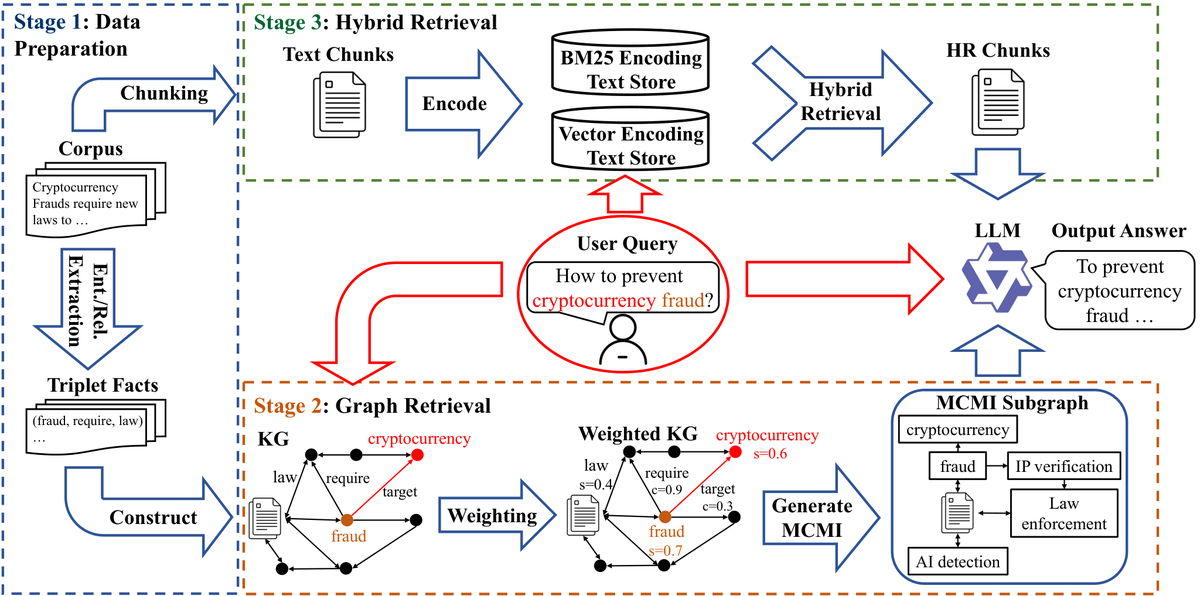
A new graph-based RAG framework replaces LLM entity extraction with TFIDF statistics and builds explicit reasoning subgraphs, cutting hallucination rates from 4.25% to 0.40%.
 Pro
Takeaways
- AGRAG proposes a graph-based RAG framework using TFIDF entity extraction and a novel MCMI reasoning subgraph.
- Replaces LLM-based entity extraction with statistics to avoid hallucination and error propagation into the knowledge graph.
- Formulates retrieval as Minimum Cost Maximum Influence subgraph generation, proven NP-hard with a 2-approximation greedy solver.
- Cuts hallucinated classification rate to 0.40% on WOS versus 4.25% for HippoRAG2 and 36.88% pure LLM.
- Beats NaiveRAG, GraphRAG, LightRAG, HippoRAG2 on fact retrieval, reasoning, summarization, and generation tasks.
- Code and prompts released at github.com/Wyb0627/AGRAG.
Graph-based retrieval-augmented generation was supposed to fix everything wrong with vanilla RAG. By extracting entities and relations into a knowledge graph, models could reason about connections across chunks instead of pulling isolated passages. In practice, graph-based systems keep tripping over their own construction pipelines, and on certain summarization tasks they lose to plain old NaiveRAG. A team from HKUST and PolyU has proposed AGRAG, an advanced graph-based RAG framework that tries to fix three failure modes at once. The numbers are striking: hallucinated predictions on a classification benchmark dropped from 4.25% (the previous best) to 0.40%.
Why graph-based RAG keeps stumbling
The authors diagnose three specific failures in current pipelines. Existing methods use LLMs to extract entities and relations from source documents to serve as graph nodes and edges, but LLM hallucination introduces noise into the constructed graph and propagates through the whole pipeline. Garbage in, garbage propagated everywhere.
Retrieval also stays opaque. Walking-based models feed retrieved chunks directly into the LLM as contexts without any explicit structural reasoning chain to explain why those particular chunks were selected, making the LLM struggle to locate query-related context. When you do try to bolt on a reasoning chain using a shortest-path algorithm, the path can be overly simple and omit many query-related facts, leading to incomplete reasoning chains and inadequate answers with low information coverage.
Ditching the LLM for entity extraction
AGRAG's first design decision is almost heretical for a modern RAG paper: skip the LLM at graph construction time. Instead of prompting a model to name entities, AGRAG scores every n-gram in each chunk with a modified TFIDF formula and keeps whatever crosses a threshold. Words or phrases where the score exceeds tau become entity nodes. Only after that does an LLM come in to detect the relations between the extracted terms.