
HKUST Maps How to Actually Trust Graph Neural Network Predictions
A new survey maps how to make graph neural networks and graph foundation models tell you when they don't know something, organized by representation and handling.
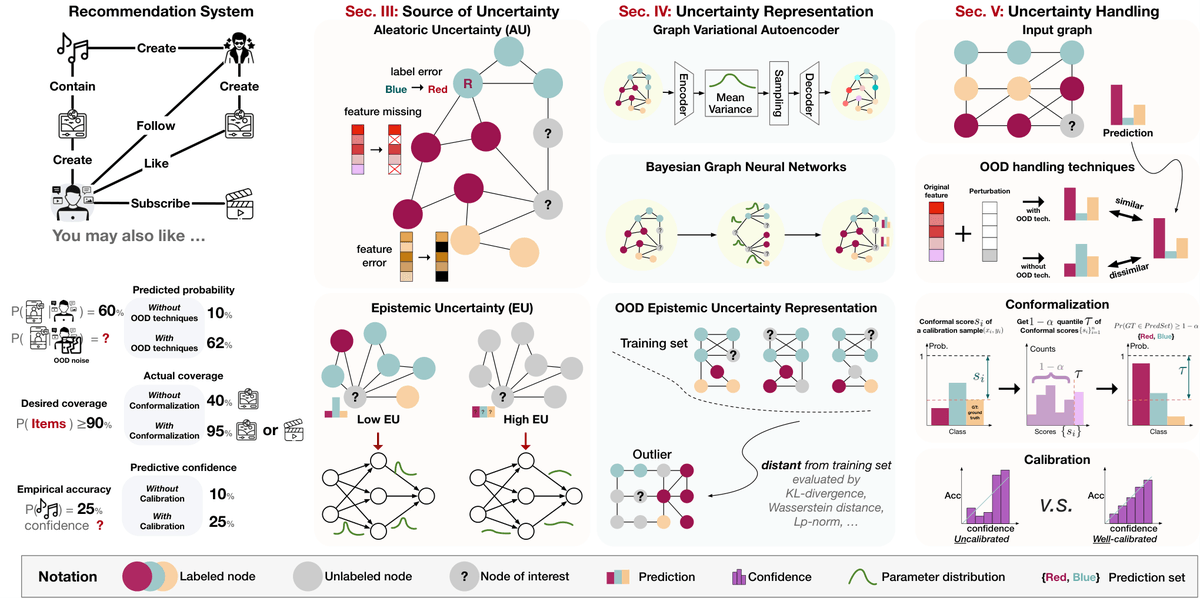
Takeaways
- New survey organizes uncertainty quantification for graph neural networks and graph foundation models along two axes: representation and handling.
- Splits total uncertainty into aleatoric (irreducible data noise) and epistemic (reducible, from limited knowledge or OOD data).
- Representation methods covered: Dirichlet-Multinomial, Bayesian VAE/BNN, Gaussian Processes, Stochastic Differential Equations, and OOD-focused approaches.
- Handling covers Bayesian inference, distributionally robust optimization, adversarial training, self-supervised learning, calibration, and conformal prediction.
- Highlights that i.i.d. calibration and conformal methods break on graphs, with fixes like DAPS and CaGCN.
- Full paper includes appendix with open-source code links for most surveyed methods.
Graph neural networks power a lot of quiet infrastructure: recommendation feeds, protein interaction predictors, fraud detectors, spam filters. When a GNN spits out a confidence score of 0.92 for a suspicious user or a molecular interaction, how much should you actually trust it? A new survey from researchers at HKUST, UIC, and collaborators tries to answer that by mapping the fast-growing field of uncertainty quantification (UQ) for graph learning, including the emerging class of graph foundation models (GFMs).
Why graphs make uncertainty harder
Uncertainty in graph models arises from three sources: inherent data randomness, learning algorithm imperfections, and unexpected test distributions. These hinder deployment in high-stakes domains like healthcare, autonomous driving, and natural language generation, where you actually need to know when the model is guessing.
Graphs make this worse than the usual i.i.d. setting. GNNs contend with noisy links, missing nodes, and mislabeled data, and a single bad edge can propagate through message passing to poison predictions several hops away. The survey follows the standard split of total uncertainty into two flavors: aleatoric (the irreducible noise in the world, like sensor error or ambiguous labels) and epistemic (what the model doesn't know because it hasn't seen enough data or the test point is out-of-distribution).
A two-axis map instead of a model-by-model list
The survey's main organizational move is separating uncertainty representation (how you model uncertainty) from