
HKU's GEEK Framework Beats 175B Models at Reasoning With Just 11B
GEEK, an 11B-parameter framework from HKU and Huawei, beats 175B+ LLMs on complex implicit question answering by iteratively excavating Wikipedia knowledge
 Pro
Takeaways
- GEEK is a new iterative QA framework that beats 175B+ LLMs on StrategyQA using only an 11B-parameter model.
- It loops through four actions -- decompose, retrieve, self-answer, finalize -- building up a reasoning strategy as facts accumulate.
- A "Strategy Exploration" mode branches into 16 parallel reasoning paths at inference time, boosting accuracy from 75.98% to 78.17% with no retraining.
- GEEK scores 78.17% on StrategyQA, second only to PaLM (540B) at 81.6%, while using less than 6% of its parameters.
- 54% of errors come from incorrect retrieved facts; the hallucination problem is reduced but not eliminated by the retriever-extractor pipeline.
- No code or weights are publicly released; the system requires fine-tuning on annotated decomposition data and a Wikipedia-scale retrieval corpus.
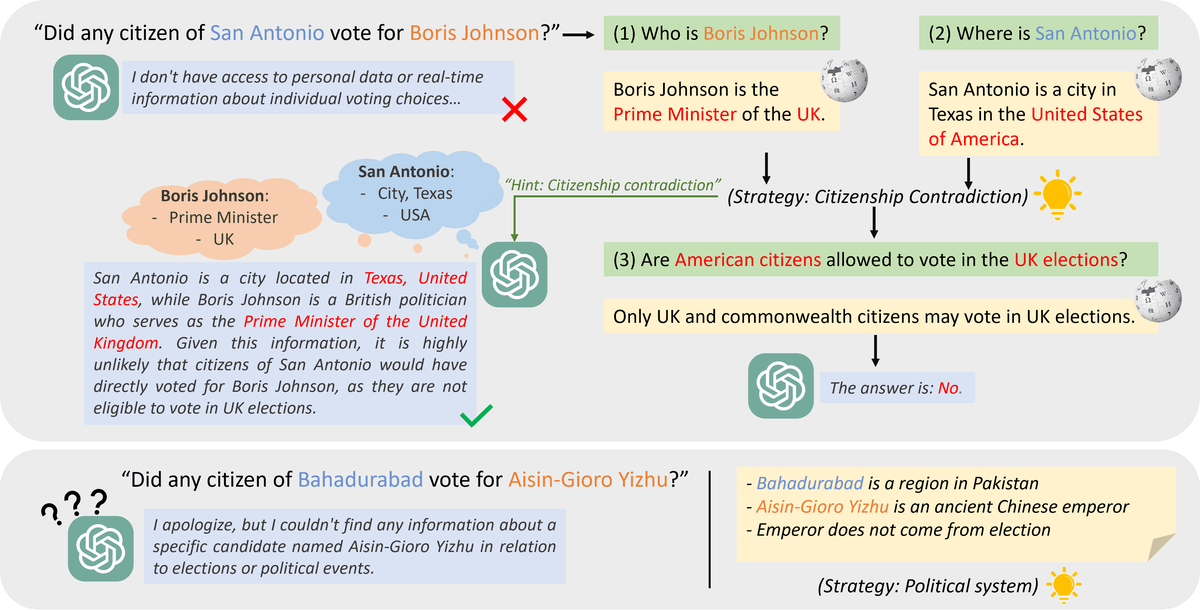
There is a class of questions that trips up even the most capable large language models: questions where the reasoning strategy itself is hidden inside the answer. Ask an LLM "Did any citizen of San Antonio vote for Boris Johnson?" and it will likely fail -- not because the answer is hard, but because the model first needs to realize that the relevant strategy is checking citizenship rules, not searching voting records. This is the problem of implicit complex question answering, and a new paper from the University of Hong Kong and Huawei Noah's Ark Lab proposes a surprisingly efficient solution.
The framework is called GEEK (Gradually Excavating External Knowledge). Running on an 11B-parameter backbone, it achieves 78.17% accuracy on the StrategyQA benchmark -- outperforming systems built on models more than 16x its size, including GPT-3.5 (175B) and Gopher (280B), using less than 6% of their parameter count.
Why one-shot generation fails here
Most LLM-based QA systems work in one shot: you give the model a question, it generates an answer. Chain-of-thought (CoT) prompting -- where you ask the model to reason step by step before answering -- helps, but it still relies entirely on knowledge already baked into the model's weights at training time. That creates two hard failure modes:
- Missing or stale knowledge. The model simply doesn't know the fact, or its training data is out of date.
- Invisible strategy. The decomposition strategy needed to solve the question can't be inferred from the question text alone -- it only becomes apparent once you start uncovering background facts.
The question is implicit if the decomposition strategy cannot be formulated merely from the question text -- some sub-questions can only be formulated once enough facts are uncovered. This is what makes StrategyQA hard: it is an open-domain benchmark whose questions require an implicit multi-step reasoning strategy that humans synthesize from world knowledge but is not stated in the question. Each item has a yes/no answer, a decomposition into reasoning steps, and Wikipedia evidence for each step -- it tests whether a model can plan and decompose, not just retrieve a fact.

The GEEK loop: think, retrieve, revise
GEEK treats question answering as an iterative decision process rather than a single generation. At each step, a core model (Flan-T5-11B, fine-tuned with supervised learning) looks at everything it has gathered so far -- the original question plus all sub-questions and facts accumulated so far -- and picks one of four actions:
- AddDecomp -- generate the next sub-question to investigate
- Retrieve & Extract -- call an external retriever (DPR over Wikipedia) to find relevant paragraphs, then compress them into a concise fact sentence using a FiD-based extractor
- SelfAnswer -- answer a sub-question directly from logic or already-known facts, without hitting the retriever
- FinalAnswer -- synthesize everything into a yes/no conclusion with a chain-of-thought trace
During intermediate steps, GEEK can adjust the remaining sub-questions based on the gradually increased external knowledge, forming a valid strategy dynamically. This is the key insight: the strategy is not planned upfront. It emerges as facts accumulate, just like a human researcher who changes their line of questioning as they learn more.
A concrete example from the paper: when solving a question about whether Alice's Adventures in Wonderland could have inspired Macbeth, GEEK first retrieves the publication date of Alice (1865), then Macbeth (1623), then self-answers the logical sub-question "Is 1865 before 1623?" -- and correctly concludes "no" without ever needing to retrieve that final step.

The pre-answer trick and strategy exploration
Two design choices push accuracy meaningfully higher. The first is a pre-answer trick: when generating a new sub-question, the model is also asked to generate all remaining sub-questions with placeholder (pseudo) answers. These pseudo-answers are thrown away after generation, but they force the model to plan a coherent, solvable path forward rather than generating a dead-end sub-question in isolation.
The second is Strategy Exploration (SE): at each decomposition step, the model uses beam search to generate multiple candidate sub-questions, branching into parallel reasoning paths. Considering that there often exist multiple valid solutions for a question, GEEK branches out different sub-questions during the solving process, exploring a strategy space and improving final accuracy. Up to 16 branches are explored (expansion rate of 4, for at most 2 iterations), and a majority vote picks the final answer. SE alone lifts accuracy from 75.98% to 78.17% with no retraining required.
Beating models 16x its size
The results on StrategyQA are striking. Here is how GEEK compares to key baselines:
| Method | Backbone Size | Accuracy |
|---|---|---|
| ChatGPT (CoT) | 175B | 62.5% |
| Visconde | 175B | 69.4% |
| RR (prior SOTA <300B) | 175B | 77.7% |
| PaLM (CoT + SC) | 540B | 81.6% |
| GEEK (ours, CoT+SE) | 11B | 78.2% |
GEEK achieves 78.17% accuracy with a much smaller model size than previous baselines, setting a new SOTA for ~10B LLMs, and is the second best among all existing methods except PaLM. The ablation study tells a clean story: CoT alone on the fine-tuned model gets 70.74%, adding retrieval and extraction jumps it to 75.98%, and adding strategy exploration brings it to 78.17%.
Where it still struggles
The paper's error analysis is unusually candid. Of the failure cases on the dev set:
- 54% are due to incorrect facts -- the retriever finds irrelevant paragraphs, or the extractor hallucinates a summary
- 40% are due to unreasonable decomposition -- the model picks a sub-question path that doesn't lead to the answer
- 20% are logical deduction errors -- correct facts but wrong final answer
- 8% are wrong action selections
As long as neural reasoning is involved, the hallucination problem is inevitable in theory, due to the black-box nature of neural networks. By using a retriever and an extractor, the hallucination problem can be alleviated from factual references, but not completely avoided. The authors also note that GEEK's logic is not guaranteed to be correct -- it can produce the right answer via wrong steps, or correct steps but a wrong answer.
What this means in practice
GEEK is most useful when you need a small, deployable model to handle questions that require multi-hop reasoning over a live knowledge base -- think enterprise search over internal wikis, customer support over product documentation, or research assistants that need to synthesize facts from multiple sources. The plug-and-play retriever design means you can swap Wikipedia for any corpus without retraining the core model.
The framework is not a drop-in replacement for general-purpose LLM APIs. It requires fine-tuning the core model on annotated decomposition data, and the iterative retrieval loop adds latency compared to a single-pass generation. But for the specific problem of implicit multi-step questions over a bounded knowledge base, it offers a compelling efficiency trade-off: near-300B-class accuracy at 11B-class cost.
No public code or model weights are released with the paper, but the architecture is straightforward enough to reproduce: a fine-tuned Flan-T5-11B core, a dual-stage DPR retriever over a Wikipedia dump, and a FiD-T5-3B extractor. The authors trained on 8 V100 GPUs using DeepSpeed for memory management.