
HiTZ's Latxa Instruct Matches GPT-4o on Basque Without a Single Human Instruction
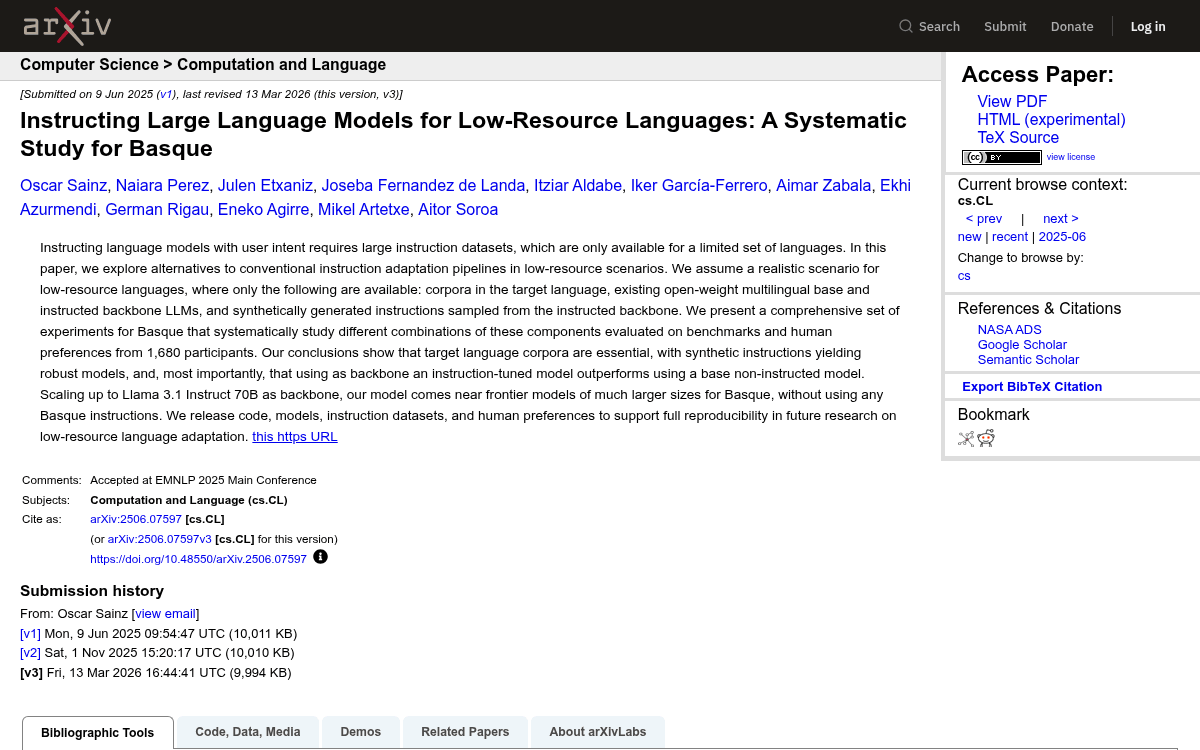
A systematic Basque study finds that starting from an instruction-tuned English backbone beats the standard base-model-first pipeline for low-resource language adaptation.
 Pro
Takeaways
- HiTZ Center systematically tested 18 instruction-tuning recipes for Basque using Llama 3.1 backbones
- Starting from an instruction-tuned English model beats adapting a base model first
- Bilingual synthetic instructions produced the most robust models across benchmarks and human arena
- 70B variant matches GPT-4o and Claude 3.5 Sonnet on Basque linguistic quality without native instructions
- Community arena gathered 12,890 preference annotations from 1,680 Basque speakers
- Weights, datasets, and code released on GitHub and Hugging Face
Most open large language models are still overwhelmingly English. When teams try to adapt them to smaller languages, they usually follow a fixed recipe: take a base model, continue pretraining on target-language text, then fine-tune on translated instructions. A new study on Basque questions almost every step of that pipeline, and along the way ships an 8B and 70B instruction-tuned model that gets close to GPT-4o and Claude 3.5 Sonnet on Basque tasks, without using a single human-written Basque instruction.
The team from the HiTZ Center at the University of the Basque Country ran 18 different training configurations on Llama 3.1 and measured them with both static benchmarks and a community-run arena that collected over 12,000 human preferences. The result is one of the most thorough ablation studies of low-resource instruction tuning to date, and it flips a piece of conventional wisdom.
The low-resource pipeline problem
Basque ranks approximately 50th in Common Crawl with a presence approximately 1,000 times smaller than English, and notably lacks pre-existing instruction datasets. That makes it a realistic stand-in for hundreds of other languages where the usual ingredients simply do not exist. The standard multi-step process first adapts the base model through continued pretraining, then performs instruction tuning, but nobody had systematically tested whether that ordering actually helps.
The authors set up a clean experimental grid with three backbones and three data ingredients:
- Backbones: Llama 3.1 base (BASE-EN), a Basque-adapted Latxa base (BASE-EU), and Llama 3.1 Instruct (INSTRUCT-EN)
- Basque raw text corpus (Corpus-EU, roughly 3.5B tokens)
- Synthetic English instructions sampled from Llama 3.1 Instruct itself
- Basque instructions produced by translating those English ones with the Basque base model

Crucially, they avoided distillation from GPT-4 or Claude. Using existing English instruction datasets would introduce an additional confounding factor into the analysis, namely knowledge distilled from a powerful LLM, which could lead a model trained on such data to outperform their INSTRUCT-EN baseline. Instead, they used the Magpie technique to sample instructions directly from Llama 3.1 Instruct, then translated a subset to Basque using few-shot prompting with the Basque base model.
What the ablations actually showed
Three findings stand out. First, target language corpora are essential, with models lacking exposure to plain Basque text showing degradation regardless of other techniques. Adding Corpus-EU to instruction tuning was worth up to 12 points in accuracy and over 300 points in arena score when no other Basque signal was present.
Second, bilingual instructions win. English-only instructions were competitive, but mixing English and Basque instructions produced the most robust models across both benchmarks and human preferences. The improvement is not just a data-quantity artifact, since using more monolingual instructions (1M vs 4M) resulted in similar results.
The most interesting finding is the third one, and it contradicts the standard pipeline. Models based on INSTRUCT-EN consistently outperform those based on BASE-EN, both in human evaluations and benchmarks. Starting from a well-instructed English backbone yields better performance than learning everything from scratch. Similarly, teaching Basque first via continued pretraining then adding instruction tuning offered no measurable advantage over learning both simultaneously. In other words, you should skip the multi-stage curriculum and just fine-tune an already-instructed model on a mix of target-language text and synthetic bilingual instructions.
Scaling to 70B and closing the gap with frontier models
The team then took the best 8B recipe (INSTRUCT-EN + Corpus-EU + English instructions) and scaled it to Llama 3.1 Instruct 70B. The results are striking for a model that never saw a human-written Basque instruction:

On BertaQA-Local, which tests knowledge specific to Basque culture, the 70B adapted model scored 77.71 versus 74.83 for GPT-4o and 80.45 for Claude 3.5 Sonnet. On the MGSM math benchmark in Basque, it hit 80.0 against GPT-4o's 79.2. The best model is on par with the commercial models in perceived linguistic quality, but falls behind the best model in the content quality and global scores. That linguistic-quality parity is the real headline: a mid-size open model, adapted without native instructions, produces Basque that native speakers rate as fluently as Claude or GPT-4o's.
The trade-off nobody talks about
Adapting a model to a new language is not free. The paper measures the cross-lingual cost carefully and finds that INSTRUCT-EN-based models exhibit a clear trade-off: improvements in Basque come at a cost of decreased performance in English and Spanish, suggesting a competitive relationship between languages in the model's parameter space. Models built from the plain base backbone were more flexible and improved across all three languages, but from a lower starting point.
Safety mostly transfers from the English instruct backbone, but not perfectly. Starting from a base model rather than an instructed one produced a much worse safety profile in Basque, with violation rates of 44% versus 24% for the instructed variant. Bias scores in Basque also trailed English scores across the board, a reminder that alignment does not translate for free.
Correlation between benchmarks and humans
One useful side result: average Basque benchmark performance and arena rankings correlate strongly, with Spearman's rho above 0.80 across all arena dimensions, suggesting that automated Basque benchmarks may provide a reliable proxy for human evaluation in future research. The strongest correlations came from benchmarks natively constructed in Basque rather than translated from English, which is worth remembering when building evaluation suites for other languages.
What is released
Everything needed to reproduce the work is on GitHub and Hugging Face:
- The 8B and 70B Latxa Instruct model weights
- Synthetic English and Basque instruction datasets, filtered and unfiltered
- The Basque preference dataset with real user prompts and pairwise annotations, usable for future DPO or reward modeling work
- Training code and evaluation harness configurations
For anyone working on a language that lacks native instruction data, the practical takeaway is a simpler recipe than the one most teams currently follow: pick the best available instruction-tuned model in a high-resource language, generate synthetic instructions from it directly (Magpie-style), translate a portion of them into the target language using a base model that already speaks it a little, and fine-tune on a mix of raw target-language text plus bilingual instructions in one pass. Skip the separate pretraining stage. It will not close the gap to GPT-4o entirely, but it gets closer than the standard pipeline for a fraction of the effort.