
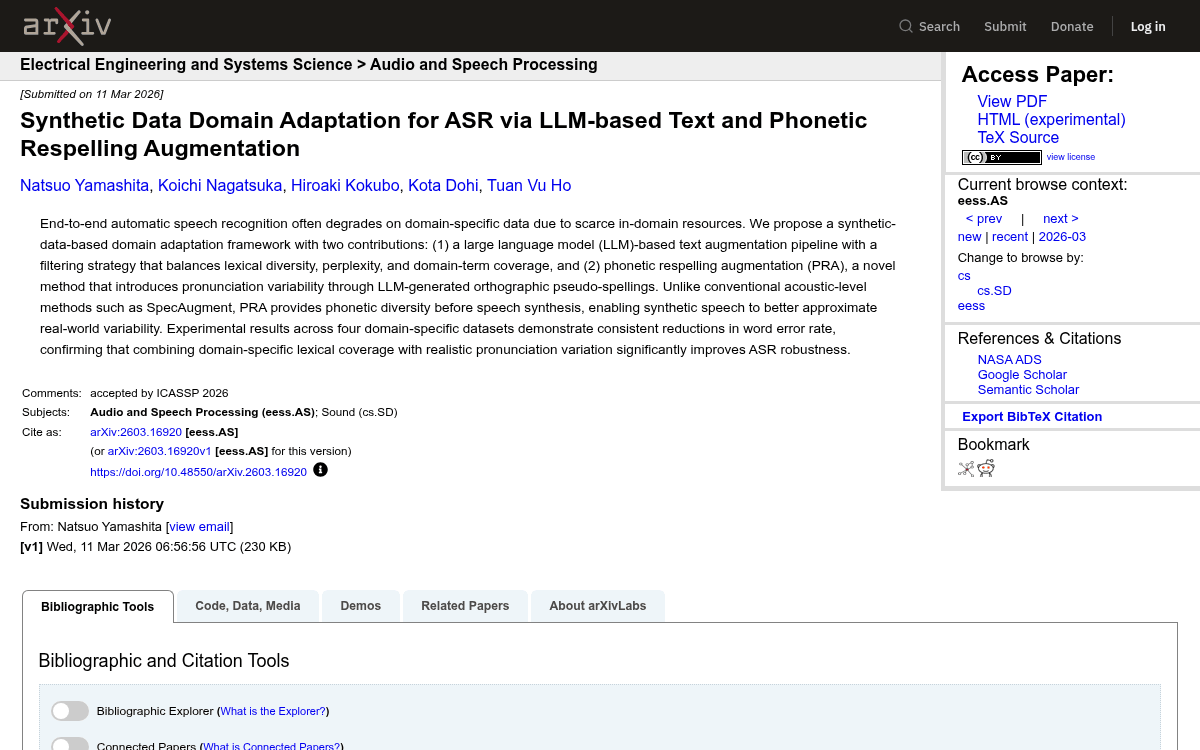
Hitachi Teaches Whisper Jargon by Faking Mispronounced Audio, Cutting Errors 57%
Hitachi researchers combine LLM text generation with phonetic misspellings to close the accuracy gap on air traffic, court, and medical speech recognition.
 Pro
Takeaways
- Hitachi proposes a synthetic-only ASR domain adaptation framework using LLM text generation and phonetic respelling.
- A tri-objective filter balances lexical diversity, high perplexity, and domain-term coverage.
- Phonetic Respelling Augmentation rewrites sentences as pseudo-spellings like "Sevem" before feeding TTS.
- Fine-tuned Whisper-large-v3-turbo cut Court B-WER from 85.6 to 36.8 on domain terms.
- PRA outperformed SpecAugment on three of four domains including air traffic and medical speech.
- Prompts, filtering code, and audio samples released on the project page.
Fine-tuning a speech recognition model on jargon-heavy domains like air traffic control or courtroom audio usually hits a wall: there is not enough real recorded speech to learn from. A team at Hitachi proposes skipping real audio entirely, using large language models to fabricate both the transcripts and the pronunciation quirks that make synthetic speech sound closer to what humans actually produce.
Their paper lays out a two-part pipeline that consistently cuts word error rate (WER) on four specialized datasets, with the sharpest gains on domain-specific vocabulary. Prompts, filtering code, and audio samples are posted on the project page.
Why synthetic ASR data keeps falling short
End-to-end ASR systems degrade sharply when target audio drifts from the training distribution, and gathering domain-specific speech is expensive. Prior work has tried to paper over the gap by generating domain text with LLMs and converting it into speech via text-to-speech (TTS), but two problems keep surfacing.
- Existing pipelines mostly maximize the volume of text without optimizing for domain-aware lexical diversity and coverage.
- TTS-generated speech lacks the pronunciation variations, errors, and idiosyncrasies found in real recordings.
Standard acoustic tricks like SpecAugment mask spectrogram regions after synthesis, which can be detrimental when applied to uniformly rendered synthetic audio. The Hitachi group argues the fix has to happen further upstream, at the text.
Over-generate, then filter with a three-way score
The first half of the framework treats text generation as a funnel. Multiple LLMs (GPT-4.1-mini, Llama-4-Maverick, and Qwen3-32B) crank out candidate sentences conditioned on a domain seed like "air traffic control," scenario seeds, and operational lexicons such as call signs or product names. Prompts are constructed in English, Japanese, and Chinese, and the outputs are translated back into the target language to enrich linguistic diversity, then paraphrased.
The novel piece is the filter. Each candidate sentence gets scored on three axes and picked greedily:
- Type token ratio, so the selected set stays lexically diverse.
- Perplexity, which the authors deliberately push up rather than down to preserve technical phrasing.
- Domain-term density, weighting sentences that include target vocabulary.
Chasing high perplexity is the counterintuitive move. Since the texts come from high-quality LLMs, fluency is already ensured, so filtering out weird-looking sentences would just discard the technical ones. The authors cite an air-traffic sentence with perplexity around 14,550 that still reads fluently in context. Selection uses multilevel subset selection (MUSS), which clusters candidates and greedily picks representatives inside each cluster in parallel before a global pass.
Teaching TTS to mispronounce on purpose
The second contribution, Phonetic Respelling Augmentation (PRA), is the more surprising idea. Rather than perturbing the audio, an LLM rewrites each sentence into a pseudo-phonetic English spelling before it reaches the TTS engine. The paper's example turns "Zhang Feng piloted the Boeing Seven Three Seven aircraft" into "Jang Feng pilotid ze Bo-in Sevem Three Sevem eer-kraft."
These respellings encode assimilation, elision, and substitution patterns a real speaker might produce. During training the respelled text is used only as TTS input, while the ASR target remains the original canonical sentence, so the model learns to map messy pronunciations back to clean transcripts. Because the output stays in the Latin alphabet, it works with off-the-shelf TTS like Kokoro-TTS without needing IPA symbols or phoneme dictionaries.
The numbers on four domains
The team fine-tuned Whisper-large-v3-turbo (encoder frozen) on 50 hours of synthetic speech per dataset, and evaluated on ATCOSIM and ATCO2 (air traffic), an Indian Supreme Court corpus, and MedSyn (pharmaceutical descriptions). Biased WER (B-WER) measures accuracy specifically on domain-specific terms.
| Dataset | Whisper baseline WER / B-WER | Pipeline + PRA WER | Pipeline B-WER |
|---|---|---|---|
| ATCOSIM | 28.9 / 84.0 | 21.2 | 40.5 |
| ATCO2 | 57.1 / 73.2 | 41.1 | 45.1 |
| Court | 20.3 / 85.6 | 16.8 | 36.8 |
| MedSyn | 10.5 / 74.8 | 8.7 | 32.4 |
The B-WER collapse on Court is the eye-catching result: from 85.6 to 36.8, despite the domain-term ratio being only 0.5%. PRA also beat both standard and "modest" SpecAugment configurations on three of four datasets, with the exception being MedSyn, whose evaluation audio is itself synthetic.
Where it works and where it does not
The ablations offer useful guardrails. Optimal filter weights land at 6:3:1 for diversity, perplexity, and domain terms. Piling on synthetic hours has diminishing returns: performance held stable up to 100 hours, then WER gradually worsened, reaching 48.5 at 200 hours and 48.0 at 250. For PRA, a 40 to 60 percent mixture of respelled and original data works best, since respellings alter most of the sentence and leaning on them too heavily hurts training on clean text.
Two caveats are worth noting. The experiments are English-only with a single TTS/ASR pairing, and evaluation audio is clean rather than noisy real-world capture. The PRA respellings also depend on the LLM's intuition about how English is actually mispronounced, which will not transfer uniformly to languages with different orthographic conventions. For teams shipping ASR into a narrow vertical with a known vocabulary list, this is a cheap recipe that pushes rare-word accuracy substantially without recording a single hour of real speech.