
Hebei's G2C Beats Complex AI Baselines by Teaching Models to Self-Correct
A two-stage T5 pipeline drafts sentiment quads then revises them in one shot, cutting near-miss errors on Rest15 and Rest16.
 Pro
Takeaways
- G2C adds a T5 corrector after a T5 generator to revise ASQP drafts in one shot.
- The corrector is trained on DeepSeek-R1-synthesized drafts with common near-miss error patterns.
- F1 rises from 49.75 to 52.40 on Rest15 and 61.33 to 62.80 on Rest16 over Stage-1.
- Beats MvP, DOT, STAR, and SCRAP baselines while using only two forward passes.
- Inference is 96% faster than MvP and 73% faster than DOT on both datasets.
- Code available at github.com/EarthOnlinePlayer5732/G2C, trains on a single RTX 4090.
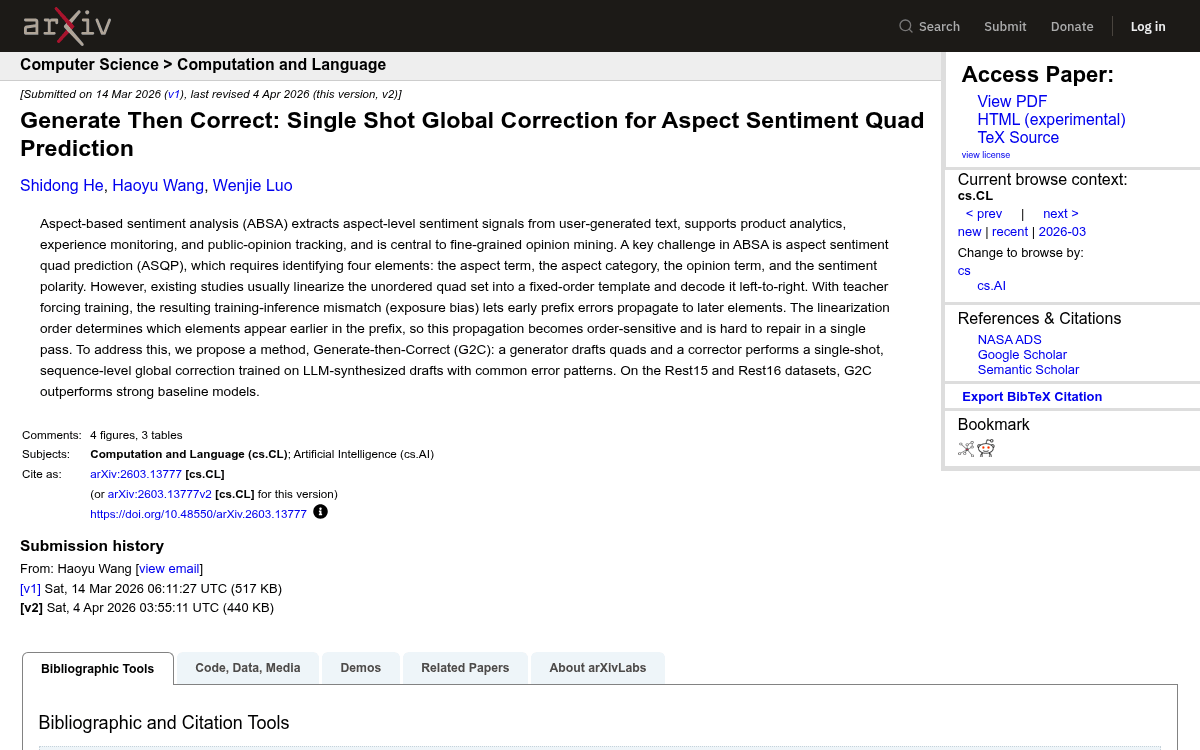
Getting structured outputs right on the first try is hard, and language models struggle with it too. A new paper from Hebei University and Dalhousie University proposes Generate-then-Correct (G2C), a two-stage pipeline that mimics how humans actually write structured text: draft something, then re-read and fix the mistakes. Applied to aspect sentiment quad prediction, this simple idea beats a stack of stronger, more complicated baselines.
The exposure bias problem in quad prediction
Aspect-based sentiment analysis pulls fine-grained opinions out of user reviews. The hard version of the task, aspect sentiment quad prediction (ASQP), requires identifying four elements: the aspect term, the aspect category, the opinion term, and the sentiment polarity. Under the standard exact-match criterion, a predicted quad only counts if all four elements are correct, which makes even minor slips expensive.
Modern ASQP systems flatten each quad into a template like [category] is [sentiment] because [aspect] is [opinion] and let a sequence-to-sequence model like T5 decode it left to right. The catch is that existing generative methods decode in a single left-to-right pass, where early errors, once emitted, cannot be revisited. Humans, by contrast, seldom expect to get structured outputs right on the first attempt, but instead draft first and then revise against the full context. A misplaced opinion span or flipped polarity early in the sequence poisons everything after it.
Draft, then rewrite the whole thing
G2C keeps the standard text-to-text setup but bolts a second model onto the end. Stage 1 is a T5-base generator fine-tuned in the usual way to produce a draft. Stage 2 is a corrector that performs a single-shot, sequence-level revision conditioned on the sentence and the draft, giving the model an explicit opportunity to fix near-miss errors from the first pass. The corrector shares the generator's architecture and is initialized from its weights.

Crucially, the corrector sees the complete draft, not a partial prefix, so it can add, delete, or edit any element to better match the sentence. It is not locked into the original template order. The pipeline stays end-to-end text-in, text-out, and only requires two forward passes at inference.
Fabricating the training set with DeepSeek-R1
Standard ASQP datasets do not contain paired flawed-draft and gold-output examples, so the authors built them synthetically. For each training sentence, DeepSeek-R1 generates five draft variants in a single call, plus one identity pair where the draft already equals the target. Four of the drafts each perturb exactly one component of the quad:
- Aspect: swap in a plausible but incorrect in-sentence noun phrase
- Category: substitute a semantically related but wrong label from the taxonomy
- Sentiment: flip to a different polarity value
- Opinion: replace with a wrong but plausible in-sentence term
A quality-control filter drops duplicates, discards drafts that contradict the sentence, and keeps only outputs that parse under the linearization template. Aspect and opinion replacements must come from the source sentence, and category labels must belong to the predefined taxonomy.
What the numbers say
On the Rest15 and Rest16 restaurant-review benchmarks, G2C beats every recent baseline the authors compare against, including MvP, DOT, GDP, STAR, and SCRAP. F1 climbs from 49.75 to 52.40 on Rest15 and from 61.33 to 62.80 on Rest16 when the corrector is added on top of the Stage-1 generator. The corrector particularly helps with the errors it was designed for: single-element confusions are the dominant error mode in ASQP, and on Rest15 they account for 60.4% of all Stage-1 mistakes. Adding the corrector cuts opinion errors by 8%, aspect errors by 12.7%, and sentiment errors by 19%.
The efficiency picture is the other surprise. Multi-view methods like MvP need many decoding passes under different linearization orders and then vote across the candidates. G2C needs exactly two forward passes.
| Method | Rest15 inference (s) | Rest16 inference (s) |
|---|---|---|
| Paraphrase | 10 | 13 |
| MvP | 1932 | 1970 |
| DOT | 257 | 271 |
| G2C | 70 | 74 |
That is roughly 96% faster than MvP and 73% faster than DOT on average, while still winning on F1.
When it fits, and when it does not
G2C is a good match for teams building product-review analytics, feedback dashboards, or opinion-mining pipelines that already run a T5-style generator and want a targeted accuracy bump without a massive latency hit. The recipe generalizes beyond ASQP too: any structured-generation task with a rigid template and expensive exact-match evaluation could benefit from a corrector trained on synthetic near-miss drafts.
There are caveats. The evaluation covers only two restaurant-domain datasets, so we do not know how the corrector holds up on laptop reviews, cross-lingual data, or long-form text. The corrector also inherits any systematic bias DeepSeek-R1 injects into its synthetic drafts, and on Rest15 category errors ticked up slightly because some complex multi-element mistakes got partially fixed into category-only mistakes. And you are paying for a second full T5 forward pass on every input.
The code and full synthesis prompt are open source on GitHub, and the whole thing trains on a single RTX 4090.