
HE-GP Trains Satellite Scheduling Policies 18% Faster Without Losing Quality
HE-GP cuts satellite scheduling training time by 18% while evolving interpretable, uncertainty-aware observation policies that outperform hand-crafted heuristics across all tested scenarios.
 Pro
Takeaways
- HE-GP is a new Genetic Programming framework for scheduling agile Earth observation satellites under uncertainty in profit, visibility, and memory consumption.
- It cuts training time by 17.77% vs. exact-only GP by dynamically switching between fast approximate and precise exact constraint evaluation modes.
- The hybrid switch is driven by two real-time signals: evolutionary stage progress and population diversity, favoring approximate evaluation early and exact evaluation late.
- HE-GP achieves the best average rank (1.4375) across 16 simulated orbital scenarios, outperforming all handcrafted heuristics and single-mode GP baselines.
- Evolved policies are interpretable math expressions deployable on CPU-only satellite hardware -- critical for aerospace certification and onboard autonomy.
- No public code repo yet; paper available at arxiv.org/abs/2603.08447.
Scheduling an agile Earth observation satellite sounds like a logistics puzzle, but it is one of the hardest combinatorial optimization problems in aerospace engineering. Every day, operators must decide which ground targets a satellite will photograph, in what order, and exactly when -- all while the satellite hurtles through orbit at 7 km/s. A new paper from Junhua Xue and Yuning Chen introduces Hybrid Evaluation-based Genetic Programming (HE-GP), a framework that learns scheduling policies for satellites operating under real-world uncertainty, and does so roughly 18% faster than prior approaches without sacrificing solution quality.
Why satellite scheduling is so hard
Agile Earth observation satellites (AEOSs) feature three degrees of freedom in attitude control -- roll, pitch, and yaw -- and their enhanced maneuverability enables them to handle overlapping observation requests and complex operations. That flexibility is a double-edged sword: compared to conventional satellite scheduling, the AEOSSP's search space is considerably larger, with theoretically innumerable observation windows within visible time windows for each request.
Most existing research treats this as a clean, deterministic problem. Reality is messier. Most existing AEOSSP studies tend to oversimplify real-world operational conditions, frequently adopting static and deterministic problem formulations. Cloud cover degrades image quality unpredictably. The rate at which the satellite writes imaging data to onboard memory fluctuates. Some targets may simply be invisible on a given pass. This paper tackles all three sources of uncertainty simultaneously under what the authors call the Uncertain AEOSSP (UAEOSSP).

The goal is to find a scheduling policy -- a mathematical rule the satellite can apply autonomously onboard -- that maximizes expected total imaging profit across many possible environmental scenarios. Handcrafted scheduling policies have demonstrated some efficacy, but their performance is highly scenario-dependent and contingent upon specific optimization objectives. Moreover, designing effective policies tailored to specific scenarios requires substantial time and domain expertise.
Deep learning approaches exist but carry a critical flaw for aerospace: most existing satellites are equipped solely with CPU hardware, whereas complex models such as deep neural networks require high-performance GPU resources. Additionally, these network models suffer from the "black box" problem, which limits transparency and interpretability and hinders their direct application in satellite scheduling scenarios that impose stringent engineering reliability requirements.
Genetic Programming as a policy factory
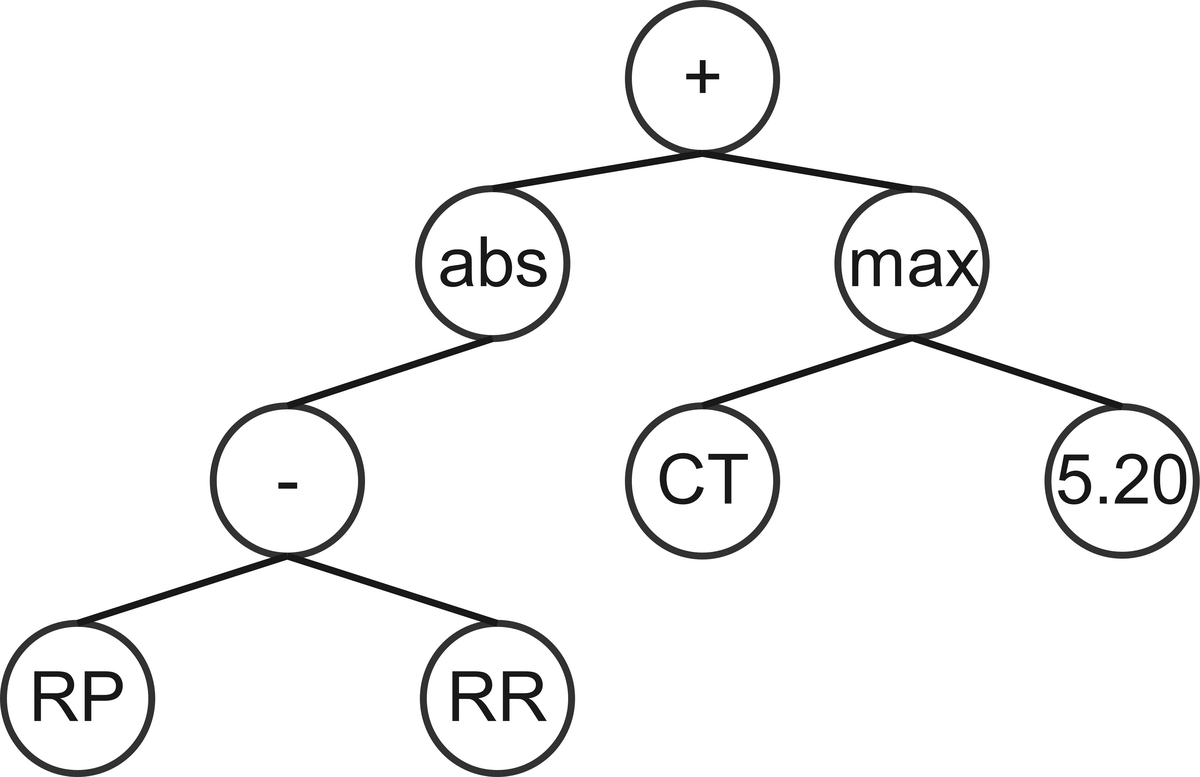
Genetic Programming Hyper-Heuristic (GPHH) is an evolutionary algorithm that breeds scheduling rules rather than schedules directly. Instead of optimizing a single timetable, it evolves a population of mathematical expressions -- tree-structured formulas -- each of which acts as a priority function. At every decision point during a simulated satellite pass, the formula scores all candidate observation requests and the satellite picks the highest-scoring one. After many generations of selection, crossover, and mutation, the best formula is kept as the deployable policy.
The appeal is interpretability: the evolved policies can be expressed as transparent and interpretable mathematical formulations, thereby enhancing user comprehension and trust. One example policy the system discovered looks like: max(EMUR, |RR|) + max(EMUR, EMUR) / (RP / (0.5239 + RP)), where EMUR is the expected memory usage ratio, RR is the relative ranking of a request by visibility window start time, and RP is the real profit. A human engineer can read and audit this.
The problem is cost. GPHH is distinguished by high computational requirements, largely attributable to the time-intensive evaluation process. To score a single candidate policy, the system must simulate an entire satellite pass -- running the Online Scheduling Algorithm (OSA) across dozens of uncertainty scenarios. Multiply that by a population of 200 policies over 50 generations, and training becomes expensive.
The hybrid trick: two evaluation modes, one smart switch
The core innovation of HE-GP is a Hybrid Evaluation (HE) mechanism that blends two modes of constraint checking inside the OSA:
- Exact filtering mode: Uses four constraint-checking modules -- a pruning judgment, a complete-imaging check, a memory check, and a two-stage binary search algorithm to find the precise earliest observation window for each candidate request. Time complexity per request: O(log w), where w is the width of the visibility window.
- Approximate filtering mode: Skips the memory check and replaces the binary search with a precomputed maximum transition time lookup. Time complexity per request: O(1). It is faster but may retain or discard slightly different candidate requests than the exact mode would.
Unlike evaluation models that rely on a single mode, the HE-OSA dynamically alternates between filtering modes based on the real-time evolutionary status of the GP population, thereby achieving an optimal balance between computational efficiency and search effectiveness.
The switching logic uses two real-time signals:
- Evolutionary stage factor (
fac_es): how far through the total generations the algorithm is. Later = more exact evaluation. - Population diversity factor (
fac_pd): the fraction of unique fitness values in the current population. Lower diversity = more exact evaluation to distinguish near-identical policies.
These two factors combine into a probability P_exact that governs which mode is used for each evaluation call. During the initial phases of evolution, the focus is on global exploration by generating diverse strategies aimed at covering potentially optimal regions. At this stage, the primary evaluation criterion prioritizes efficiency over accuracy. Conversely, in the middle to later stages of evolution, as the population's overall fitness improves, the algorithm should shift toward local exploitation.

A sensitivity analysis across all 16 test scenarios found that balanced weighting (e.g., 0.5/0.5 or 0.6/0.4) works best, and that no single parameter setting consistently outperforms the others in most scenarios -- a sign the adaptive mechanism is doing real work rather than being dominated by one factor.
Benchmarks: 16 scenarios, real orbital mechanics
Due to the lack of established benchmarks, the authors used Satellite Toolkit (STK) to simulate 16 distinct AEOSSP scenarios. Each scenario varies across four dimensions: number of requests (50 to 200), scheduling horizon (1 or 2 hours), onboard memory capacity (2048 or 4096 GB), and cloud coverage probability (15% or 30%). Uncertain parameters -- profit and data write rate -- were drawn from gamma distributions, a natural fit for non-negative random variables with controllable variance.
HE-GP was compared against five baselines:
- LAH1/LAH2/LAH3: Look-ahead heuristics that greedily pick from the next 1-20 candidate requests
- MDH1/MDH2/MDH3: Manually designed heuristics based on value density and proximity
- EE-GP: GPHH using only the exact evaluation mode
- AE-GP: GPHH using only the approximate evaluation mode
HE-GP achieved the highest average ranking of 1.4375 and identified the optimal policy in 9 out of 16 scenarios. All three GP-based methods surpassed the handcrafted heuristic algorithms across all 16 scenarios. Specifically, HE-GP achieved average performance improvements of 4.857% and 12.011% over the best results of the LAHs and MDHs, respectively.
On training efficiency: HE-GP achieves an average reduction of 17.77% in training time and 17.78% in evaluation time across 16 scenarios compared to EE-GP. Notably, both EE-GP and HE-GP allocate over 99% of their total runtime to evaluation, confirming that the evaluation bottleneck is exactly what HE-GP targets.
A subtler win: HE-GP is better at escaping local optima. The evolutionary trajectories indicate that HE-GP is more adept at escaping local optima during evolution, as evidenced by continuous improvements in the best policy rather than stagnation. For instance, in scenario 100_36_20_0.30, both EE-GP and AE-GP exhibit premature convergence, with no enhancement in the best policy over an extended period. In contrast, HE-GP achieves improvements through perturbations induced by the HE mechanism.
What the evolved policies reveal
Beyond raw performance, the paper analyzes what features the evolved policies actually use. Among the feature terminals, Profit-RP, Memory-EMUR, and Time-RIST/RR exhibit relatively high frequencies. In particular, RP appears most frequently, underscoring its critical role in shaping policy logic. Real profit, expected memory usage ratio, and request timing rank are the three pillars of good satellite scheduling policy -- a finding that aligns with intuition but is now empirically grounded.
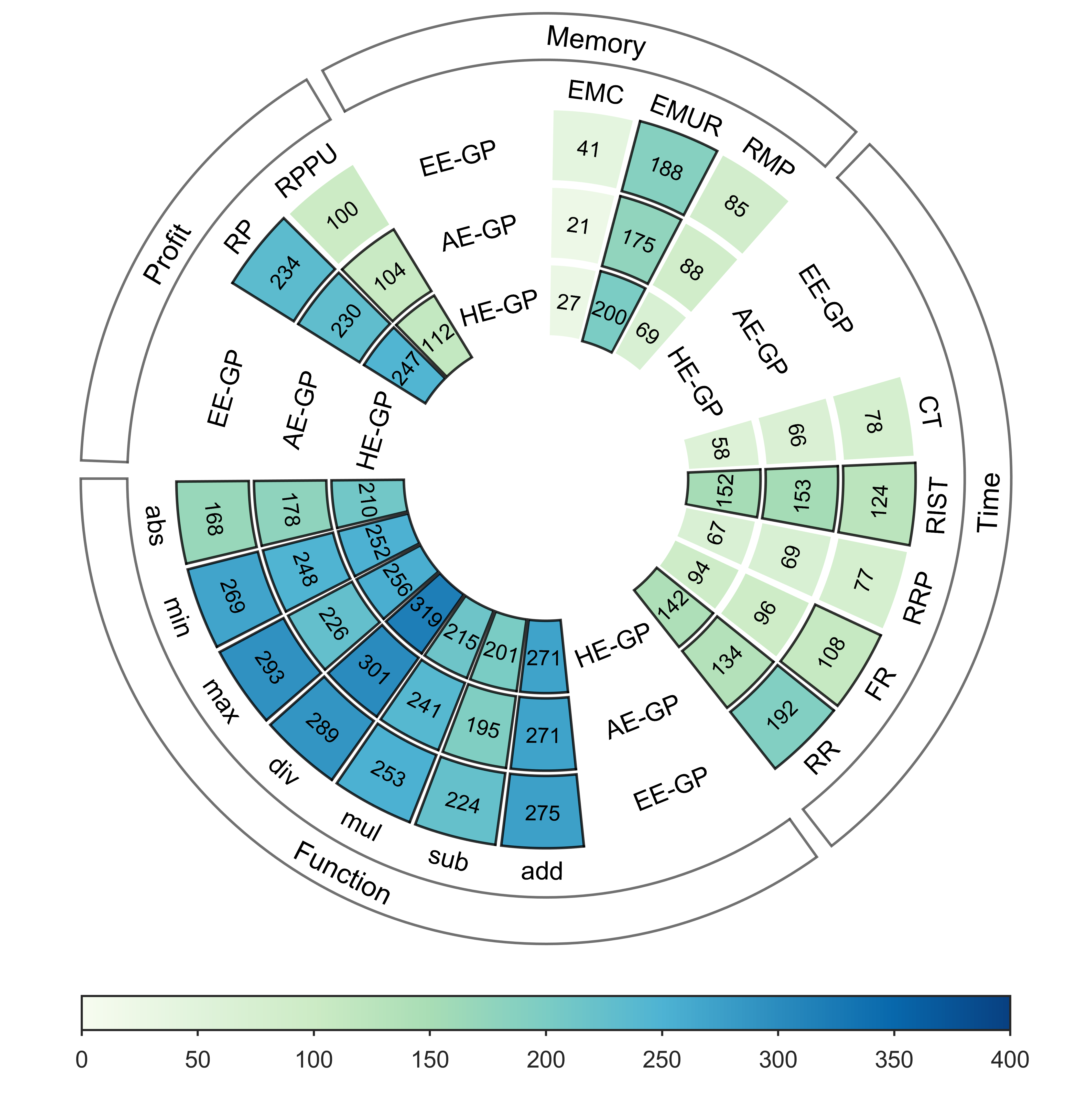
One counterintuitive result: a negative correlation exists between reward and heuristic value in both evolved policies. This counterintuitive finding suggests that HE-GP can identify policies that are challenging to discern based on expert experience but prove effective in scheduling scenarios. In other words, the algorithm found that sometimes deprioritizing the highest-profit targets leads to better overall schedules -- likely because high-profit targets often have tighter time windows that cause downstream conflicts.
Limitations and what comes next
The paper is candid about its scope. The current implementation is limited to single-AEOS scheduling; future research could extend the research to include constellations of multiple AEOSs. The 16 simulated scenarios, while carefully constructed with real orbital mechanics via STK, are not drawn from an established public benchmark, making cross-paper comparisons harder. Existing GP-based methods inevitably produce scheduling policies that include redundant structures, which not only reduce decision-making efficiency but also hinder user understanding.
No code repository is currently linked to the paper. The implementation was written in Python and run on a 32-core Intel Xeon workstation, with instance generation done in MATLAB R2020b with STK 12. The full paper is available on arXiv, and the HTML version includes all algorithm pseudocode and experimental tables. For practitioners interested in the broader GPHH literature for scheduling, the knowledge-transfer GP work by Wei et al. on dynamic satellite scheduling is a close relative worth reading alongside this paper.
The practical upshot is that HE-GP produces policies compact enough to run on CPU-only satellite hardware, interpretable enough for aerospace certification processes, and robust enough to handle the three most common sources of real-world scheduling uncertainty simultaneously. For teams building autonomous onboard scheduling systems, that combination is genuinely hard to find elsewhere.