
HDC-CL Beats GPT-4o Describing Drone Scene Changes With Moving Cameras
A new task, dataset, and lightweight model for teaching drones to describe what changed on the ground, even when the camera has moved.
 Pro
Takeaways
- New task UAV-SCC generates captions of scene changes from moving drone viewpoints, not fixed cameras.
- HDC-CL framework combines a shift-voting overlap estimator, layout-aware transformer, and orientation consistency calibration.
- UAV-SCC benchmark provides 16k+ aerial image pairs across Simple and Rich annotation variants built from GeoText-1652 and UAVDT.
- Beats CARD by 6.02 CIDEr on Simple and 3.41 on Rich; outperforms GPT-4o significantly.
- Text captions cut transmission latency from 0.6-2 seconds per image to 82-87 ms end-to-end.
- Dataset and code to be released on acceptance; training fits in under 5 GB of GPU memory.
Getting a drone to say what changed in a scene sounds simple until you realize the camera itself has moved between the two shots. A new paper introduces UAV Scene Change Captioning (UAV-SCC), a task, method, and benchmark aimed squarely at that problem, with a lightweight model that beats both specialized change-captioning baselines and GPT-4o on the new dataset.
Why fixed-camera assumptions break in the sky
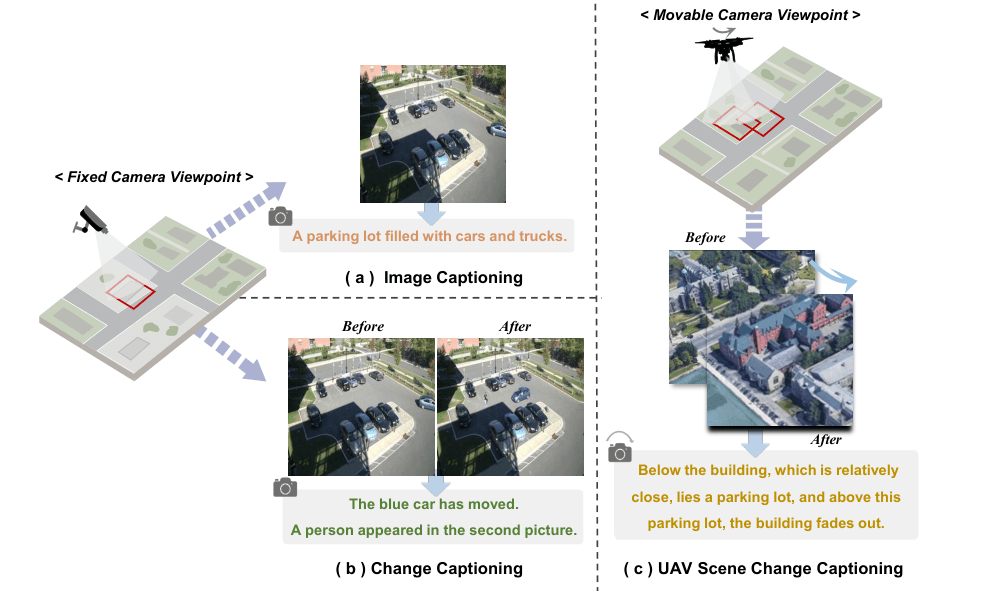
Traditional change captioning generates a sentence describing the difference between two images taken from the same viewpoint, like a surveillance camera looking at the same parking lot yesterday and today. UAV Scene Change Captioning, by contrast, focuses on image-pair differences resulting from both temporal and spatial scene variations captured by a moving camera. That distinction matters because a drone rarely returns to the exact same pose.
The consequences are ugly. The two images often share only partially overlapping content, resulting in inconsistent spatial layouts. The model has to align overlapping and non-overlapping regions across the pair while dealing with parallax, and it also has to capture directional cues introduced by the viewpoint motion. Prior methods like CARD and SMART were built assuming largely aligned scenes, so they tend to produce ambiguous captions when the viewpoint drifts.
The HDC-CL framework
The authors propose Hierarchical Dual-Change Collaborative Learning (HDC-CL), a three-stage pipeline: image alignment, scene change distillation, and caption generation. The first two stages do the heavy lifting on the geometry problem; the last one turns the distilled visual difference into words.

Two components carry most of the novelty:
- Dynamic Adaptive Layout Transformer (DALT) with a shift voting mechanism. Given ResNet-101 patch features from the before and after images, DALT estimates which patches overlap and which do not, then encodes common and different regions with region-specific [CLS] tokens in a single unified transformer layer.
- Hierarchical Cross-modal Orientation Consistency Calibration (HCM-OCC). It computes a visual direction vector by subtracting the reverse-order features from the forward-order features, does the same on the text side, and aligns them via a bidirectional margin ranking loss. This forces the model to distinguish "a building appears in the upper left" from "a building disappears in the lower right."
How the shift voting actually works
The alignment trick is worth unpacking because it is refreshingly simple. For each patch token in the before image, the model finds its most similar token in the after image and records the 2D pixel offset between them. It then votes across all patch pairs, weighting each vote by cosine similarity, and picks the dominant offset as the estimated viewpoint shift. Only correspondences within an infinity-norm distance of 2 from that dominant offset are kept, and a mutual nearest neighbor check removes inconsistent matches. The result is a binary overlap mask used by DALT to split each image into common and differential regions.
On top of that, scene change distillation applies three losses: a global InfoNCE loss to align overall background semantics, a common-region InfoNCE loss for overlapping unchanged objects, and a Hilbert-Schmidt Independence Criterion (HSIC) loss that decorrelates the difference features between the two images. HSIC here is a kernel-based measure of statistical dependence; minimizing it pushes the "what disappeared" and "what appeared" representations to carry independent information rather than echoing each other.
The UAV-SCC benchmark
Because no suitable benchmark existed, the authors built one by re-pairing images from the public GeoText-1652 and UAVDT datasets and hiring three experts to annotate scene-change captions in both forward and reverse temporal directions. Two variants are released:
| Version | Image pairs | Captions per pair | Avg. caption length | Focus |
|---|---|---|---|---|
| UAV-SCCSimple | 9,017 | 3 | ~27 tokens | Salient objects, coarse spatial relations |
| UAV-SCCRich | 7,054 | 5 | ~14 tokens | Diverse phrasing, colors, attributes, fine-grained changes |
Results and where it falls short
On the headline CIDEr metric, HDC-CL reaches 54.68 on UAV-SCC Simple and 19.16 on UAV-SCC Rich, outperforming the second-best method CARD by 6.02 and 3.41 respectively. It also wins on BLEU-4, METEOR, ROUGE-L, and SPICE across both splits. Ablations show every piece pulls its weight: removing the mask estimation drops CIDEr on Simple from 54.68 to 46.10, and dropping HCM-OCC costs another 3.21 points.

Interestingly, the team also ran GPT-4o on the dataset and found it performs significantly worse than the lightweight task-specific model, because general-purpose large multimodal models tend to underperform in domain-specific UAV scenarios where visual and linguistic patterns differ from web-scale training data. The bar chart in the paper shows GPT-4o barely reaching double digits on CIDEr while HDC-CL clears 50.
The model is not without weaknesses. Object-level accuracy is still modest, with HDC-CL scoring around 25 to 46 percent depending on the category, and it sometimes hallucinates entities that only loosely match the actual change. Long-tail objects remain hard, though the paper argues HDC-CL handles them better than CARD.
Why this is useful in practice
The strongest practical argument is bandwidth. Transmitting a 10 MB image over a UAV link takes roughly 0.6 to 2 seconds, while sending a sub-1 KB text description takes 5 to 10 milliseconds. With about 77 ms of inference time, total text generation and transmission lands around 82 to 87 ms. That is an order of magnitude improvement for scenarios like infrastructure inspection, environmental monitoring, or disaster response, where you want a human operator to know what changed without streaming full video.
Reasonable places to reach for this approach:
- Autonomous patrol drones that need to log events over spotty links
- Change monitoring in construction sites or agricultural fields where the drone flies a slightly different path each pass
- Edge deployments where a 512-dim ResNet-101 backbone fits comfortably in under 5 GB of GPU memory
The authors state the dataset and code will be publicly released upon acceptance of the paper, so reproducing or extending the work will require watching the arXiv listing for a repo drop. If you work on remote sensing, aerial robotics, or vision-language models for embodied agents, this is a benchmark worth bookmarking.