
HD-PPT Beats CosyVoice2 by Teaching AI to Separate Voice Style From Speech
A new speech synthesis framework called HD-PPT splits speech into content and style tokens, then generates them in a structured order to sharpen prompt control.
 Pro
Takeaways
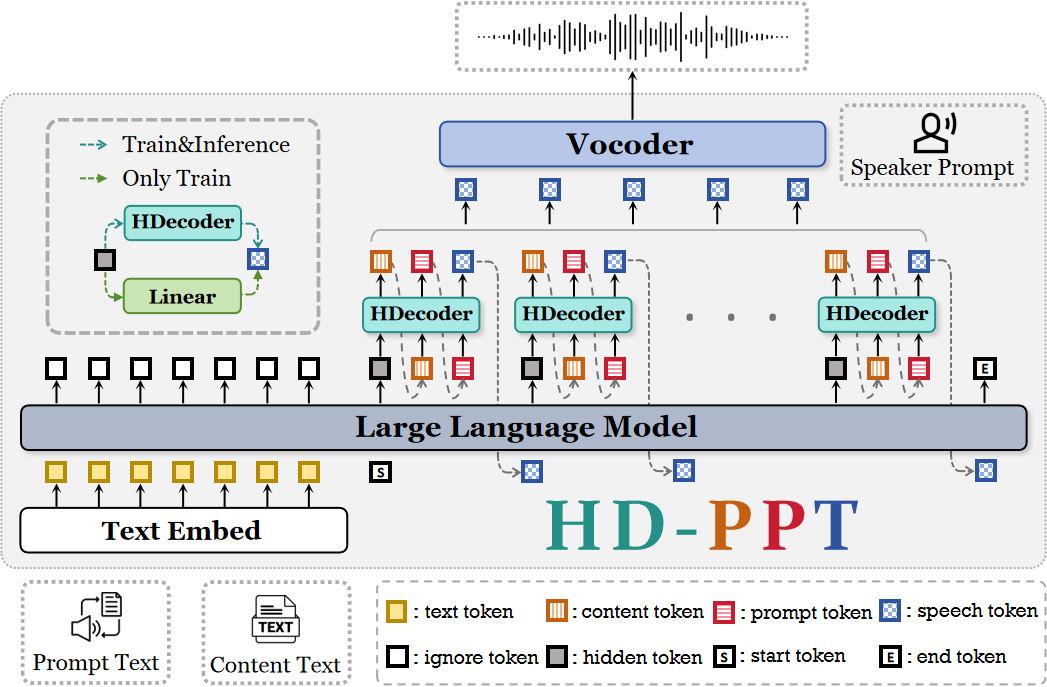
- HD-PPT reframes instruction TTS as hierarchical decoding of separate content and style tokens inside the LLM.
- A new FSQ-based codec splits CosyVoice2 tokens using ASR and CLAP supervision into disentangled streams.
- Qwen2.5-0.5B predicts content, then style, then acoustic tokens sequentially at every timestep.
- Beats CosyVoice2 on MOS-N (4.11 vs 3.92), MOS-S (4.17 vs 3.89), and EMO-SIM (0.753 vs 0.714).
- Real-time factor rises from 0.711 to 0.952, a moderate latency cost for tighter control.
- Audio samples at the demo page; no code released yet.
Instruction-based text-to-speech has a control problem. Models can produce voices that sound convincingly human, but ask them to render a line with a specific emotion, prosody, or speaking style described in plain English, and results get flaky. A team from South China University of Technology and Foshan University argues the issue is architectural: today's LLM-driven TTS systems try to squeeze a single-level text instruction directly into a multilevel speech signal. Their new framework, HD-PPT, breaks that mapping into structured layers and posts state-of-the-art numbers on naturalness and style adherence.
The hierarchical mismatch
Recent LLM-based TTS systems like CosyVoice2, Spark-TTS, and MiniMax-Speech treat speech tokens as one flat sequence. Yet speech is inherently hierarchical, carrying linguistic content, paralinguistic prosody and emotion, and extralinguistic speaker and scenario information all at once. When an LLM predicts a monolithic token stream conditioned on a style prompt, fine-grained stylistic instructions get diluted across every acoustic detail simultaneously.

Explicit style-encoding approaches like PromptTTS and PromptStyle achieve basic prompt control but remain coarse-grained, while LLM-based methods offer flexibility yet struggle with precision on subtle prompts. HD-PPT tries to keep the LLM's flexibility while forcing it to respect that hierarchy.
Splitting speech into two preference tokens
The first piece is a new speech codec that decomposes a pre-trained CosyVoice2 token stream into two disentangled discrete representations:
- Content-preference tokens anchor semantics. They are supervised by an ASR task using a Whisper-Small decoder to predict text, exposing them to semantic information.
- Prompt-preference tokens carry style. These are supervised by a CLAP-based contrastive loss, with a cross-attention module mapping them to a fixed-length embedding that is trained to maximize cosine similarity with the RoBERTa embedding of the matching prompt and minimize it against non-matching prompts.
Under the hood, a transformer-based preference-token extractor encodes speech tokens into a continuous representation, two independent finite-scalar-quantization modules quantize it into distinct discrete tokens, and a causal transformer combiner fuses them back to reconstruct the original speech tokens, with random noise injected during training for robustness. The FSQ codebook sizes are 1296 for content and 64 for prompt tokens, both running at 25 Hz.

Decoding in three stages
The second piece is how the LLM uses those tokens. Rather than predicting speech tokens directly, a Qwen2.5-0.5B backbone paired with a lightweight 2-layer transformer decoder generates them in a strict order at every timestep:
- Content foundation. The LLM emits a hidden state and the decoder predicts the content-preference token, locking in what is being said.
- Style rendering. The decoder then predicts the prompt-preference token, conditioned on the hidden state and the just-generated content token.
- Final acoustic token. The full speech token is produced by fusing the hidden state with both preference tokens, then fed back to the LLM for the next step.
During training, the authors probabilistically mask hidden states and prompt tokens and concatenate token logits with embeddings, forcing the decoder to draw from all three sources rather than leaning on one. An auxiliary linear head projects LLM hidden states directly to speech tokens to keep the internal representations acoustically grounded.
The numbers
HD-PPT was evaluated on TextrolSpeech for fine-grained style control and EmoVoice-DB for emotional control, against PromptStyle, PromptTTS, CosyVoice, CosyVoice2, and EmoVoice-PP. It leads across subjective and objective metrics:
| Model | MOS-N | MOS-S | DNSMOS | EMO-SIM | WER |
|---|---|---|---|---|---|
| PromptTTS | 2.92 | 2.60 | 3.65 | 0.588 | 4.38% |
| CosyVoice2 | 3.92 | 3.89 | 3.83 | 0.714 | 5.71% |
| EmoVoice-PP | 3.69 | 3.59 | 3.87 | 0.613 | 8.56% |
| HD-PPT | 4.11 | 4.17 | 3.84 | 0.753 | 5.18% |
The style-consistency jump (MOS-S from 3.89 to 4.17 over the CosyVoice2 baseline) is the headline result, and emotional similarity climbs from 0.714 to 0.753. Ablations confirm both halves of the design matter: stripping content-preference tokens spikes WER, removing prompt-preference tokens drops EMO-SIM, and killing both degrades every metric. A parallel or single-step decoding variant also underperforms, which validates the sequential ordering rather than the token split alone.
Trade-offs and what this unlocks
Structured decoding is not free. The real-time factor on an NVIDIA 4090 rises from 0.711 for single-step generation to 0.952 for the hierarchical version, so throughput takes roughly a 34% hit for the control gains. The authors also flag that the multi-component complexity poses challenges for low-resource language adaptation, and plan to explore reinforcement learning to close that gap.
The broader idea, disentangling what is said from how it is said inside the token stream itself, is what makes this interesting beyond the leaderboard. For anyone building expressive voice agents, audiobook narration, or emotion-tunable dialogue systems, this suggests a template: stop asking one LLM head to solve semantics and style in the same softmax, and give it an intermediate representation that separates them. Audio samples are hosted on the authors' demo page. Code has not been released alongside the paper, which limits immediate reproducibility, but the codec sits on top of the open CosyVoice2 tokenizer and vocoder, so the ingredients are public.