
HawkesRank Proves PageRank Is Just a Frozen Snapshot of Dynamic Influence
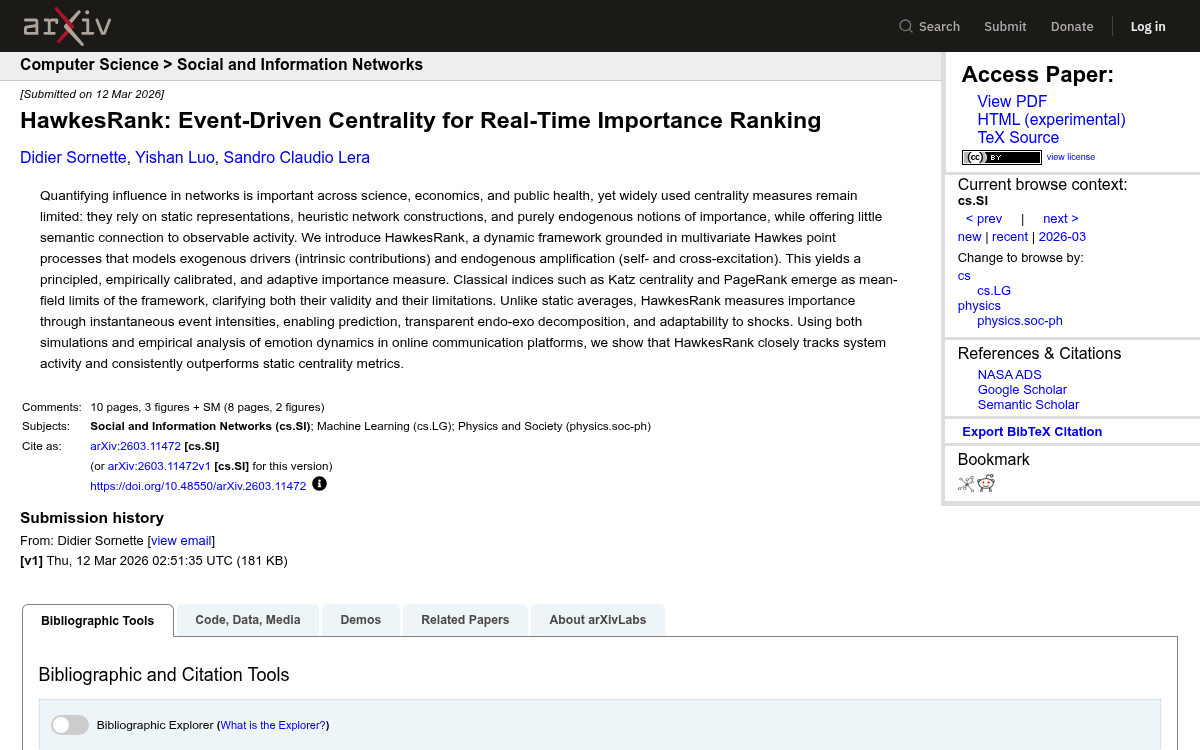
A new framework replaces static PageRank-style rankings with event-driven intensities from Hawkes processes, separating intrinsic value from network amplification in real time.
 Pro
Takeaways
- HawkesRank ranks nodes by instantaneous event intensities from multivariate Hawkes processes rather than static graph scores.
- Katz, PageRank, and eigenvector centrality all emerge as mean-field limits of the same framework.
- The branching ratio matrix is inferred directly from event timestamps, removing arbitrary bin and threshold choices.
- Simulations with shocks show static baselines lose ranking correlation while HawkesRank tracks true dynamics.
- YouTube live-chat emotions reveal anger-disgust feedback loops missed by lead-lag correlation networks.
- Endo-exo decomposition enables new use cases: detecting bubbles, fake influence, citation manipulation, super-spreading.
Rankings run modern life. They decide which papers get read, which stocks get bought, and which posts get seen. Yet the math powering most of them, PageRank and its cousins, has barely changed in decades and quietly assumes the world stands still. A new paper introduces HawkesRank, a dynamic ranking framework that treats influence as an event rate rather than a fixed score, and shows that classical measures like PageRank and Katz centrality are just frozen snapshots of it.
The framework is grounded in multivariate Hawkes point processes that model exogenous drivers (intrinsic contributions) and endogenous amplification through self and cross excitation. In plain terms, it separates how much of a node's importance comes from the outside world (a news event, a viral moment, intrinsic quality) from how much comes from the network echoing itself.
Why static centrality quietly breaks
Eigenvector-based scores like PageRank and Katz have a self-referential logic: you matter because you are connected to others who matter. That works for a snapshot of the web circa 2000, but the authors identify concrete failure modes that show up everywhere else.
- They inadequately capture exogenous drivers of relevance, neglecting activity generated independently of the network such as media exposure, advertising, policy shocks, or intrinsic appeal.
- They are static, assuming fixed structures and immutable scores, and even PageRank exhibits a temporal bias where earlier nodes are favored over newer entrants.
- The adjacency matrix is often not directly observed but inferred through heuristic choices such as temporal aggregation windows, thresholding rules, or normalization schemes.
- Eigenvector-based scores are dimensionless and lack direct physical interpretation, weakening interpretability and empirical grounding.
- External signals blend slowly evolving intrinsic value with transient visibility surges from advertising, social amplification, or opportunistic exposure.
Importance as an event rate
The core move is to reinterpret importance operationally. For each node i, HawkesRank defines an intensity function that gives the instantaneous rate at which events (page visits, posts, trades, spikes) happen at time t. That intensity has two additive parts: a background term capturing external drivers, and a sum over past events, each weighted by how strongly node j excites node i and how much time has passed.
The decay is controlled by an exponential memory kernel with timescale tau, and cross-excitation strengths are collected in a branching ratio matrix N. The scalar branching ratio n, defined as the spectral radius of the matrix N, must satisfy 0 ≤ n < 1 to ensure that the Hawkes process is well-defined and non-explosive. Crucially, N is not hand-built from thresholded correlations, it is estimated statistically from the raw event timestamps by maximum likelihood.
Old rankings fall out as a special case
The paper's cleanest theoretical result is that classical centralities are not competitors, they are corner cases. Take the expectation of the intensity, let the memory kernel shrink to a Dirac delta, and the mean-field equation collapses into the Katz recursion. Identifying the exogenous vector with beta and the branching ratio matrix with alpha times the adjacency matrix A shows that the stationary first moment of the Hawkes process recovers Katz centrality. PageRank is a normalized variant of Katz obtained by row-normalizing A, and eigenvector centrality is the limit as the exogenous term vanishes and alpha approaches its critical value.
This means every implicit assumption baked into PageRank, homogeneous exogenous input, no memory, stationary dynamics, becomes visible and challengeable.
How it performs when things move
To test whether dynamics actually matter, the authors simulate a 10-node system using preferential attachment with a target branching ratio of 0.6 and compare four static baselines against the ground-truth instantaneous rankings.
- First-moment Hawkes ranking using the true baseline intensities.
- Katz centrality with a uniform exogenous vector.
- Eigenvector centrality as the limit of Katz.
- PageRank on the row-normalized branching matrix.
The first-moment Hawkes ranking achieves the best overall performance, followed by conventional Katz centrality with homogeneous exogenous terms, underscoring the importance of accounting for exogenous influence and particularly its heterogeneity. Then they inject a shock: at time 150, they multiply the smallest baseline intensity by ten and hold it for 50 steps. Once the shock occurs, the correlations of all static benchmarks exhibit higher variability and a pronounced decline in agreement with the true rankings, and even the first-moment Hawkes ranking provides only limited improvement because it assumes exogenous contributions are time-invariant.
A real test on live chat emotions
The empirical study looks at emotion dynamics in YouTube Live chats, using the six basic emotions (joy, surprise, anger, disgust, fear, sadness) tagged on each message, following the authors' earlier Communications Psychology work. The comparison is with a standard lead-lag correlation network built from binned time series.
The estimated branching matrix N differs markedly from the adjacency matrix derived from the static network construction, revealing strong self-excitation effects consistent with prior evidence of emotional contagion in online interactions. It also flags a bidirectional anger-disgust loop that the correlation network misses, and the static network misleadingly assigns joy as a dominant source of all other emotions, an interpretation that is behaviorally implausible since expressions of joy rarely induce fear or surprise. The correlation approach is also fragile, changing the bin size or lag produces materially different networks from the same data.
The real breakthrough
The headline is dynamism, but the deeper contribution is the endo-exo decomposition. HawkesRank splits total activity into what was driven from outside (the video's dramatic moments, a news event, a product launch) versus what was amplified inside the network (users reacting to each other). That distinction has been notoriously slippery in economics and information systems, and here it falls out of the model naturally.
The paper points to concrete downstream use cases that were previously heuristic:
- Detecting speculative bubbles in markets when endogenous amplification overtakes fundamentals.
- Distinguishing genuine social media influence from artificially boosted visibility.
- Separating intellectual impact from citation manipulation in science.
- Untangling baseline disease transmission from super-spreading spikes.
Caveats worth knowing
HawkesRank is not a free lunch. Fitting a multivariate Hawkes process is heavier than computing an eigenvector, and calibration is known to be delicate. Assuming the exogenous term is constant when it is actually time-varying induces a bias where bursts get misattributed to endogeneity, pushing estimates of N toward criticality. The current implementation uses exponential kernels and a mean-field approximation that fixes fertilities at their expectations, so systems with long-memory power-law dynamics, inhibition, or time-varying interactions will need the richer variants the authors flag as future work. Scaling to millions of nodes is also an open problem, they explicitly call out the need for online algorithms with uncertainty quantification.
No code repository is referenced in the paper. Practitioners who want to experiment today can use existing Hawkes libraries like tick to fit the process and then treat the fitted intensities directly as the ranking signal, which is exactly what the framework prescribes.