
Harvard's CTRL Beats Top AI Methods Predicting Refugee Jobs Across 26 Regions
CTRL is a new meta-learning method that helps ML models stay accurate across dozens of small, heterogeneous data sources — already outperforming deployed systems in Switzerland's asylum placement program.
 Pro
Takeaways
- CTRL is a new meta-learning method that finds clusters of similar data sources to share residual models, solving the accuracy-vs-heterogeneity tradeoff in multi-source ML.
- It outperforms all baselines (Global, Local, TRL, JTT, RWG) on MSE, Small-Source MSE, and Rank-Weighted Average across 5 large datasets.
- The key innovation is residual-level clustering: grouping sources by how similar their prediction errors are, not by feature distance — achieving 83% cluster recovery vs. 31% for Wasserstein distance.
- The primary application is Switzerland's live asylum seeker placement pilot, where CTRL already beats the deployed system on decision-quality metrics.
- CTRL is model-agnostic and works with linear regression, decision trees, random forests, and BART as base learners.
- Code and 4 of 5 datasets are publicly available; the Swiss asylum data requires a formal request to the Swiss State Secretariat for Migration.
When a machine learning model is trained on data from dozens of different locations, hospitals, or demographic groups, it faces a brutal tradeoff: pool everything together and lose local nuance, or train separately per group and starve on small samples. A new paper from researchers at Harvard, Stanford, and UC Berkeley proposes a principled way out of this dilemma , and tests it on one of the highest-stakes real-world deployments of algorithmic decision-making in existence.
The paper introduces Clustered Transfer Residual Learning (CTRL), a meta-learning method that combines two previously separate ideas , residual learning across domains and adaptive data pooling , into a single framework that consistently outperforms state-of-the-art baselines across five large-scale datasets.
The Problem With Many Small Datasets
CTRL is a meta-learning algorithm for the many-locations prediction problem that addresses both distribution shift and data scarcity, clustering sources based on conditional similarity captured through residuals. The motivating scenario is one that appears across a surprising range of domains: you have data from many distinct sources (locations, treatment arms, demographic groups), those sources differ in their underlying distributions, and crucially, some sources have far fewer samples than others.
The canonical example in this paper is refugee resettlement. Ensuring that refugees and asylum seekers find employment in their host countries is a profound humanitarian goal, and in the past few years, innovations in analytics have given rise to ML models that predict integration outcomes using personal characteristics , with recent research proposing algorithms that assign refugees to geographic locations in a manner that maximizes average employment.
Asylum seekers in Switzerland are allowed to work only in the canton to which they are assigned during their asylum proceedings. This allocation is based on politically defined parameters like a canton's population size , factors such as labor market integration and employment prospects are not taken into account. A pilot program currently running in Switzerland seeks to maximize the average predicted employment level of refugees through an online assignment algorithm, and while it improves upon the status quo by about 40%, it results in a periodically imbalanced allocation to localities over time.
The problem CTRL is designed to solve sits one level deeper: how do you build the employment prediction model itself when you have 26 Swiss cantons, each with wildly different sample sizes (50 to 3,900 individuals), and each with its own labor market dynamics?
Two Strategies, One Flaw Each
Before CTRL, practitioners had two main approaches, each with a critical weakness:
- Global models: Pool all data and train one model. Fast and data-efficient, but it blurs real differences between locations , a canton with a strong tech sector gets the same predictions as one dominated by agriculture.
- Local models: Train a separate model per location. Captures heterogeneity perfectly in theory, but collapses for small locations where there simply isn't enough data to fit a reliable model.
A middle-ground approach called Transfer Residual Learning (TRL) , which the paper introduces as a baseline , trains a global model first, then fits a location-specific residual model (a correction term) on top. Residuals here mean the errors the global model makes for each location; the residual model learns to predict those errors using only local data. This is better, but still struggles when a location has very few samples , the residual model becomes noisy and unreliable.
What CTRL Actually Does
CTRL's key insight is that locations with similar residual patterns can share their residual models. Instead of fitting a residual model on just one location's data, CTRL finds a cluster of locations whose residual behavior is similar enough to pool together for the fine-tuning step.

The algorithm works in two stages:
- Train a global base model on all data from all locations. This captures shared structure.
- For each target location g, find a cluster of other locations whose residual models best predict g's actual residuals. Train a shared residual model on that cluster's pooled data, and add it to the global model's predictions.
The cluster-finding step is the technical core. CTRL solves a mixed-integer optimization problem: given all location-specific residual models trained on 80% of the data, find the subset of locations (up to a size limit λ) whose weighted combination of residual predictions best matches the actual residuals of location g on the held-out 20%. This is run γ = 250 times with different random splits for stability, and the final cluster is selected using the 1-Standard-Error Rule , a classic regularization heuristic that favors simpler (smaller) clusters when performance differences are within noise.
A key theoretical result (Proposition 5.1) proves that this residual-matching objective is asymptotically equivalent to minimizing the actual prediction risk for location g , meaning the algorithm is doing exactly what you want it to do, not just a proxy. The paper also derives excess-risk bounds showing when pooling helps versus hurts: pooling reduces variance but introduces bias proportional to the distribution shift between source and target. CTRL navigates this tradeoff automatically.
Crucially, CTRL clusters on conditional residual similarity, jointly stabilizing small sources, adapting cluster size, and reverting to TRL or the global model when appropriate , a formulation that is intuitive, theoretically grounded, model-agnostic, and generalizes across datasets. If no useful cluster exists for a location, CTRL gracefully falls back to plain TRL.
Why Residuals, Not Raw Features?
A natural question is: why not just cluster locations by geographic proximity, demographic similarity, or standard distributional distance metrics like Wasserstein distance? The paper tests exactly this. On a synthetic dataset where true cluster assignments are known, CTRL's residual-based clustering achieves a Weighted Precision@3 (a metric measuring how well the top-3 nearest neighbors match the true cluster) of 83%, compared to 31% for Wasserstein distance and just 7% for correlation-based clustering. The intuition is that what matters for prediction quality is not how similar two locations look on the surface, but whether their unexplained prediction errors follow the same patterns.
Benchmarks and Results
The authors benchmark CTRL against global, local, and residual-learning baselines as well as two state-of-the-art methods used for multi-source data, across five datasets and multiple model classes. The five datasets span very different domains:
- Swiss Asylum Seekers: ~30,000 individuals across 26 Swiss cantons, predicting two-year employment outcomes with 135 features.
- US Education: 470,000+ individuals across 51 US states/territories, predicting high school graduation from Census data.
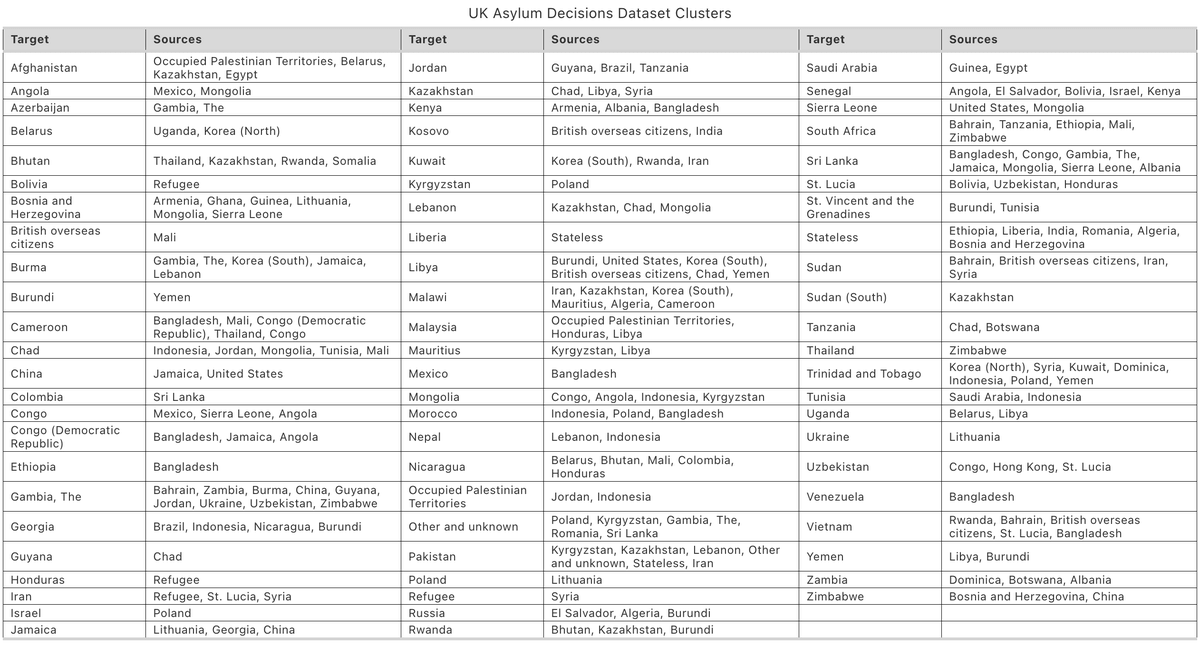
- UK Asylum Decisions: 84,000+ applications across 103 nationalities, predicting asylum approval.
- Dissecting Health Bias: 47,000+ patient records across 28 demographic groups (race × age × gender), predicting chronic illness.
- Synthetic: 40,000 simulated individuals across 50 locations with known ground-truth cluster structure.

Three metrics are used: overall MSE, MSE on small locations (bottom third by size), and Rank-Weighted Average (RWA). RWA deserves special attention , it measures how well a model identifies the top 20% of individuals most likely to succeed at each location, which directly maps to the quality of assignment decisions. CTRL consistently improves decision-quality metrics and reduces prediction error, outperforming the deployed methods that have been piloted in the Swiss asylum seeker system.
The two competing state-of-the-art baselines are JTT (Just Train Twice, which up-weights examples the model initially gets wrong) and RWG (re-weighting to equalize contribution across groups). Both are designed for robustness across subgroups, but they sacrifice differentiation , they tend to produce the same predictions for every location, which is exactly the wrong behavior for a ranking-based assignment task.
Limitations Worth Knowing
CTRL is not a free lunch. A few practical constraints to keep in mind:
- Compute cost: The cluster-finding step uses a Gurobi mixed-integer solver run 250 times per location. On an 8-core machine, this takes roughly 3 hours for ~25,000 observations. For datasets with thousands of groups, this becomes prohibitive without approximations.
- Adversarial shifts: The theoretical guarantees cover random distribution shifts between locations, not adversarial ones. If a location's data is systematically corrupted or manipulated, CTRL's robustness guarantees don't apply.
- Cluster interpretability: The clusters CTRL finds are based purely on predictive residual similarity, not semantic meaning. Alaska clusters with Hawaii and Montana in the education dataset , useful for prediction, but not because these states are geographically or culturally similar.
What This Unlocks
The practical scope of CTRL extends well beyond refugee resettlement. Any setting with many data sources of unequal size and heterogeneous distributions is a candidate:
- Multi-site clinical trials where hospitals differ in patient population and treatment protocols
- Personalized recommendations across demographic groups with very different representation in training data
- Economic forecasting across regions or countries with varying data availability
- Fairness-aware ML where minority subgroups have few samples but distinct outcome patterns
Code and datasets are publicly available at the project's GitHub repository. The authors release four of the five datasets (the Swiss asylum seeker data requires a formal request to the Swiss State Secretariat for Migration due to privacy constraints), along with a synthetic data generator and full implementation. The codebase is available at github.com/Gjain234/CtrlYourShift.
The real breakthrough here is not just a new algorithm , it is a reframing of what "good" means in multi-source prediction. Most methods optimize for average accuracy or worst-case robustness. CTRL optimizes for both simultaneously, while preserving the location-specific differentiation that makes predictions actually useful for downstream decisions. In a world where algorithmic systems are increasingly being used to make consequential allocations , of healthcare, housing, and opportunity , that distinction matters enormously.