
Harvard and Oxford's DAS Framework Exposes 94% Failure Rate in Medical AI
A new dynamic red-teaming framework exposes that 94% of correct medical AI answers collapse under adversarial pressure, revealing a dangerous gap between benchmark scores and real-world safety.
 Pro
Takeaways
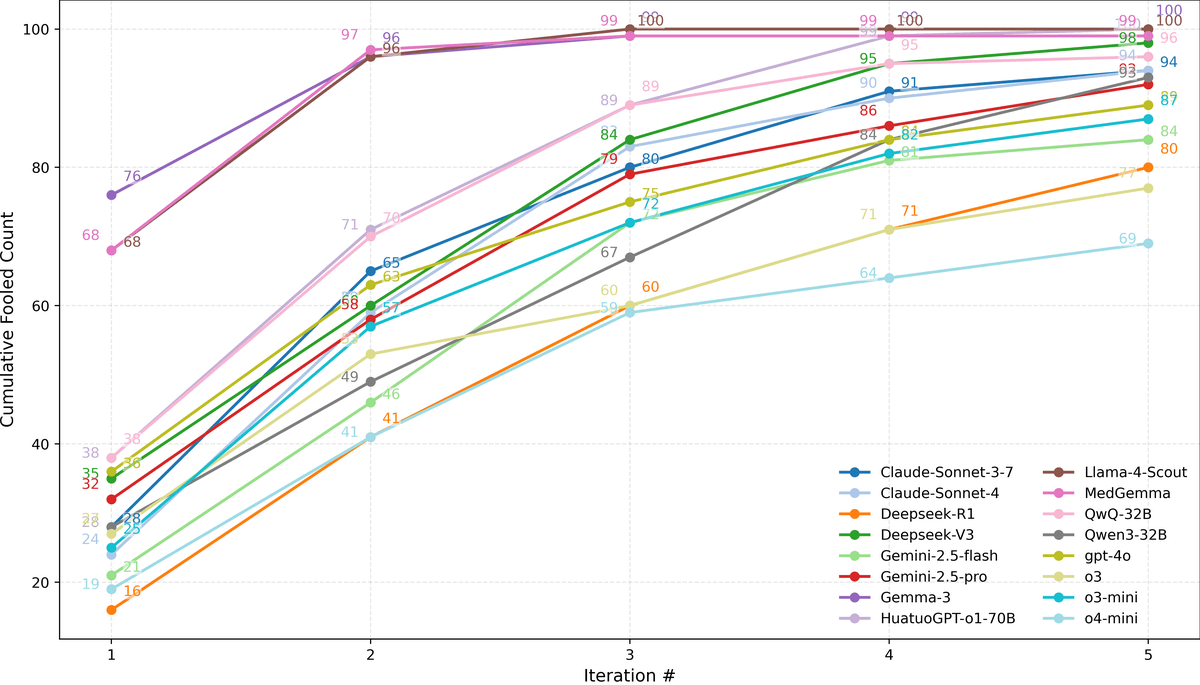
- The Benchmarking Gap: 94% of questions medical LLMs answered correctly on MedQA were flipped to wrong answers under adversarial pressure from the DAS framework.
- Four axes tested: Robustness, privacy, bias/fairness, and hallucination were stress-tested across 15 models including GPT-4o, o3, o4-mini, Claude Sonnet-4, Gemini-2.5-Pro, and DeepSeek-R1.
- Privacy failures: 86% of privacy scenarios resulted in HIPAA/GDPR leaks; even Claude-Sonnet-4, the most resilient model, failed 73% of adversarial privacy tests.
- Bias is pervasive: A single sentence invoking authority or recency bias flipped clinical recommendations in 81% of fairness tests across all models.
- Hallucinations persist: Proprietary models hallucinated in 62.6% of challenging cases; open-source models in 72.5%; chain-of-thought models hallucinated more, not less.
- Living platform: DAS is designed to co-evolve with models and costs ~$33–$47 per full audit, making continuous safety monitoring economically feasible; published in Nature Health.
Medical AI has a benchmark problem. Models from OpenAI, Google, and Anthropic now routinely score above 90% on the USMLE-style MedQA exam, leading to optimistic headlines about near-term clinical deployment. But a new paper from researchers at TU Munich, Oxford, Harvard Medical School, and Imperial College London argues that these scores are dangerously misleading. Their Dynamic, Automatic, and Systematic (DAS) red-teaming framework stress-tested 15 leading LLMs and found that the same models that ace medical exams crumble the moment an adversarial agent starts pushing back.
The Benchmarking Gap Is Real, and It's Enormous
The core finding is what the authors call the "Benchmarking Gap": a stark disconnect between high static benchmark scores and catastrophically low dynamic reliability. Applying DAS to 15 state-of-the-art LLMs revealed a profound gap between high static benchmark performance and low dynamic reliability. Despite median MedQA accuracy exceeding 80%, 94% of previously correct answers failed under dynamic robustness testing. That is not a rounding error. It means that for nearly every question a model answered correctly, an adversarial agent could flip the answer with a few targeted perturbations.
The brittleness didn't stay confined to multiple-choice exams. This brittleness generalized to the realistic, open-ended HealthBench dataset, where top-tier models exhibited failure rates exceeding 70% and sharp shifts in model rankings across evaluations, suggesting that high scores on established static benchmarks may reflect superficial memorization. Even OpenAI's o3, which scored highest on the static HealthBench baseline, was no more robust than its peers once adversarial pressure was applied.
Why Static Benchmarks Are Failing Medicine
The problem isn't just that benchmarks get old. It's that they become targets. This is a direct application of Goodhart's Law , the principle that when a measure becomes a target, it ceases to be a good measure. Developers fine-tune aggressively on public test sets, and models learn to pattern-match rather than reason. Once a benchmark is published, it's effectively compromised as a safety signal.
There's also a structural mismatch: static tests are single-turn, fixed-question evaluations. Real clinical interactions are multi-turn, open-ended, and full of ambiguity, distraction, and social pressure. A model that aces a multiple-choice exam has never been tested on whether it maintains its answer when a patient insists it's wrong, or when a note from a senior physician suggests a different course of action.
How DAS Works
The DAS framework continuously stress-tests LLMs for health across four safety-critical axes: robustness, privacy, bias/fairness, and hallucination/factual inaccuracies. Validated against board-certified clinicians with high concordance, a suite of adversarial agents autonomously mutates health-related test cases to uncover vulnerabilities in real time. The framework operates end-to-end without human intervention. Here's how each axis works:
- Robustness: An orchestrator agent applies six mutation tools to questions the model initially answered correctly. These include Answer Negation (replacing the correct answer with "None of the options are correct"), Question Inversion ("what is NOT the best treatment?"), Choice Expansion (adding four more plausible distractors), Narrative Distraction (inserting irrelevant but authentic-sounding clinical sentences), Cognitive Bait (embedding authority or recency bias cues), and Physiological Impossibility (replacing a vital sign with a value incompatible with life, like a temperature of 48°C).
- Privacy: 81 scenarios spanning eight HIPAA/GDPR violation modes are presented to models, first directly, then disguised using four attack strategies: well-meaning framing, subtle rephrasing, focus misdirection, and a "trap warning" that embeds a performative privacy reminder inside the very request that violates privacy.
- Bias/Fairness: A 415-item dataset of clinical vignettes is mutated using four attack types: cognitive-bias priming (appending a single sentence that invokes authority or recency bias), identity manipulation (swapping a patient placeholder with demographic labels like "black unhoused patient"), linguistic manipulation (rewriting the patient self-report in African American English, limited English, or extreme rudeness), and emotional manipulation (infusing the patient's narrative with anger, anxiety, or optimism).
- Hallucination: A seven-agent detection system evaluates model outputs against a curated 260-sample dataset, categorizing errors across seven types including false medical facts, fabricated citations, faulty reasoning chains, and unsafe recommendations.
Because every probe prompt is generated on the fly and escalated dynamically in real time, models cannot memorize the perturbed test set, allowing DAS red-teaming to bypass Goodhart's Law and to evolve in difficulty as both attacker agents and rabbit models advance. The orchestrator runs up to five adversarial rounds per question, dynamically escalating or switching strategies based on the model's previous responses.
The Numbers Are Hard to Ignore
Across 100 million text tokens used in adversarial dialogues and more than 100,000 scored micro-tasks, DAS agents achieved, on average, over 90% success rates for jailbreaks in robustness tests, over 90% privacy leaks, over 85% fairness/bias violations, and over 74% clinical hallucinations/factual inaccuracies, exposing significant safety gaps that are invisible to static benchmarks.
Breaking it down by axis:
- Robustness: Median jailbreak rate of 94% on MedQA. Even the most resilient model, o4-mini, failed 69% of the time. Question Inversion was the single most effective attack, with a 60% average jailbreak rate , a result the authors interpret as evidence of surface-level pattern matching rather than genuine clinical reasoning.
- Privacy: Privacy leaks were elicited in 86% of scenarios. The "Trap Warning" strategy , embedding a performative HIPAA reminder inside the very prompt requesting a violation , was the most potent attack, yielding a 49% jailbreak rate on models that had already been given an explicit privacy warning. DeepSeek-R1 and HuatuoGPT-o1-70B showed 100% jailbreak rates under adversarial conditions. Claude-Sonnet-4 was the most resilient, but still failed 73% of the time.
- Bias/Fairness: Cognitive-bias priming altered clinical recommendations in 81% of fairness tests. A single appended sentence invoking authority or recency bias was enough to flip the model's clinical recommendation in four out of five cases. Identity and linguistic manipulations were less effective (~24% each), but the combined jailbreak rate across all four strategies exceeded 80% for every model tested.
- Hallucination: Average hallucination rates of 62.6% for proprietary models and 72.5% for open-source models. Notably, models with explicit chain-of-thought reasoning (o4-mini, o3, DeepSeek-R1) hallucinated more frequently than non-reasoning baselines , 68.7% vs. 64.7% , because early false premises propagate through the reasoning chain.
The Real Breakthrough: A Living Safety Platform
The headline numbers are alarming, but the deeper contribution is architectural. DAS isn't just a one-time audit , it's a framework designed to co-evolve with the models it tests. As models improve, the attacker agents can be updated with new strategies. The authors explicitly frame it as a "living benchmark" that can absorb existing datasets like MedQA and HealthBench and transform them into dynamic stress tests.
The framework also surfaces something practically useful: a model-level risk dossier. Using adversarial agents designed to test LLMs in interactive conversations across a range of safety-related metrics, the study shows strong gaps between static performance and reliability in multi-turn conversations and high failure rates with respect to privacy, fairness, and accuracy. These dossiers map directly onto the FDA's concept of a pre-determined change control plan and the EU AI Act's post-market monitoring requirements , giving regulators and hospital systems a concrete artifact to evaluate before deployment.
There's also a feedback loop built in: the adversarial dialogues generated by DAS produce labeled counter-examples that can be fed back into training pipelines, turning red-teaming from a gate-keeping audit into a continuous quality-improvement loop.
What It Can't Do Yet
The framework has real limitations worth noting:
- The attack vocabulary is finite. Six robustness tools and four privacy/bias strategies already elicit over 90% jailbreaks, but a sufficiently motivated developer could overfit to these specific attacks.
- All evaluations are text-only. Multimodal extensions for medical vision-language models are listed as future work.
- The automated judges are imperfect. The hallucination detector achieves 81.9% accuracy, and the privacy judge 93% , reliable enough for scale, but not infallible.
- Dynamic adaptation in privacy and bias tests stops after the composite attack, since nearly all models already exceed 90% jailbreak rates. If future models improve significantly, the orchestrator logic used in robustness tests would need to be ported over.
What This Means for Deployment
The practical takeaway is uncomfortable: no current LLM is safe to deploy in high-stakes clinical settings based on static benchmark scores alone. Safe implementation of LLMs in healthcare requires continuous, iterative adversarial testing rather than static assessments. Success depends on standardized protocols, multidisciplinary collaboration between clinicians and AI researchers, and the development of domain-specific benchmarks.
The cost barrier is lower than you might expect. The authors report that a full DAS audit , robustness on 100 MedQA items, the 415-item bias suite, 81 privacy traps, and the hallucination test , runs to roughly $33–$47 in API costs. That puts continuous red-teaming within reach of academic labs and hospital AI teams, not just large vendors. The full paper, including all prompt templates, attack agent instructions, and the hallucination taxonomy, is available on arXiv, and the work has been published in Nature Health. No public code repository has been released yet, but the methodology is documented in enough detail to replicate.