
Harbin's LycheeCluster Hits 3.6x Faster AI Decoding Without Losing Accuracy
LycheeCluster replaces fixed-size KV cache paging with semantic-aware chunking and a hierarchical tree index, achieving 3.6x decoding speedup with near-zero accuracy loss
 Pro
Takeaways
- 3.6x decoding speedup at 64K context with near-zero accuracy loss vs. full attention on LongBench V2 and MATH500.
- Key insight: retrieval granularity matters as much as scoring -- swapping fixed pages for semantic chunks alone yields +15% accuracy on JSON tasks.
- Uses a three-level hierarchical index (coarse units → fine clusters → chunks) with triangle-inequality pruning for sub-linear retrieval.
- A lazy update strategy keeps the index fresh during streaming generation at less than 1% of decoding time overhead.
- Outperforms Quest, ClusterKV, ShadowKV, RazorAttention, and others on LongBench V2 and RULER benchmarks.
- Code and CUDA kernels to be released after publication; currently only accelerates decoding, not prefill.
Every time a large language model generates a token, it has to look back at everything it has ever seen in the current context. That lookback is stored in what's called the KV cache (Key-Value cache) -- a memory structure that holds compressed representations of past tokens so the model doesn't have to recompute them. The problem: as context windows grow to 128K, 1M, or even 2M tokens, loading that entire cache on every single generation step becomes a crippling memory bandwidth bottleneck. The GPU sits idle, waiting for data.
Researchers from Harbin Institute of Technology have proposed LycheeCluster, a new KV cache management method that attacks this bottleneck from a different angle than existing approaches -- and the results are striking: up to 3.6x end-to-end decoding speedup at 64K context length, with performance that matches or exceeds full attention on standard benchmarks.
Why existing fixes break things
The dominant approaches to KV cache compression fall into two camps, and both have a fundamental flaw rooted in how they slice up text.
- Eviction-based methods (like H2O, StreamingLLM) permanently delete tokens deemed unimportant. Fast, but irreversible -- if you throw away a token that becomes relevant 10,000 steps later, it's gone forever.
- Retrieval-based methods keep the full cache but only load a relevant subset for each attention step. The two leading examples are Quest, which divides the cache into fixed-size 64-token pages, and ClusterKV, which groups individual tokens by vector similarity.
Both retrieval methods suffer from what the paper calls semantic fragmentation. Quest's fixed pages arbitrarily cut through logical units -- a JSON object, a function definition, a reasoning step -- so when the model retrieves a page, it often gets half of a thought. ClusterKV treats tokens as isolated vectors and clusters them globally, which scatters locally coherent sequences (like a code block) across different clusters. The attention head retrieves a cluster and gets a bag of semantically unrelated tokens.
The team ran a controlled experiment to quantify this. They took Quest's importance-scoring algorithm and kept it completely unchanged, but swapped the fixed-size pages for variable-length chunks defined by natural text boundaries. On the StrucText-Eval benchmark (which tests structured data like JSON and code), this single change -- granularity only, no new scoring logic -- produced a +10.6% average accuracy gain, with gains as high as +15.0% on JSON extraction. The bottleneck wasn't the scoring; it was the fragmentation.
The LycheeCluster architecture
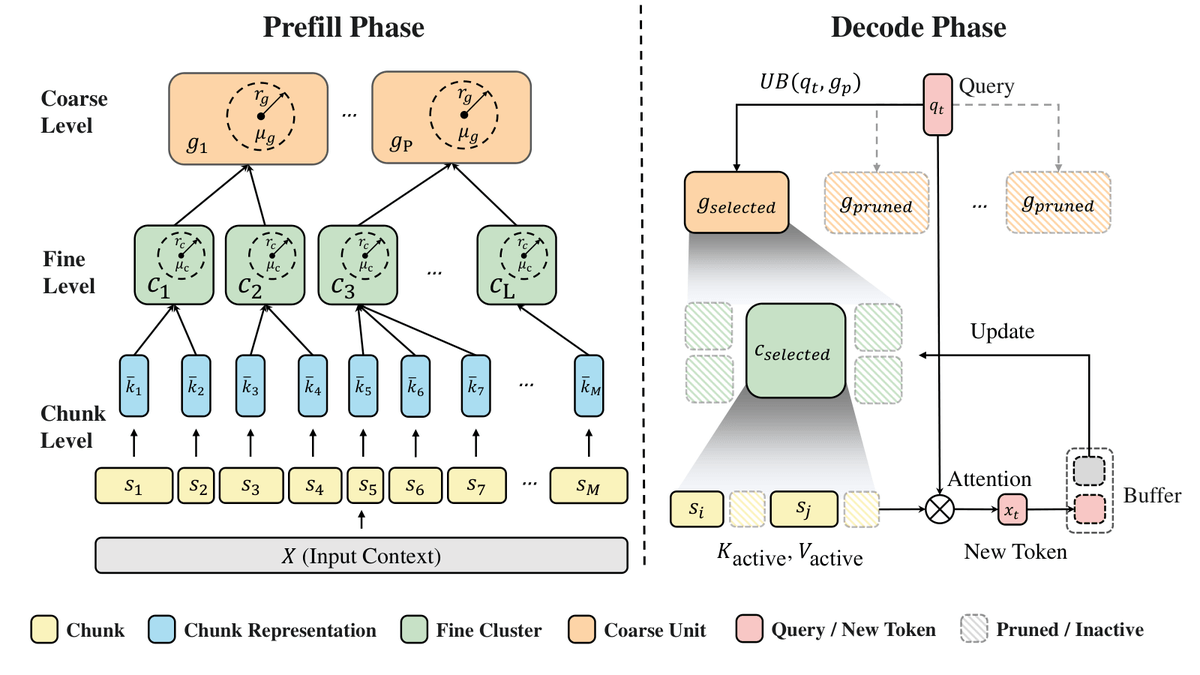
LycheeCluster is built around three interlocking ideas: semantic chunking, a hierarchical index, and a lazy update strategy for streaming generation.
Structure-Aware Chunking. During the prefill phase (when the prompt is first processed), the input is segmented into variable-length chunks using a priority hierarchy of natural delimiters. The algorithm accumulates tokens greedily and, once it hits a minimum length threshold (8 tokens), looks ahead for a high-priority break point: paragraph breaks and code delimiters first, then sentence terminators, then phrasal punctuation, then whitespace. A maximum chunk size (16 tokens) prevents runaway chunks. This produces semantically self-contained units rather than arbitrary slices.
Hierarchical KV Indexing. The chunks are organized into a three-level tree: coarse units → fine clusters → chunks. Each chunk gets a representative key vector computed by mean-pooling its token keys and L2-normalizing the result. Fine clusters are formed by running spherical k-means on these chunk vectors (average cluster size: 2 chunks). Coarse units then cluster the cluster centroids. Each node in the tree stores a centroid and a covering radius -- the maximum distance from the centroid to any child. This radius is the key to fast pruning.
Top-Down Pruning at Decode Time. For each generated token, the system computes an upper bound on the attention score for every branch of the tree using the triangle inequality:
UB(query, node) = dot(query, centroid) + norm(query) * radiusIf this upper bound is lower than the scores of already-selected branches, the entire subtree is pruned without inspecting a single token inside it. The system selects the top-k coarse units, expands to their fine clusters, selects top-k clusters, then loads the actual KV pairs from those clusters for exact attention. This transforms what would be a linear scan over all tokens into a sub-linear search.
Lazy Incremental Update. As new tokens are generated during decoding, they accumulate in a buffer. Once the buffer fills a chunk, that chunk is assigned to the nearest existing fine cluster based on centroid proximity, and the affected centroids and radii are updated via moving averages. The paper reports this lazy update consumes less than 1% of decoding time -- negligible overhead for keeping the index fresh during long generation runs.
How it performs
Experiments were run on an NVIDIA H20 GPU across three benchmarks and multiple model families.
| Benchmark | Model | Full Attention | ClusterKV | Quest | LycheeCluster |
|---|---|---|---|---|---|
| LongBench V2 (Overall) | Llama-3.1-8B | 30.02 | 26.64 | 20.68 | 30.82 |
| MATH500 | DeepSeek-R1-Distill-Llama-8B | 78.40 | -- | 72.00 | 77.00 |
| MATH500 | DeepSeek-R1-Distill-Qwen-14B | 74.00 | -- | 76.00 | 74.80 |
On LongBench V2 -- a benchmark of 503 real-world long-context questions with contexts up to 2M tokens -- LycheeCluster at a 1024-token budget actually slightly outperforms full attention (30.82 vs. 30.02). The authors attribute this to the hierarchical pruning acting as a noise filter, helping the model focus on the most relevant context in noisy long documents. On MATH500, which tests long chain-of-thought reasoning with DeepSeek-R1 distilled models, performance stays within 2% of full attention.
On the efficiency side, decoding latency (measured as Time Per Output Token) grows linearly with context length under full attention. LycheeCluster's latency stays nearly flat. At 32K context: 2.6x speedup. At 64K: 3.6x speedup. The index construction overhead during prefill adds only 10-15% to prefill time -- a one-time cost amortized over thousands of generated tokens.
The real breakthrough
The headline number is the 3.6x speedup, but the more significant finding is the pilot study result. The paper demonstrates that retrieval granularity matters as much as retrieval scoring. Years of KV cache research has focused on better importance metrics -- which tokens to keep. LycheeCluster shows that even a naive scoring function produces dramatically better results if the retrieval units respect semantic boundaries. This reframes the problem: it's not just about what you retrieve, but what shape the retrievable units are.
This has direct implications for anyone building RAG pipelines, agentic systems, or long-document processing workflows. The same insight -- that chunking strategy dominates retrieval quality -- has been observed in vector database retrieval, and LycheeCluster brings it into the KV cache layer of inference itself.
Practical considerations
Where LycheeCluster shines:
- Long-context RAG and agentic workflows where the decoding phase dominates total latency
- Structured data tasks -- JSON parsing, code completion, document analysis -- where fixed-size chunking destroys syntactic units
- Chain-of-thought reasoning with models like DeepSeek-R1, where the generated reasoning chain itself grows long and requires retrieving early premises
- Memory-constrained deployments: the index overhead stays at ~1% of full KV cache size even at 64K context
Where it has limitations:
- The method only accelerates the decoding phase, not prefill. For workloads dominated by prefill (e.g., single-pass summarization with short outputs), the benefit is smaller.
- Integration with production serving frameworks like vLLM or SGLang requires additional engineering work -- the authors note this explicitly.
- In safety-critical domains (medical, legal), the approximate attention introduces a theoretical risk of information loss that warrants careful evaluation.
Code and custom CUDA kernels are promised upon publication. The implementation builds on top of ClusterKV's codebase with redesigned index construction and token selection logic, plus new kernels for variable-length chunk pooling, centroid updates, and radius calculations.